
Priscilla Monge (San José de Costa Rica, 1968) presents at the Rufino Tamayo Museum in Mexico City her work of the last eight years, a collection of pieces that explore, from a female perspective, the role played by gender in society. Her discourse interrogates the psychological and even physical violence that the masculine gaze exerts on women and the constraints it imposes on their behavior while reprieving traditional feminine handiwork, such as embroidery.
In three canvases with printed decorative patterns, she uses acrylic paint to represent scenes that initially distort our reading of the piece, appearing impassible while in fact, they are loud voices of alarm. In one case, it is the image of a gun; in another, a soccer field populated by fighters instead of players; in the third, the image of a desolated woman. In the same vein of “organized violence," we see a soccer ball made of leather patches and pieces of sanitary napkin, protective boxing masks with little music boxes, and drawings of monuments to anonymous soccer players treated as national heroes.
In the same hall, we find two power drills with, instead of drilling tips, a little bronze ballerina that executes her pirouettes when the tool is activated. These pieces make more specific Monge’s ironic treatment of the signs that customarily define male/female relationships. More playful, albeit in a sinister way, are Monge’s colored resin paddles with doll figures, within which there are several human teeth. Among the show’s best pieces are her pants and overalls patched with sanitary napkins, with which the artist once created a performance piece around her own menstrual period, positing the need for accepting oneself and one’s body’s biological functions in an attempt to redefine the taboo that surrounds, to this day, menstruating women.
Singularly beautiful is Monge’s closed padded room, its walls, ceiling, and floor covered with rugs and sanitary napkins used as bricks. The room makes one feel comfortable and protected, and it irradiates feelings of warmth, cleanliness, and quiet. The room is soundproofed reflecting the fact that sanitary napkins are manufactured for maximum absorbency.
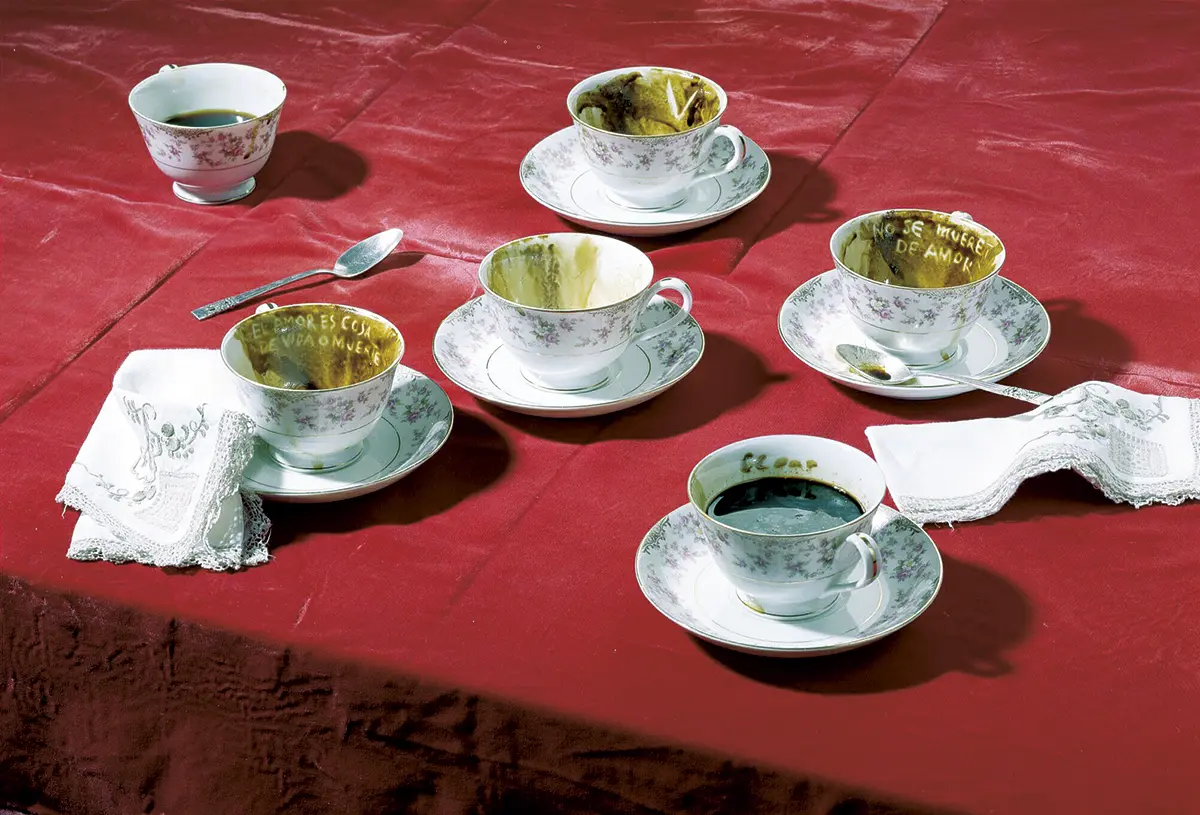
More explicitly confrontational are her wooden boomerangs with pyrographed male-bashing insults such as “drunk," “hypocrite," “pig," “weakling," “shit-eater," “sissy," etc, and her gold-plated dozen eggs, inscribed with the words “Quien los lleva es quien manda” (He Who Has Them is Boss —a reference to the fact that, in Spanish, the word for “egg” is often used colloquially to refer to the testicles). There are also some marble tombstones with resentful, humorous, and wildly sarcastic epitaphs. Addressing a different topic with the same ironic intent, one of Monge’s still life paintings reproduces a bowl of alphabet soup in which the letters spell the sentence “Art is a Matter of Life and Death,” while another one claims that “The Only Difference Between Life and Art is Death.” In yet another still life, the remnants of a cup of coffee proclaim the notions that “Love is a Matter of Life or Death,” and that “One Does Not Die of Love.” Similarly, Monge presents a series of sentences organized in the manner of a student’s writing on a blackboard as punishment for some misdeed: “I should not be obsessive, I should not fuck the curator, I should not love too much, I should not sleep with the gallery owner, I should not cheat…”
Other works recapture the clamor of the female, without being stereotypically feminist works of art. There is, for instance, a hairbrush with human hair instead of bristles; there are canvases embroidered with linen or cotton where a chain letter addressed to Saint Jude and the Great Invocation to Change the World can be read; there are, stamped on canvas, prescriptions on “How to Make Him your Slave” and “How to Make a Lot of Money.” In a series of smaller pieces, Monge has embroidered severe sentences for young people who are being punished for engaging in common, innocuous activities. Finally, the artist presents three videos in which a woman is being made up by a professional, another one plays at being a suicide for love, and a third one gets dressed very slowly, in a critique of strip-tease. These videos of television, refer almost to popular soap operas —the most accessible and persuasive discourse in contemporary society.
LUZ MARÍA SEPÚLVEDA