
The large crowds filling the State Art Gallery on the second morning of Albert Eckhout’s show are a testament to the interest generated by the arrival of the artist’s works in São Paulo, after their sojourn in Recife and Brasília. Indeed, throughout the duration of the show, the number of visitors was remarkable, as was the attention with which they read the many informational texts. The show was historical in character, and it adopted an entirely didactic mode of presentation.
This is the first time that all 21 works by Dutch painter Albert Eckhout (c.1612–c.1665), currently housed in the National Museum in Copenhagen, have left Denmark for an international tour. The Brazilian public had already had the opportunity to appreciate a small selection of these works, shown at MASP in 1991 and 1994. Some of the works were also seen at the 24th Biennial (1998) and at the Rediscovery Exhibition (2000), both in São Paulo.
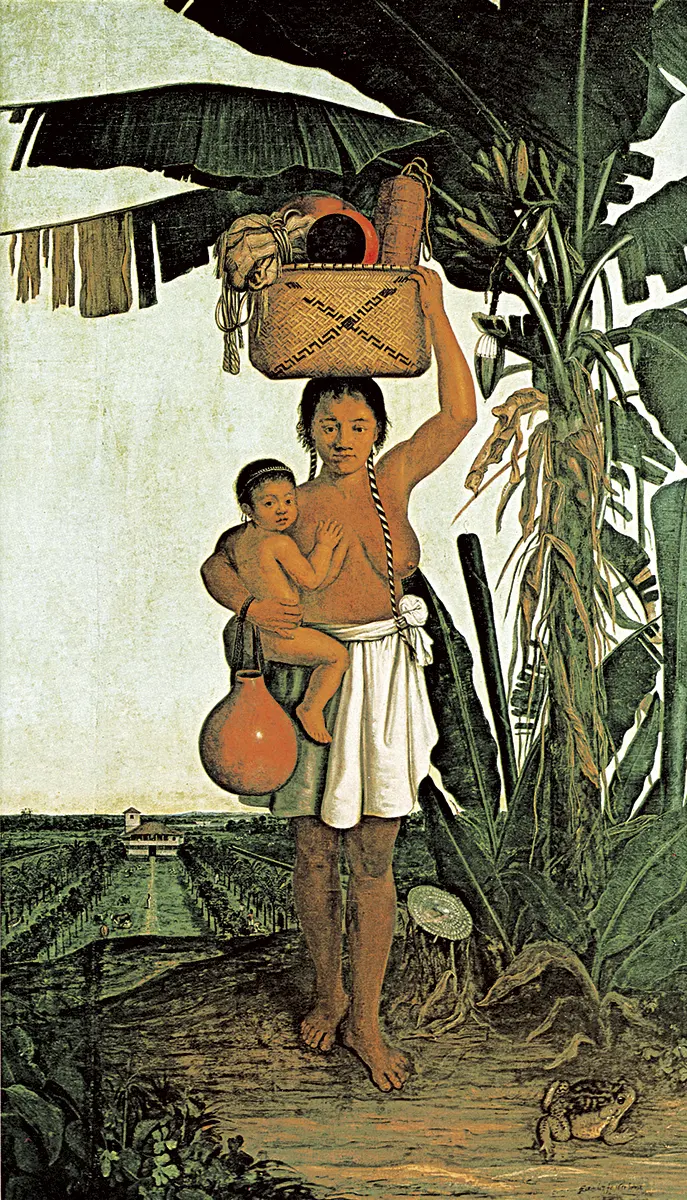
Eckhout’s paintings are among the most impressive and significant Brazil-themed bodies of work in a foreign institution. They were the result of the artist’s seven-year stay in the Pernambuco region as a member of the entourage of Johan Maurits Van Nassau-Siegen, appointed Governor General of all Dutch territories in Brazil by the Dutch West Indies Company in 1637.
The works shown are twelve still-life paintings representing fruits that are indigenous to Brazil or had adapted to the country’s climate; eight life-size portraits representing four couples of the main mestizo types among the local population; and one canvas depicting the ritual dance of the Tupian Indians, which has become the show’s landmark piece. These paintings were presented by Nassau-Siegen as gifts to King Frederick III of Denmark in 1654 and have been displayed in the King’s Kunstkammer since that year.
Beyond their evident artistic quality, a sort of aura envelops these paintings: they are the first to depict the natural environment and inhabitants of Brazil (along with paintings by Frans Post, a colleague of Eckhout’s in Nassau’s entourage). They helped popularize Brazil and fueled a vision among historians of an original Brazilian identity defined by the abundance of natural resources and the ethnic diversity of the population. The current show at the State Art Gallery avoids such reductive readings, instead opting to place Eckhout’s work in a historical context, locating it at the intersection of Seventeenth-Century European Art and the history of Brazil’s economy and society. Above all, the current show deliberately deflects the overcharged theatrical effects that characterized the controversial Rediscovery show, which in 2000 celebrated 500 years of Portuguese presence in the country.
The show is organized in seven rooms. First, there is an assortment of rare books, maps, and prints from the artist’s time, as well as a video about him. These elements are intended to reconstruct the history of the Dutch conquest of Brazilian territories, clarifying the reasons for Eckhout’s presence in the country. Next to the still lifes, which occupy two rooms, there are labels explaining the origin of each plant species and the artifacts shown in the respective painting, while texts on the wall analyze the works in the context of the history of the genre in the Seventeenth-Century Netherlands. The majestic series of portraits is shown in one space, the paintings hung much higher than conventional museography would advise, reinforcing the hypothesis that they were created as decorations for one of Nassau’s palaces, which would have required considerable distortions in perspective as optical corrections.
The Tupian Indian dance scene, shown in the last room, merits its own environment, with incidental music and rounded walls resembling those of a native lodging. Visitors are placed in the position of the voyeur who has stumbled upon a group of naked, dancing Indians. Undoubtedly, this show seeks to address a wider public than usual. For specialists, the excess of didacticism can be uncomfortable, but this becomes irrelevant when considering the unique opportunity to appreciate Eckhout’s work, extraordinarily well preserved, in its entirety. Considering that not too long ago there wasn’t a single museological space capable of housing such a special oeuvre, this is a big step forward.
VALERIA PICCOLI