Alejandra Seeber’s work, on view at Dabbah Torrejón Arte Contemporáneo, reaffirms the possibility and the vitality of the art of painting, at a time when its supposed death is routinely announced. In Seeber’s intriguing show, Living Rum, it is evident that beyond the paintings on canvas or on the wall, everything the artist does is pointedly associated with the art of painting, even when she is working digitally or with inexpensive, “made in China” ceramic knickknacks.
Despite having lived in Brooklyn for three years, Seeber is well aware of both what surrounds her in that New York neighborhood—from where she witnessed the traumatic explosion of the Twin Towers on September 11, 2001—and of her beloved Buenos Aires. While in the city of Providence finishing the work for the exhibition, Seeber helped a friend, who was completing a documentary about Argentina, interpret the words of the participants in the events of December 19 and 20, 2001, events that brought on the fall of the constitutional president Fernando de la Rúa.
Amidst the sounds of banging pots and pans (Seeber’s studio is located next to the video editing house) and the tranquility of the times that painting with oil inspires, the artist persists in treating painting her own way. “They are things that I do to the paintings. They are small attacks, almost to defend them from the big attack they are under. Capitoné, for example, is one of my attacks, counterattacks, on painting. In some sense the big attack against painting lately has been to make it decorative. I think in these times in which we live full of extreme sensations almost everything becomes decorative. I think reality exists with backdrops behind it, as it occurs in painting,” said Seeber, alluding to her piece Living Rum.
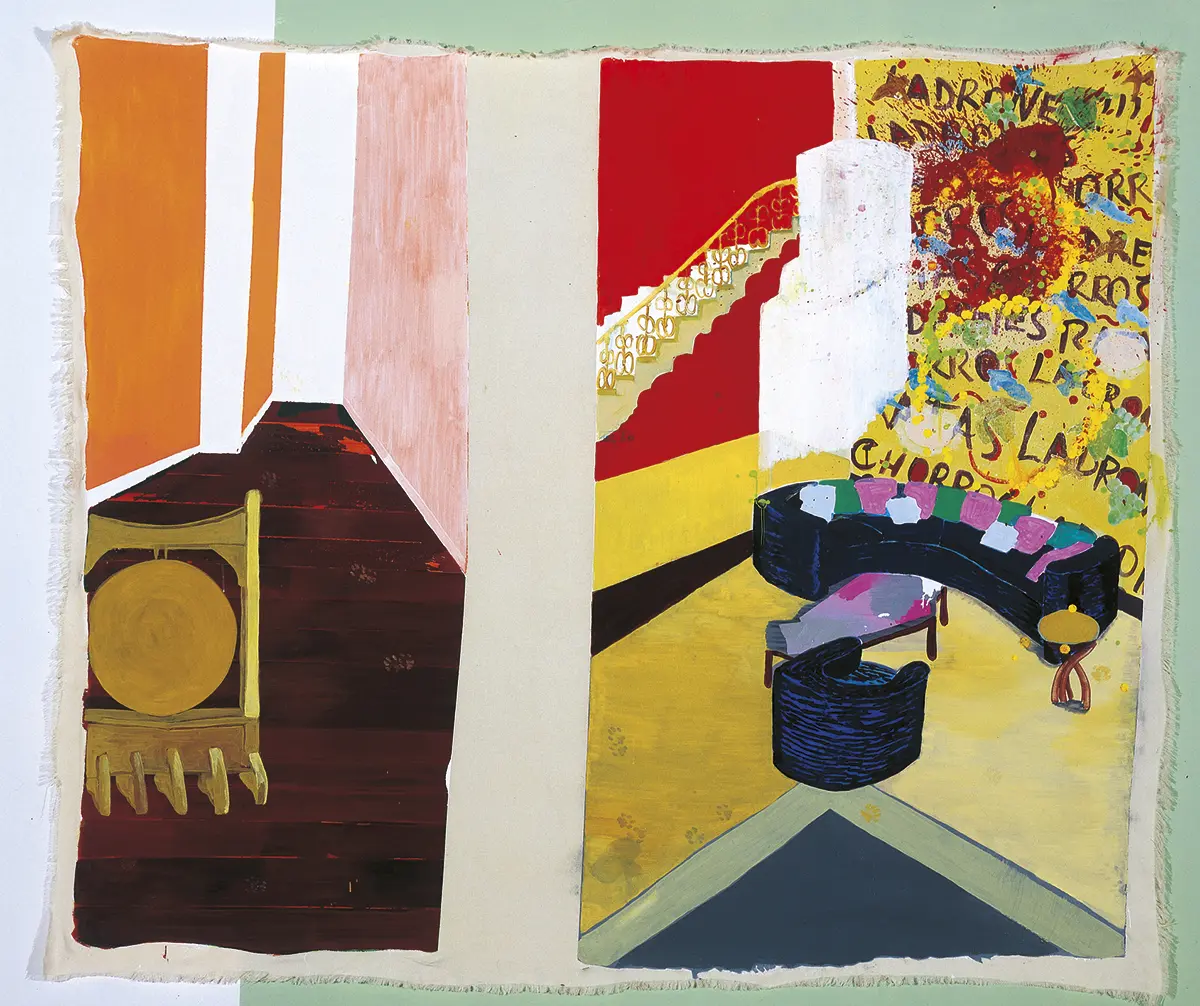
Most of the works exhibited at Dabbah Torrejón do not depict the stark external reality of New York or Buenos Aires. Instead, they seem to project the interior of living spaces in upheaval. Far from the hypothetical tranquillity of the interior, the images appear to confirm the disturbing external reality, weakening the boundary between private and public spaces. Seeber intensifies this blurring of boundaries in her presentation—at least in one series of paintings—that duplicates the center of attraction and exaggerates the contrasts, like the soft edges of the images of furniture on a canvas. Are the images opposed to or in dialogue with the geometric angles? In the same sense, an imperial style competes with the rustic look of the adjacent painting. Could it be that the duality in the paintings recreates the tyranny that the artist feels in her nomadic life in the United States and the affects and customs that she left behind in Argentina? Or is it that the artist develops in the light of contradiction and her work reveals in the art of contradiction?
Decentered and paradoxical, and in a style that defies classification but with elements that highlight a certain expressionism and a sense of the absurd, the apparently modest scenes that Seeber details are a cross between a supposed carelessness and an obsessive sense of detail, between softness and perplexity. Her elaborate paintings are in some sense caricature-like, yet at the same time they are serious. The images appear deceptively cheerful, but in the end are intriguingly serious. Or is it the opposite? Do they appear deceptively serious, yet end up being intriguingly joyful?
With subverted perspectives or with superimposed images, the interior landscapes are devoid of human figures and Seeber’s structures—that she makes from everyday objects—can only be seen partially, forcing observers to complete them with their own imagination. It seems that in these paintings and objects almost everything is fragmented or palimpsest-like. It is as if the images were permeated with imprints of past lives that, having fallen into an unstoppable deterioration, were salvaged by the artist who maintains a sense of optimism within the spatial instability that she creates.
Seeber’s experimentation with painting is multifaceted and always unique. Canvases with stains that allude to the painting within the painting; the representation of walls with chipping paint, holes, padding, stuffing, and ripped wallpaper with childish themes that include white elephants (the governing United States Republican Party’s emblem); portraits cut and then woven together (with the help of friend Elyse); frayed, torn, or mended support; damaged objects that have been fixed all form a disconcerting yet provoking blend. Do these works reveal a covered violence behind vibrant colors? Is it that the incongruent scenes, the tied and mended pieces, the patches, are the triumph of diversity, or a desired reconciliation of the irreconcilable or the reflection of highly emotional works of art? Perhaps. It is certainly difficult, in any case, to stabilize their meaning, because this highly energetic painting is far from being of the discursive kind.
VICTORIA VERLICHAK