
As daring as always in his work, Arnaldo Roche Rabell (Santurce, Puerto Rico, 1955) takes on now “vehemently, possessed by an existential and artistic fire” one of the characters and bodies of work of greater relevance in the history of art: Vincent Van Gogh. The dangers are as obvious as they are immense, from the pitfalls of kitsch to the risk of ending up with a merely anecdotal narrative. But Roche has been able to save all these obstacles in order to internalize Van Gogh and subject him to mimesis, while remaining (Roche) himself, full of a renewed vitality and now under the influence of a paradigmatic example of the artist who gives himself entirely to Art.
Roche Rabell is one of those postmodern artists who have no qualms in using as a resource everything that has been painted before: the eclecticism of the quotation is an essential part of his vocabulary. And among these references, Van Gogh has been a constant presence. In 1992, Roche Rabell inaugurated a series of “borrowings” with his Quinientos años sin una oreja and Todo artista debe morir sin una oreja, keeping the practice up into pieces as recent as his Y ahora qué, of 2000.
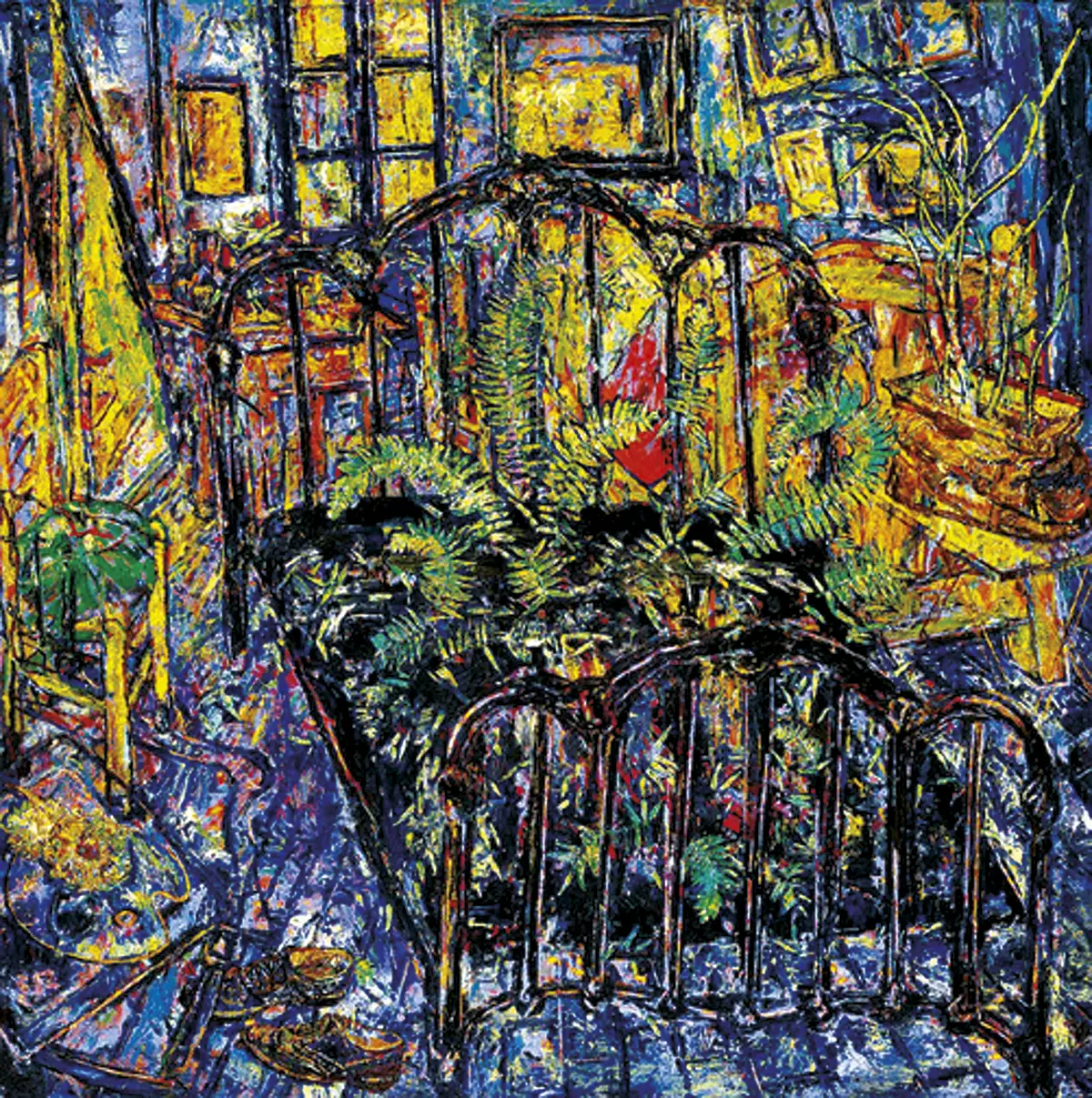
In Roche Rabell’s show at the Museo de las Américas “in practical terms a product of his work in the year 2002 but above all the result of profound, deeply felt meditations, of private circumstances, and of experiences accumulated over several years” Van Gogh is no longer an echo or the fragment of an image; the Dutch master has become a presence; mon semblable, mon frère, is what Roche Rabell seems to be saying by integrating Van Gogh as a protagonist and by recreating obsessively paintings from the most productive period in Van Gogh’s career, his Arles-Saint Rémy period when he was nearing already his final descent into madness. We get the sunflowers, the mousmé, the sower, the artist’s room in Arles, the garden of St. Paul Hospital, the self-portraits, the various images from the asylum. Yet none of this is a copy, nor are these interpretations of the original. It is the wholesale appropriation of an inner world and the fervid search for explanations where only mystery has sway.
Once again, Roche amazes us with the radical nature of his discourse. After arriving at several points in his career to something very close to paroxysm, he manages always to find a way to top himself and move beyond. The sheer physical energy required to turn each painting into a performance is joined here with the intensity of his spiritual ambition, the strength of a commitment that transcends the boundaries of the private and confronts the artists with his own demons. Roche’s large formats, almost sculptural work with the density of matter, dramatic concentration of colors (yellow-blue, yellow-orange), oversaturated and confined spaces, violently displaced human bodies “each one of these resources fits with the logic of extremes that characterizes Roche’s work, and they also make possible, even natural, an identification with Van Gogh. And this artistic fellow-feeling is also the support for a reinscription of the recurring, albeit underlying, theme of the family drama: artistic brotherhood with Van Gogh, and blood brotherhood with a man who shares Van Gogh’s tragic fate.”
The topics of personal and collective identity have been the framework of Roche’s entire oeuvre; in this exhibition, however, there is a greater focus on the more private aspects, de-emphasizing those references to the island and to Puertorrican-ness that were such an important component of his works in the past. Here, the meditation on being an artist (guided by Van Gogh’s “lighthouse”) and on a dramatic family history (the loss of a brother, and his spiritual recovery through art as a propitiatory practice). Van Gogh is the point on which both obsession meet and fuse.
None of the above means, though, that Roche has become any less of a Puertorrican artist. We still find his ferns “symbols of the Earth” and all that tropical lushness, the unbridled tropical-baroque expressionism that has always been Roche’s and that now highlights Van Gogh’s own expressionism as an obligatory synthesis.
Nevertheless, the term “expressionism” is only an approximation to Roche’s work, which is extremely sui-generis and unfettered by stylistic codes “intent, rather, on breaking such codes," hyperbolic, hyper-expressionistic in a way.
The show’s thematic unity turns it into both a narrative and an installation. It can be seen as one single work on the topic of brotherhood, which is resolved in various “moments.” Roche does not shy away from symbolic implications, cryptic relations, or a surcharge of meaning: he mixes it all into a generous pictorial matter, charging ahead unstoppably, and tenaciously and achieving the precise tone his discourse requires.
Once again, the insistent presence of the self-portrait, now superimposed on Van Gogh’s characters (the woman with the striped dress known as La Mousmé, the man of Old Man in Sorrow [On the Threshold of Eternity], The Sower), underlines the identification aspect of Roche’s proposal. Older images, such as the twins, reappear in a dramatic fashion alongside newer ones such as those of ropes tied around trees, creating an oppressive atmosphere like that of the artist’s closed spaces. The palettes and the easels peak an affinity for painting, while Van Gogh’s sunflowers intertwine with Roche’s Caribbean ferns (De esta mesa comemos todos). The artist appropriates Van Gogh’s room in Arles, populating it not only with his own bed but with those blues that are so his (El tercer huésped). In the same room, there is a “set table” in the tradition of Dutch still life “which speaks of absences”: Mi hermano nunca volvió.
With this important work, Arnaldo Roche takes yet another step in an exploration that is, more than an artistic oeuvre, a whole life project involving the passion that justifies any great undertaking.
*The show will be exhibited at the Museo de Arte de Ponce from April 5 through July 27, 2003.
FEDERICA PALOMERO