“Greatness does not come in pairs.” For any mortal, greatness in one field would be enough. Against the grain of this common wisdom, however, Clorindo Testa surprises us with just such dual excellence: his greatness as an architect is matched by his greatness as a visual artist. To which we should add yet another uncommon trait: the acknowledgment by successive generations of younger artists of Testa’s work as the epitome of an implacably lucid critical conscience. Similar cases could be those of Antonio Berni, Enio Iommi, León Ferrari, and Víctor Grippo.
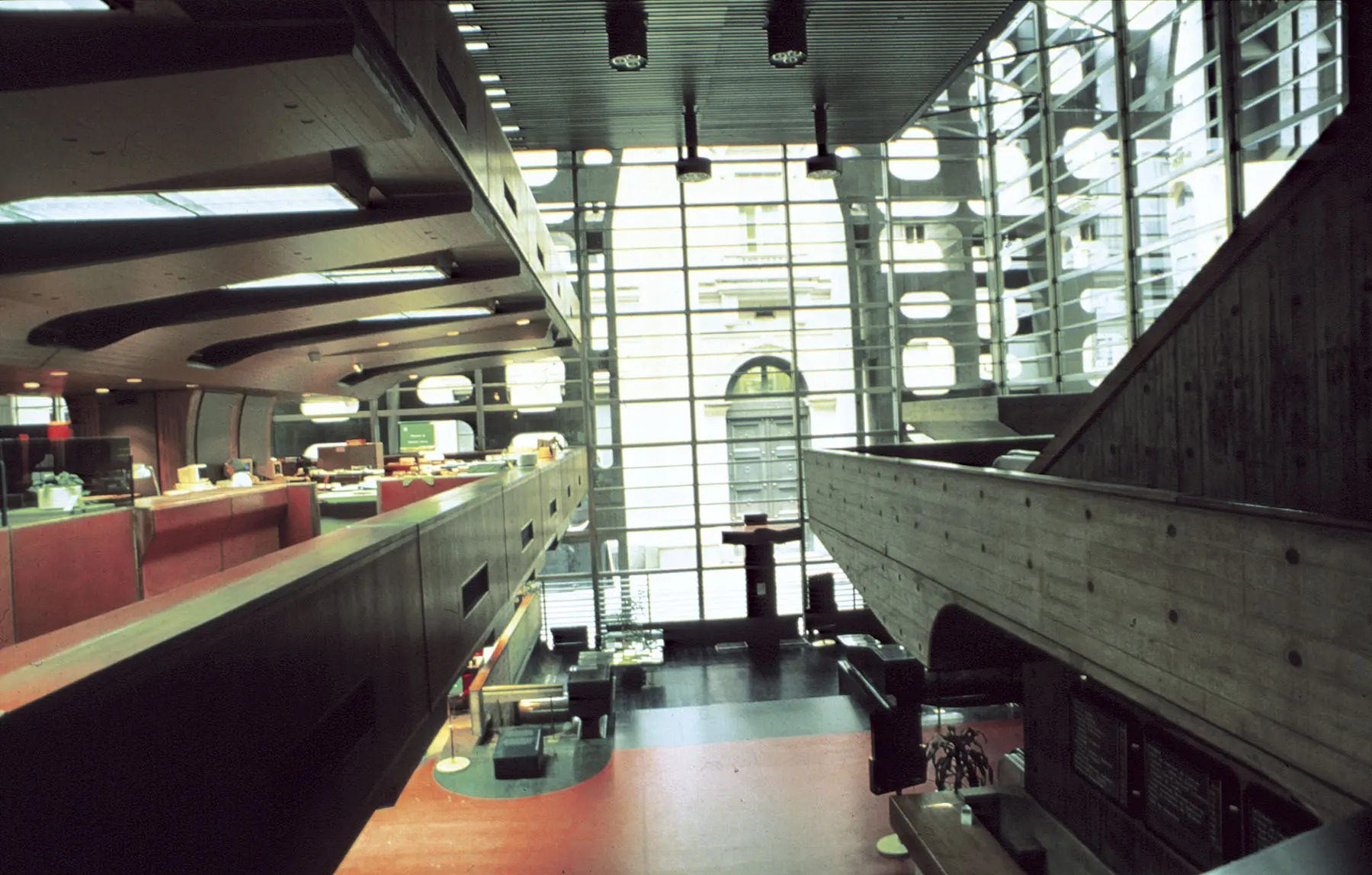
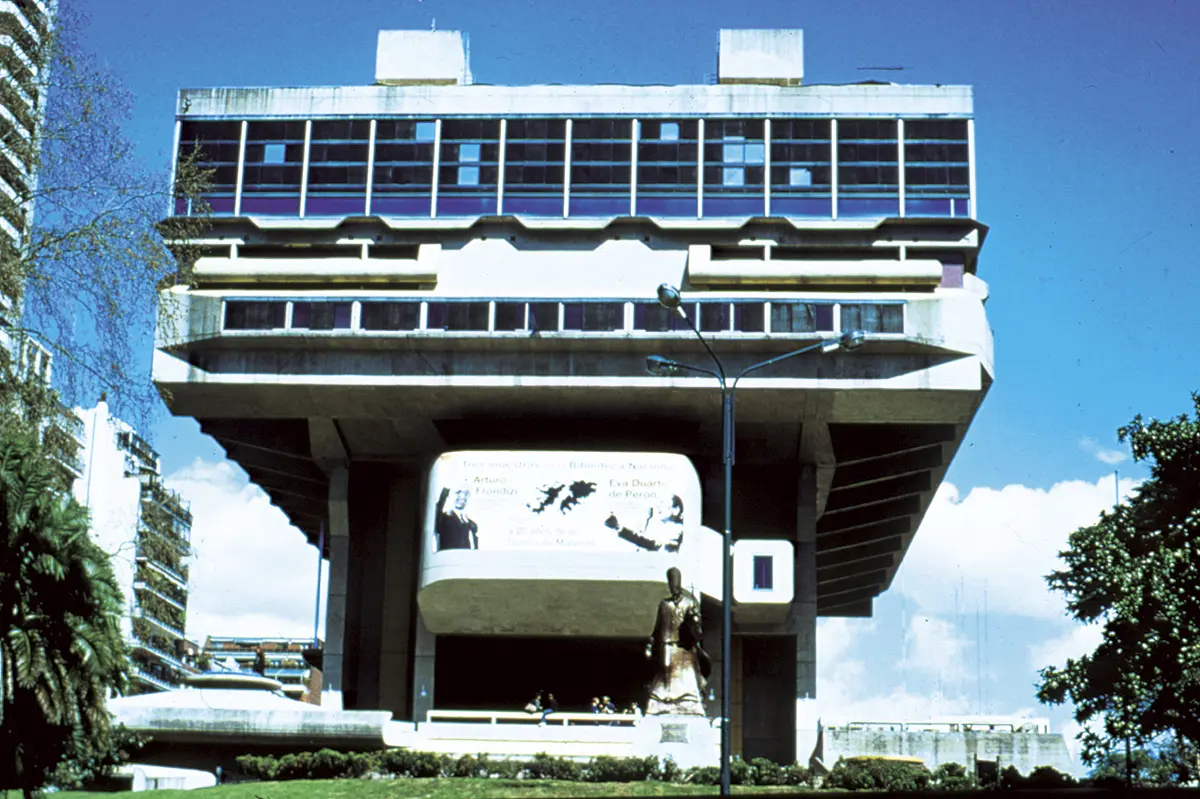
Clorindo Testa is the creator of some of the key pieces in contemporary architecture. With his collaborators, Testa projected two of Buenos Aires’s most significant architectural icons: the Banco de Londres y América del Sud building (1960) and the Biblioteca Nacional (1961). He was also responsible for the La Perla resort in Mar del Plata, the Buenos Aires Design Center, the Community Center for the Sociedad Hebraica Argentina, and the Central Navy Hospital, as well as for the remodeling of both the Museo Nacional de Artes Visuales in Montevideo, Uruguay and the Instituto Di Tella—the latter a legendary space in the 1960s.
Yet, Testa’s prestige as an architect has always run parallel to his well-deserved prestige as a visual artist and continues to do so. In 1961, one of Testa’s informalist paintings was awarded the National First Prize of the Instituto Di Tella, the most important recognition at the time. In 1977, he and the other members of the CAYC group won the Itamaratí Grand Prize at the São Paulo International Biennial, and in 1987 Testa received the Architects of the Americas Triennial Award, presented by the Pan American Federation of Architects. Testa has been a Supernumerary Member of the Academia Nacional de Bellas Artes since 1976, and a Doctor Honoris Causa of the Universidad de Buenos Aires since 1992) among other awards and distinctions.
In the beginning…
The son of an Italian medical doctor and his Argentine wife, who were married in Buenos Aires, Clorindo Manuel José Testa was born in Naples, Italy, on December 13, 1923. “My father, perhaps out of romanticism, wanted me to be born in Italy,” he explains. In truth, Testa has always felt more Argentine than anything else (he was five months old when his parents returned to Buenos Aires).
Testa began his college education in the field of Naval Engineering at the Universidad de La Plata, later switching to Civil Engineering at the Universidad de Buenos Aires. He graduated from the latter institution in 1948, with a degree in Architecture. That same year, title in hand and already under the influence of Le Corbusier’s rationalist ideas, Testa joined the recently created department, Study of the Regulatory Plan for Buenos Aires. This municipal department employed Ferrari Hardoy, Vivanco, and Bonet, three architects who had met in 1937 while working under Le Corbusier on an urban plan for the city of Buenos Aires.1 It was here, more than at the University, that the young Testa encountered contemporary architecture, thanks in part to his contacts with Ernesto Rogers, an Italian architect and urban planner who acted as an advisor to the Regulatory Plan. He has explained, "In school, we had veteran professors, cultured and mild-mannered teachers who nevertheless taught us nothing of what was actually going on… I first heard of Le Corbusier perhaps in my fourth year there.”
In 1949, Testa won a Universidad de Buenos Aires fellowship for a study trip to Europe, and over the course of two years, he traveled in Italy, France, and Spain. Only a handful of European names continued to influence him: Uccello, Botticelli, Balla, Boccioni, Klee, Picasso, and Modigliani. Yet, his Roman sojourn provided the opportunity for his career as a visual artist to take off. It was in Rome that Testa met Franz Van Riel, one of the most prestigious Argentine gallerists. (Over time Van Riel’s honesty and professionalism would reinforce that prestige.)
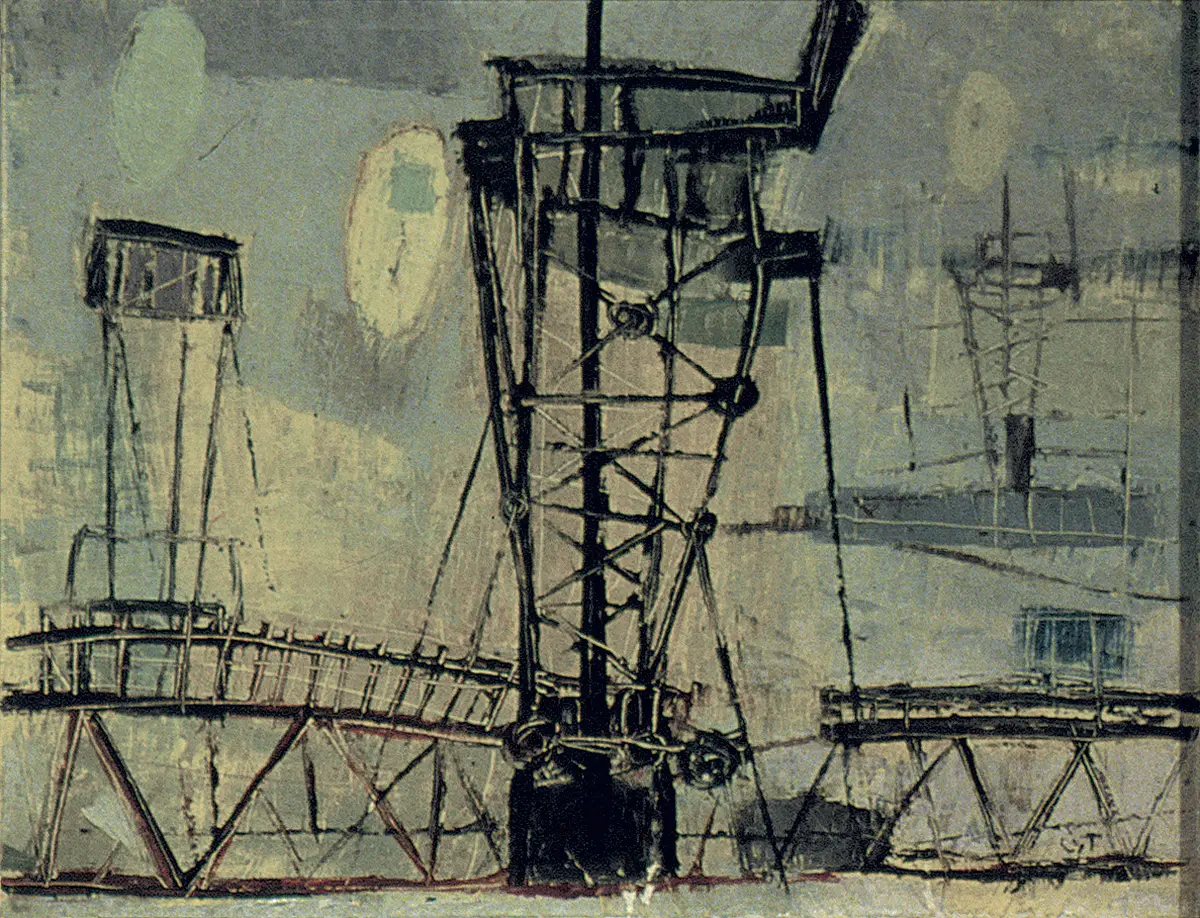
Captivated by young Clorindo’s sketches of his travels, Van Riel programmed a show of Testa’s work at his Buenos Aires gallery, located in the very central Florida street, and Testa’s first solo exhibition opened there in the Fall of 1952. It included twelve small oil paintings with an architectural theme: bridge structures, heavy construction machinery, train platforms, gas meters, and cranes. Testa returned to the same gallery a year later but with a wider array of motifs: bicycles, boats, sewing machines, mechanical fans, stoves, and bird feeders.
Interestingly, the first critical notice of Testa’s work was not for his painting, but for a set design he created for the drama El burgués gentilhombre (The Gentleman Bourgeois). The note appeared in 1951, in the pages of the daily La Nación, under the byline of the critic and writer Manuel Mujica Láinez. Nonetheless, Testa’s central role in Argentina’s painting was appreciated early on by the critic Aldo Pellegrini, who in the mid-1960s wrote that in Testa’s work, one could find “some of the most important works in Argentine painting of recent years."2
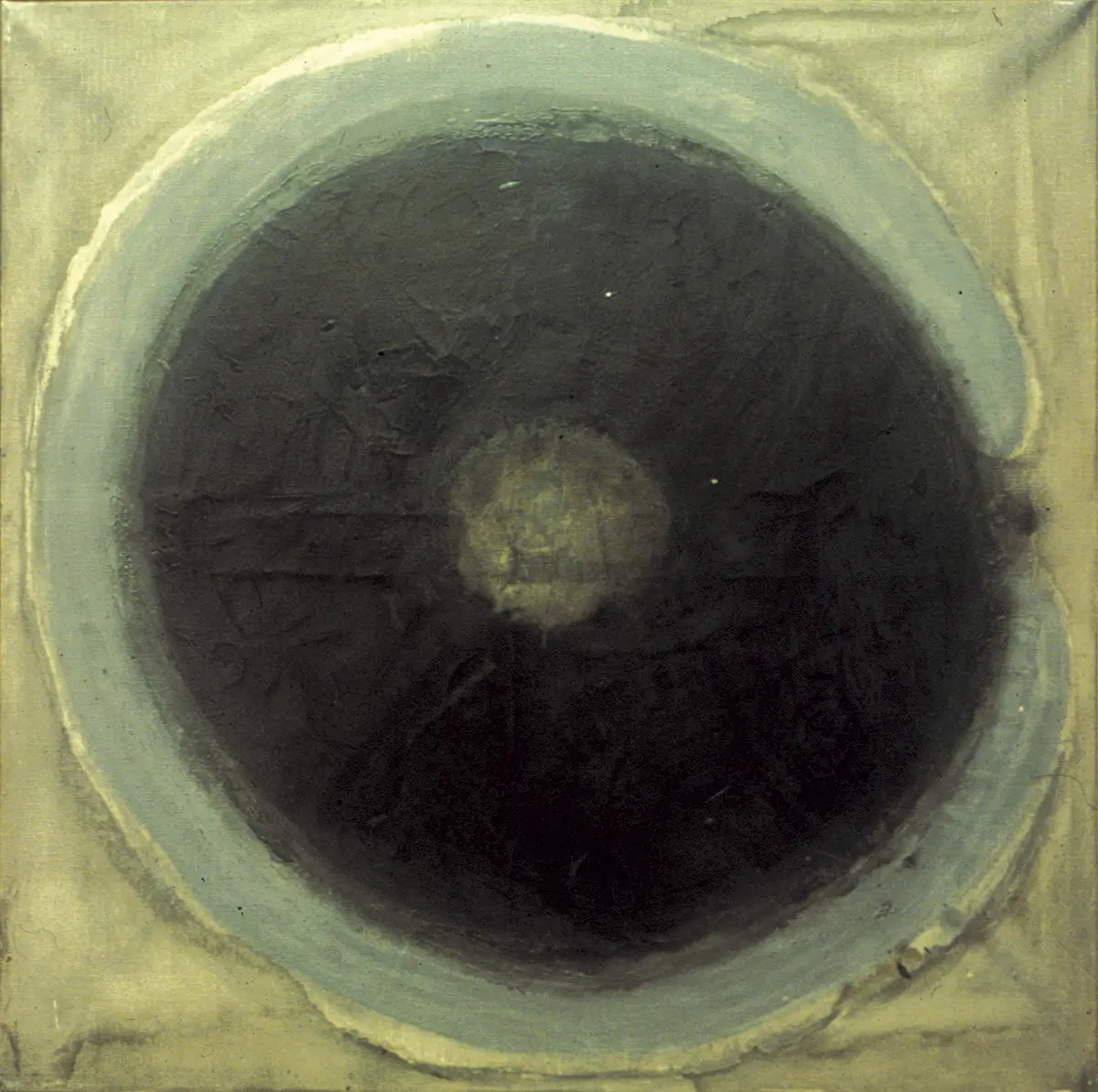
Figurativism, abstraction, informalism, conceptualism. These are, in the tightest synthesis, the stations of Testa’s artistic evolution. In a one-person exhibition held at Galería Antígona in 1956, Testa showed the abstract pieces through which he would arrive at a distilled informalism. His informalist orientation contributed to the many-sided spirit of the Grupo Siete of abstract painters, whose members included Osvaldo Borda, Víctor Chab, Rómulo Macció, Martha Peluffo, Josefina Robirosa, and Kasuya Sakai. Grupo Siete’s 1957 show at Galería Pizarro made clear that they were united in the attempt to leave behind the academic tradition.
Testa-the-Informalist makes maximum use of a simple formal repertoire—circles, ovals, rectangles, and squares, centered or displaced—and a subtle material treatment. If on occasion the image was enlivened by drippings and scribblings, this was never carried to the extremes to which the informalists were so adept. Testa’s chromatic asceticism was made evident in his use of whites, blacks, and grays—his palette would remain, as someone put it, “half in mourning” until 1965.
“That year [1957] I sent two paintings, already in black and white, to an exhibition held in Whitcomb. This lasted until 1965; that year, I got invited to the Palanza competition thanks to all that painting I had been doing. But I didn’t feel like going on with the black-and-white stuff any longer, and I sent my fold-ups. I made five color fold-ups, the canvas held together with pins. Thanks to these, I was never invited again."3 These fluted works were followed by pieces made with spray-painted paper, folded and affixed to a hardboard backing.
But it wasn’t only in the field of painting that the name of Clorindo Testa began to make itself heard in the 1950s and 1960s. In 1951, Testa’s project for the Cámara Argentina de la Construcción received First Prize, and in 1956 another one of his projects was selected for the Centro Cívico in Santa Rosa, capital of the La Pampa province. It has been said that “It was Testa-the-Architect who managed to put food on Testa-the-Painter’s table,” but, in truth, this is not a case of “architect by day, painter by night.” Recognition in both fields came almost simultaneously, and it came early.
An important moment in Testa’s international recognition as an architect was his First Prize in the competition for the Banco de Londres y América del Sud headquarters, in Buenos Aires (1960). A year later came the First Prize for the construction of the city’s Biblioteca Nacional. These two projects, however, were to have very different fates. The bank building opened its doors in 1966; construction of the Biblioteca Nacional only got underway in 1971, ten years after Testa had won the competition, and by 1981 only a third of the project had been completed. The Biblioteca was finally inaugurated on April 10, 1992, a record-breaking thirty-one years after it was commissioned. This was not the only problem; among other things, the authorities decided to do without the parasol system that had been part of Testa’s original project.
A Critique of Functionalism
With the new conception of space expressed in the Banco de Londres building—which made the relationship between interior and exterior ambiguous through the columns that projected onto the street—and with the utilization of symbolic form in the Biblioteca Nacional project, Testa had embarked on a provocative deviation from Le Corbusier’s Functionalism, questioning, in more general terms, the idea of instrumental reason and of a "managed world," in the sense in which Theodor Adorno used these words. Matter, in this case, reinforced concrete, had become the protagonist just as the drippings and scribblings were the protagonists of Testa’s informalist paintings.
Testa’s critique of Functionalism is all the more evident in his installation Habitar, Circular, Trabajar, Recrearse (To Live, To Move Around, To Work, To Be Entertained) 1974, so titled in reference to Le Corbusier’s definition, in the Letter From Athens, of the four functions of urban planning. Testa’s installation was comprised of one hundred seven cardboard pieces, each sixty centimeters square, showing the poor quality of life in a strict Functionalist order. The series describes a day in the life of Mr. A: we see him sleeping alongside his wife, washing in the bathroom, eating breakfast in the kitchen; we see him as a public transportation passenger and as a worker in the office; finally, by the end of the day, we see him relaxing in front of the TV screen. Mr. A lives, moves around, works, and is entertained in a Le Corbusier-inspired city, yet his condition is more like that of a prisoner than a free individual.
Siglo XX ¿Fin de Siglo? Una ciudad (Twentieth Century, Century’s End? A City) 1993, another installation, is an equally expressive critique of modern urban planning. Here, two flimsy drawing boards are a city’s main support; the city is represented by five vertical columns of sharpened glass shards, placed between wooden blocks. The piece is certainly beautiful, yet it projects a powerful sense of desolation and vulnerability.
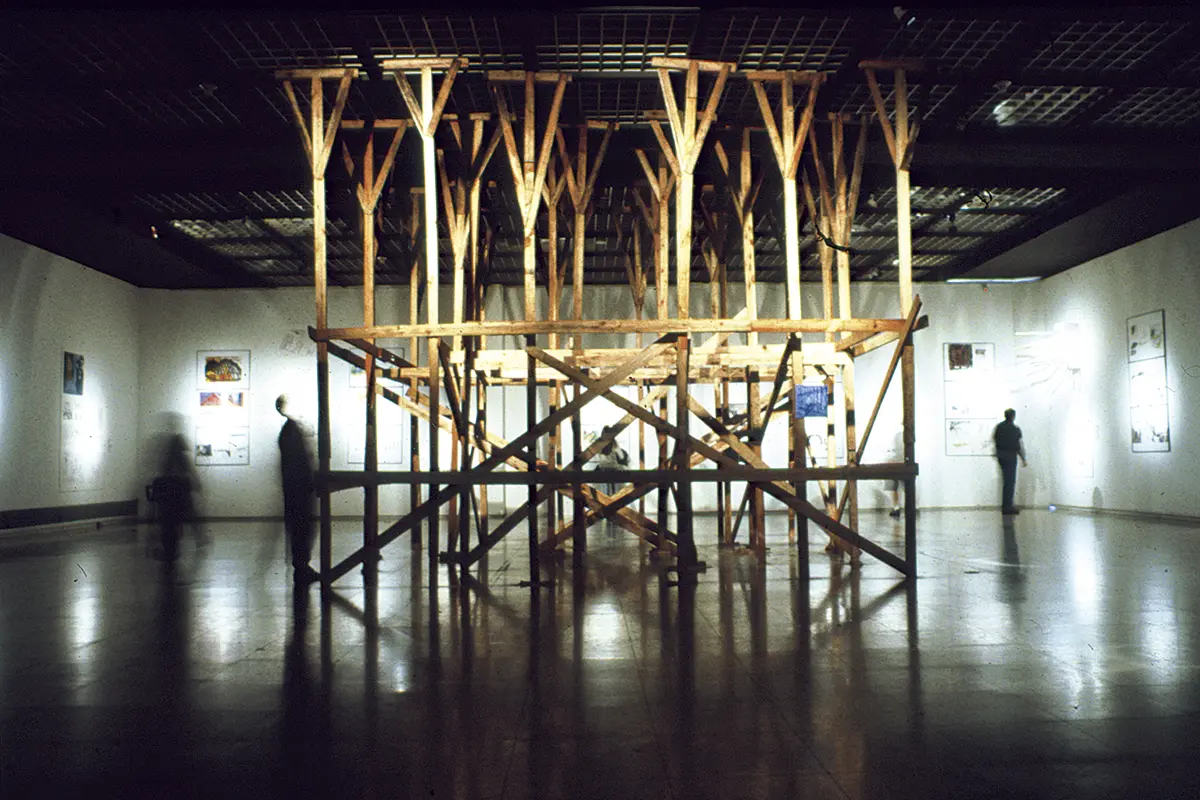
In summary, we can say that Testa-the-Architect is the one who builds things, and Testa-the-Visual-Artist is guided by the need to shed light on the cracks of the system, questioning the insertion of society’s constructive mechanisms. As a consequence of this spirit of negativity—which Adorno considered essential in art—by the 1960s Testa already had defined his position within the field of conceptual art. A key piece in this regard is his Apuntalamiento para un museo (Support For A Museum) 1968. It is a large iron structure, partially painted in blue. It was presented in the group show Materiales, nuevas técnicas, nuevas expresiones (Materials, New Techniques, New Expressions) at the Museo Nacional de Bellas Artes. Many years later, in 1994, Testa would create a new support for the same Museo Nacional de Bellas Artes. The newer piece’s dimensions are equally impressive (4.59 x 6 x 2.50 m), but instead of metallic structures, this new version was made with flimsier materials: wooden, unpolished beams. This switch gave the work a series of new meanings. Testa was still talking about the need to support and prop up cultural institutions that were in a state of profound disrepair, but he was also pointing out the precarious nature of the enterprise in new times, given the lack of resources.
Testa’s conceptual work was seen in numerous group shows of the CAYC group (the acronym stands for Art and Communication Center, in Spanish), a central reference in the history of Argentine conceptual art. The group was founded in 1975 by Jorge Glusberg; its immediate antecedent is the Group of Thirteen of 1971. Along with Testa, the CAYC group included Jacques Bedel, Luis Fernando Benedit, Jorge Glusberg, Víctor Grippo, and Alfredo Portillos.
In July 1971, Testa was a part of the exhibition Arte de Sistemas (Systems Art), mounted by CAYC at the Museo de Arte Moderno de Buenos Aires. Also in this show were important names in international conceptualism such as Vito Acconci, Arakawa, John Baldessari, Christian Boltanski, Gilbert and George, Hans Haacke, Allan Kaprow, Joseph Kosuth, Dennis Oppenheim, Richard Serra, and Bernar Venet. Among the Argentine delegation, in addition to Testa, we find Víctor Grippo, Luis Benedit, Antonio Trotta, Nicolás García Uriburu, David Lamelas, Vicente Marotta, Alfredo Portillos, Juan Carlos Romero, and Edgardo Vigo.
The Plague
If one were looking for common threads in Testa’s conceptual oeuvre, we would have to mention his attempt to recover both individual and historical memory.
Testa’s series La peste en Ceppaloni (The Plague in Ceppaloni) 1978 is autobiographical and, at the same time, historical. It refers to the suffering of the artist’s ancestors under one of history’s most cruel disasters: the bubonic plague, or "black death." The villages and towns of the Caudino Valley, among which was Ceppaloni, were devastated by the plague in the sixteenth and seventeenth centuries. Surprisingly, Testa imagines the plague under the guise of a character in a children’s story: Little Red Riding Hood. Is the artist denouncing the sinister, lurking presence of disaster where we least expect it? The most beautiful, peaceful, innocent appearance can be “evil” in this sense.
“As time goes by,” the artist says, “Little Red Riding Hood is closer and closer to us, and the howling is louder and louder, but it can’t be heard, because it exists on a different frequency.” This “howling of the plague,” which today we cannot, or refuse to hear, comes from sources that are different but no less corrosive than those of the past. Wars continue to devastate the land, the living conditions of marginal populations have not changed, accelerated technological development ends up diminishing our quality of life, heart disease is widespread, and the contamination of the environment, with its corollary of damaged health, is greater than ever.
The topic of the plague had appeared in Testa’s work before his Ceppaloni series. In 1977, as a member of the CAYC group, Testa presented to the XIV São Paulo Biennial the installation La peste en la Ciudad (Plague in the City), a sequence of sketches of rats placed on the floor and weighed down with bricks.
The rat as a symbol of pollution and danger has a long tradition in literature. The story of Hamelin, where the piper uses his musical talent to drown the rodents and save the town, is well known. Today, the threat of contamination in the inner city is multiplied exponentially, while nobody seems capable of repeating the piper’s feat. “The connotation here,” says Glusberg, “is something like: an urban planner, in his own realm, must take into account the threat of contamination in any large city."4 It is important to note that the City Government of Buenos Aires informed the public in 1996 that there were seven rats per human being in the Argentine capital.
The technique used to represent the rats in La peste en la ciudad blurs the distinction between the artistic and the architectural vision. May rats —symbols of contamination— be part of an invisible, perverse project from which a few, the usual corrupt few, obtain benefits? If this is the case, Testa is alerting us to a lethal peril.
We can conclude that, beyond its ecological position, La peste en la Ciudad alludes metaphorically to political and ethical contamination. It relates, for instance, to dramatic events in Argentine history—it related to them as they unfolded, in real-time: the 1976-1983 period, so painful for the country and its citizens. After the fall of the Peronista regime led by María Estela Martínez de Perón, a military junta employed the practice of extreme repression, in the end, “disappearing» thirty thousand Argentine citizens. The “plague” unleashed upon society from the highest spheres of power was experienced in its most abominable effects.
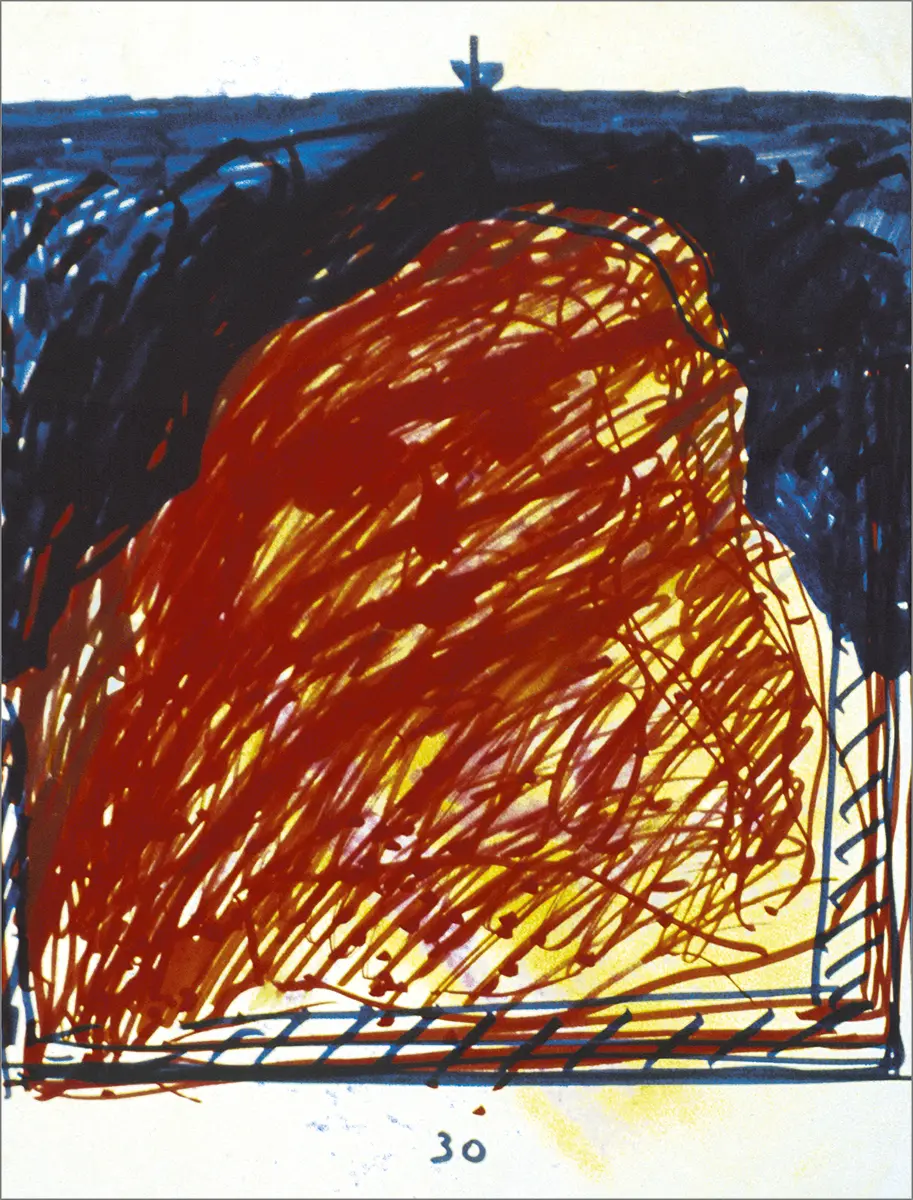
In one of the drawings that comprise La peste en la ciudad we can see a rat coming out of an open human mouth. This image refers back to those of the series, “La medición de un grito” (“The Measuring of a Cry,”) 1972. Here the cry is an immediate response by the victims of aggression, even if they are being victimized by disasters that they themselves have caused. Testa’s "measuring" show the side view of a face, using the techniques of architectural drawing that would later be used in the representation of the rats. An intense black graphic emerges from the figure’s mouth to ends in a line that measures its power. The series pays homage to the German architect Neufert, author of a well-known treatise on anthropometric measures applied to architecture. Is Testa trying to “measure” in order to slow down, in order to defeat an uncontrolled expansion of “evil”?
Memory and History
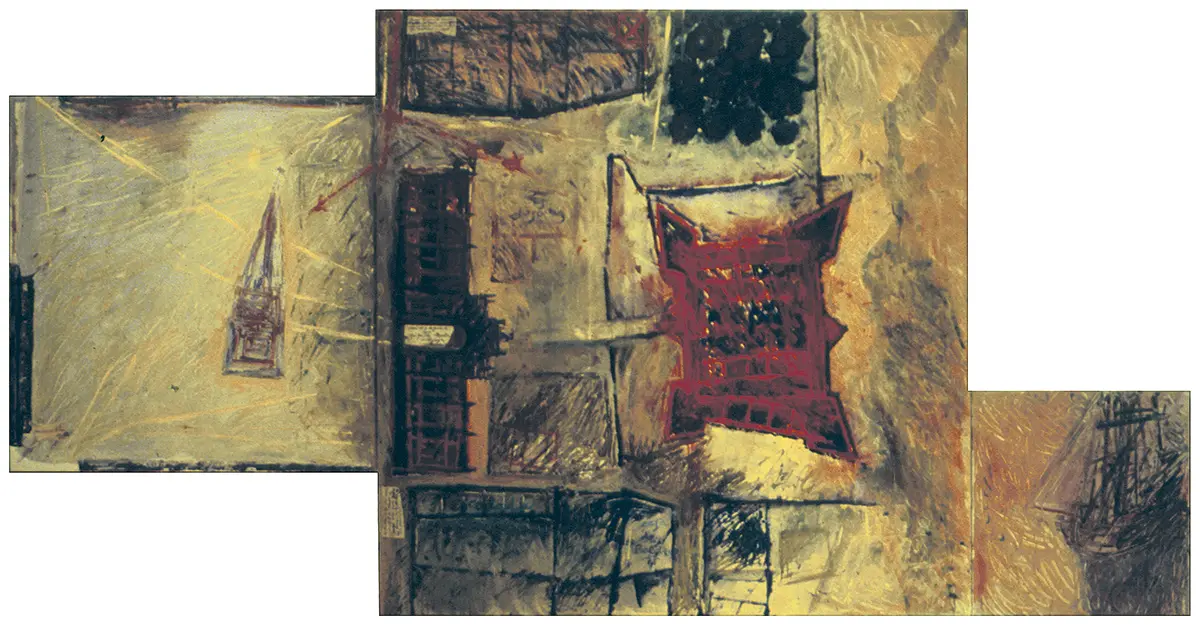
Often, when Testa reflects on the future, he takes History as his point of departure; he reviews the distant past and tries to avoid the commonplace, as in La explosión de la Casa de la Moneda de Potosí (The Explosion of the Potosí Mint) 1996, where historical and imaginary facts intertwine.
Testa’s more recent works also refer to the historical, this time, to the City of Buenos Aires’s past. Here, he shows the fire that destroyed the flimsy fort established by the Adelantado, Pedro de Mendoza in 1536, or the killing of the conquistador, Juan de Garay by the natives as a rather subdued group of Spanish soldiers look on. An aerial view of the Plaza San Martín is the background for the bloody British invasions and the armies’ allegedly prearranged retreats. Similarly, a view of the old Plaza de Mayo is the stage for the selling and the mismanagement of public goods. These themes have an amplified significance in contemporary Argentina, and they drive us to reflect on the effects of a centuries-long legacy.
We should note that Testa is interested in the recuperation of both the historical and the individual memory and that sometimes, as in La peste en Ceppaloni, these two memories are explicitly brought together. This is precisely what we encounter in El ahorro (Thrift), a 1986 installation where Testa recovers pages from his oldest school notebook full of notes in praise of the virtue of saving for the future. Along with the recuperation of his own childhood history, this piece chronicles the instability of Argentina’s economy in the 1930s, multiplied by the ups and downs of the world’s economic landscape. For today’s Argentina, El ahorro articulates an ironic commentary on the supposed benefits of saved monies: as is well known, towards the last days of 2001 a large number of the country’s savings account holders saw their money indefinitely frozen by government decree.
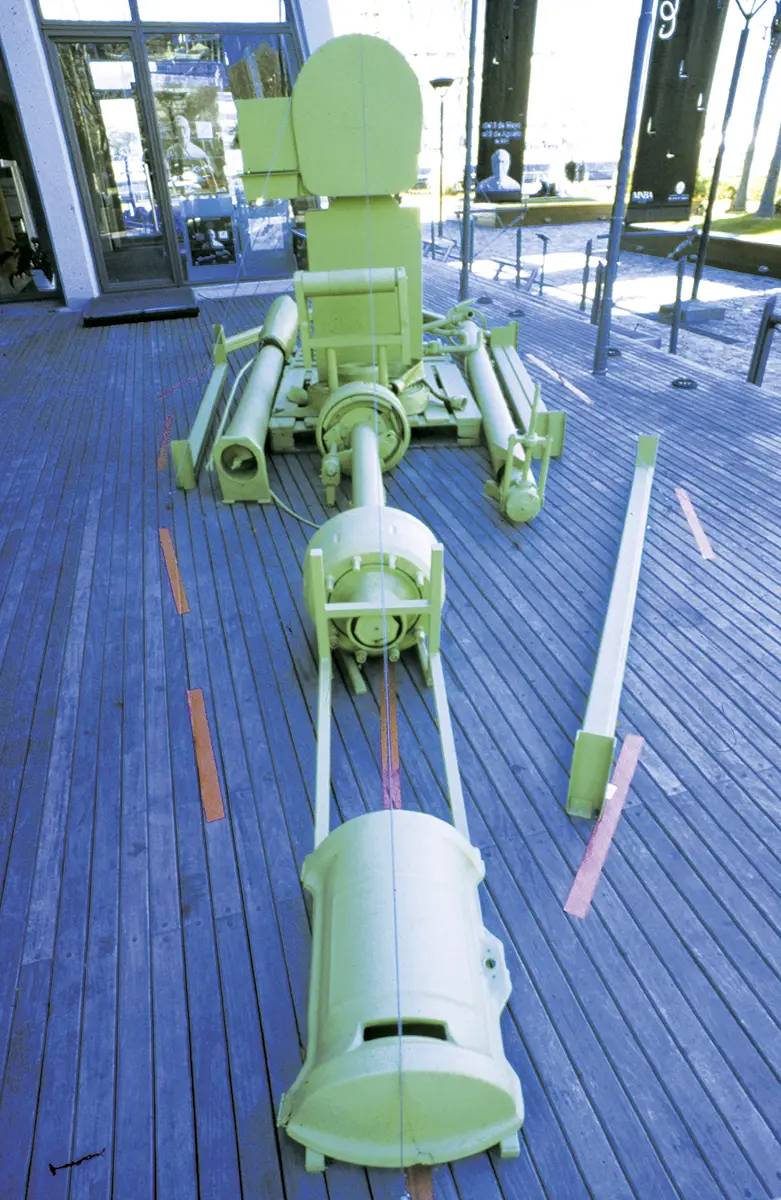
Individual memory is also operative in another recent work: Submarino de guerra de 1914. Recuerdo de infancia (1914 War Submarine. Childhood Memory). This piece reconstructs on a large scale one of Testa’s childhood toys. “In 1933,” he explains, «after watching a film in which the hero was a submarine commander, the kids of Haedo’s Club Discóbolo de Tenis decided to build a submarine in the Club’s garden, with some scrap metal and pieces of wood. This is what I have rebuilt in 2001.”
Convergence
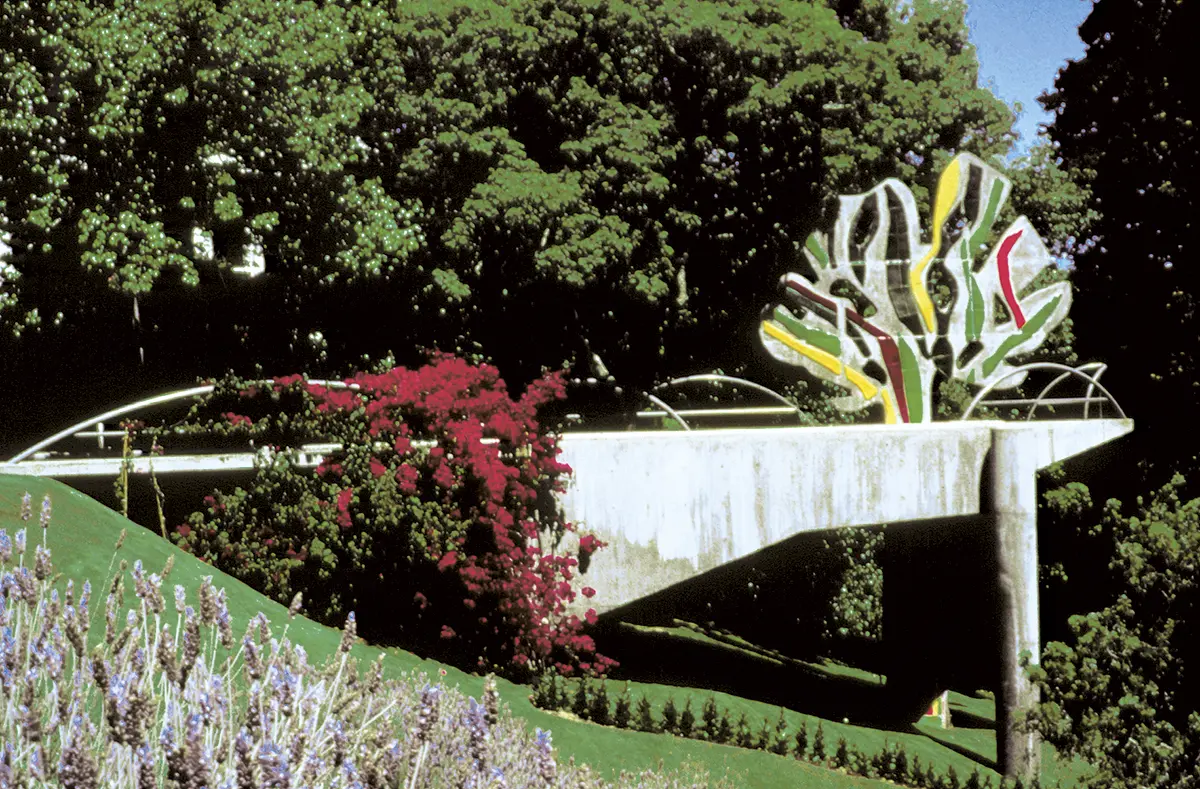
Art and architecture are two paths through which the single ability to be contemporary expresses itself; they are the vessels that communicate a single lucid vision, one that at times adopts the stance of humor and irony. What kind of meaning, if not an ironic one, could Testa’s suspended pool have, or his painted concrete tree in the natural park of a Martínez-area remodeled house?
It has been noted that Testa’s inclination towards the visual arts and his inclination towards architecture stem from a single root. According to this view, it all began with his interest in drawing; more specifically perhaps, it all began with his drawings of his 1949 European trip. These preliminary sketches would thus constitute the point of departure for what over the years was to take the form of sculptures, paintings, objects, installations, models, buildings, and cities. But we could take this idea further yet, all the way back to those first doodles and the first examples of writing in that schoolboy’s notebook.
Between the respective oeuvres of Testa-the-Architect and Testa-the-Visual-Artist, there is an evident and permanent communication. Testa-the-Visual-Artist has more than once replicated the work of the architect: he who designs, draws to scale, writes, erases. Similarly, Testa-the-Architect has more than once replicated the work of a painter in terms of making the materials, shapes, and colors of his buildings “express themselves.” Beyond adopting a conciliatory stance, Testa makes them confront each other and generate tension. This is why his architectural spaces, at times transformable, tend not towards calm but towards provocation and contradiction.
Yet, it is in the visual arts that Testa lets loose his impulse to play with the ephemeral. It is this field, moreover, that allows for Testa’s oeuvre to become an unending work in progress. This is how he presented it in a 1999 retrospective at the Museo Nacional de Buenos Aires, following a totalizing conception for the montage. Some of the pieces could be taken not as “finished” in themselves; next to other works, they became integral parts in a new grouping. We were led to think of a single, very large installation that also included never-completed architectural projects, “conceptual” works of sorts.
In Testa, the perspective of action and thought is so wide that it can conflict with itself. If, on the one hand, he builds, on the other hand, he speaks to us of the unintended, undesired consequences of construction. If, on the one hand, he plans hospitals (such as the Central Navy Hospital in Buenos Aires), on the other hand, he makes explicit his ideas about illness, as in La peste en Ceppaloni, La peste en la ciudad, and later, in his 1992 installation La fiebre amarilla en Buenos Aires (Yellow Fever in Buenos Aires), in which three empty beds, recreated with crumpled pieces of paper, summarize a great tragedy.
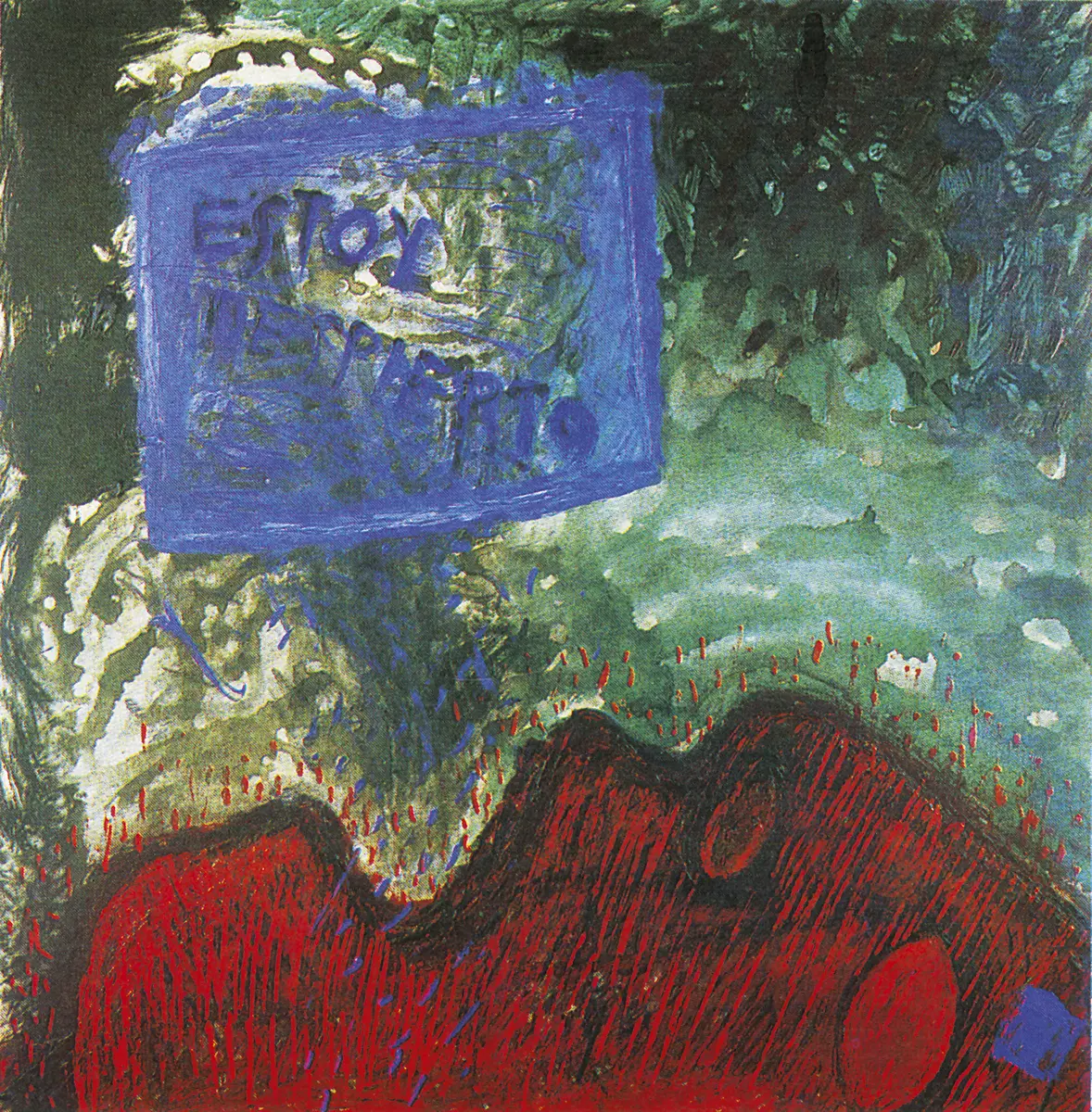
Perhaps we can put it this way: while Testa-the-Architect builds, Testa-the-Visual-Artist thinks about “the home.” His series Repeticiones (Repetitions) 1994 includes a two-part piece titled Esta es mi casa (This is my home), the irony of an architect who, situated as a visual artist, represents his own home by means of some wooden spikes precariously resting on the floor. This is the symbolic realm of a human being who, in profile, utters incoherent sentences such as “I am crying,” “I am alive,” “I am dead,” “I am awake,” “I am going home,” “What a beautiful day.” Whether the texts are different or even contradictory, the character’s expression remains unchanged, neutral, and incapable of connecting with its own inner being.
Between Testa-the-Architect and Testa-the-Visual-Artist, there exists an all-encompassing figure: Testa-the-Humanist, obsessed with alleviating the effects of destruction and decay. It is Testa-the-Humanist who metaphorically “measures” and disputes the consequences of progress. He does this in his own way, through the creation —as though engaged in a salvaging operation— of new things from the ruins of the present and the future, while pushing us forward along the path of urgent ethical reconstruction.
NOTES
1. Le Corbusier visited Argentina in 1921, invited by the Asociación Amigos del Arte and the Program of Architecture (made a full University School in 1947) of the Universidad de Buenos Aires. He gave ten lectures.
2. Aldo Pellegrini, Panorama de la pintura argentina contemporánea, (Buenos Aires: Paidós), 1967, p. 80.
3. A.A.A.V. V, Seis décadas de arte argentino, (Buenos Aires: Universidad Torcuato Di Tella), 1998.
4. Jorge Glusberg, Del Pop Art a la nueva imagen, (Buenos Aires: Gaglianone), 1985, p. 215.
ELENA OLIVERAS
Doctor of Aesthetics from the University of Paris, Professor of the University of Buenos Aires, essayist, and