
A few blocks from Caracas’ conflict-ridden Plaza Altamira, the Sala RG of the Rómulo Gallegos Center of Latin American Studies presented Zona de Distensión. Inventario y estadísticas de una experiencia de diálogo, an exhibition by David Palacios. At a time when Venezuela is crying out for an understanding between the government and opposition groups, Palacios’ work attempts to ease the tension between two fields equally at odds: the art world and the material production sector.
The exhibition, which was open to the public from October 2002 to January 2003, was based on an investigation into the use of brick in contemporary art, be it in installations and ambientation, or in sculpture, painting, drawing, and photography. The increased use of bricks, preferably exposed, is not limited to the material aspect but also includes the symbolic dimension. Transcending its use-value, there is an infinite number of meanings in the presence of one brick, or a group of bricks, in a work of art. Ironically, the use and abuse of one referent to suggest diverse meanings has become one of the many common threads in art today. When a material or an artistic technique, in this case brick, is used repetitively, it becomes banal; it loses its aura as it gets closer to the anonymous world of industrial production.
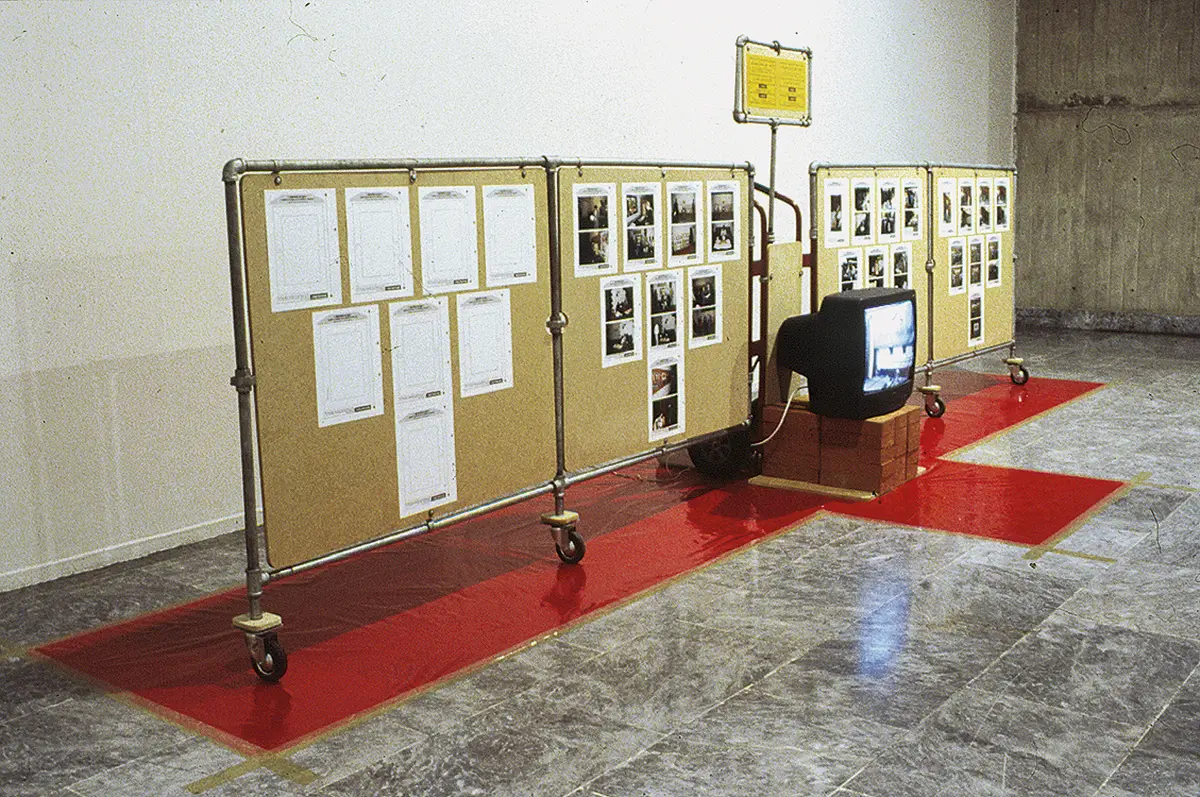
Taking this into consideration, Palacios’ exhibit is centered on the strategy of mediation, with the first stage detailing the inventory of those works and authors that compose what could be considered a “poetics of brick.” Palacios distributed this material among the workers of a brick factory, Obra Limpia, located in Guatire, a few miles from Caracas. Each one of the workers in this factory, the majority of them with high school education, received a personalized folder with the images in question so they could see and become familiar with what is done in the art world with the very bricks that they produce in the factory. Some of these images were also displayed on a wheelbarrow mural built on-site with tubes and plates of artificial wood. During the process, Palacios documented the stages of the experience and requested information about the typology and function of bricks, as well as how they are produced.
The documentation of this itinerary inside the plant is part of the exhibition, which is set up like a large video installation combining photographic and audiovisual documents, statistical graphics, and folders placed on movable shelves designed by Palacios. On this meeting ground, the experience in the factory became confused with the art information, as if there were no division between these two areas of human activity. An example of this is seen in the video projections. While the engineer, Lacides Mora, explains the incidence of lunar phases in the selection of clay, artist Antonieta Sosa reflects on the meaning of bricks in her work Situación titulada casa (1981). Adding to this idea is the fact that Palacios’ piece is displayed in a comfortable documentation room where the visitor can sit and view the materials, those related to the works of art (where a brick is NOT a brick) as well as those that are a result of industrial production (where a brick IS a brick).
As in other works by Palacios, this project is situated between irony and parody. In this case, the brick is no more than a pretext or a scheme used to question the object’s polysemic inflation, by confronting it with its practical function. Instead of abstracting the object from its context in order to bestow it with an artistic meaning, in the manner of Marcel Duchamp, Palacios proposes returning the object to the place where it originated and removing from it the magical halo that many believe is essential in a work of art. This notion becomes even more suggestive insofar as the exhibition adopts the model of a study, subject to bureaucratic and falsely systematic classification, turning the work into the parody of an archive. Added to these are references to popular engineering, especially those structures built by street peddlers for the display of their merchandise, the model Palacios uses for the construction of his mural wheelbarrow and his shelves. This interplay of audiovisual technology and popular solutions produces a kind of eclectic atmosphere. Based on the union of heterogeneous elements, Zona de distensión... is grounded in an experience of symbolic exchange that transcends disciplinary fragmentation and promotes collaboration between distinct forms of human activity.
FÉLIX SUAZO