The eighth edition of the Bogotá Art Biennial took place between mid-December and early February, with exhibits presented at different points in the city in order to “expedite the process of promoting contemporary Colombian art and bringing it to the public... and to create a new dynamic for the city through an expansion of its cultural map.” The chosen sites were the Museums of Modern Art, Urban Development, and Contemporary Art, as well as the new Tunal and Tintal libraries. The Biennial presented twenty-five artists and included eleven works that are considered important referents in the history of Colombian art. The event, sponsored by Colombia’s Ministry of Culture and the Culture and Tourism Institute, was curated by Jaime Cerón, Ana María Lozano, Fernando Escobar, and Fernando Uhía.
The Bogotá Biennial has been held without interruption for fourteen years, and, along with the Luis Caballero Award and the National Salon, is one of the most significant events in the country’s art calendar. It includes artists from many regions of the country under its various categories and selection processes, and since its inception, it has adhered to the lines established by the old Atenas Salon, also held at the Museum of Modern Art: to call attention to trends or attitudes in contemporary art and to highlight a break with the paradigms of modern art.
The current edition’s organizing structure brings to light what Spanish critic Ana María Guash has said about the role of some exhibitions in the late twentieth and early twenty-first centuries as curatorial propositions that imply a redefinition of art and its function, and replace the tradition of the avant-garde manifest. “Postmodern exhibitions,” Guash says, “can be compared to ecosystems, this is to say, to systems of an interactive nature that encompass not only their creators, their creator’s works, and the narrative discourses advanced by the commissars of a given space (gallery, museum, public site, etc.), but establish a relationship between all of the above, on the one hand, and the public and the critics on the other. As J.-M. Poinsot said, these exhibitions are not limited to affirming artists’ aesthetic projects; they also activate other projects and discourses directed at writing the history of contemporary art and organizing its temporality, as well as turning art into a social utopia."1
“In this sense, Guash continues, art exhibitions have become part of ‘the consciousness of the times,’ while their new artistic strategies, more interested in providing a context for the work of art than in presenting formal registers, have turned them into ‘didactic situations’ where the works and the inherent discourses provoke specific responses from the public, responses that in turn become integral elements of the exhibition."2
This new edition of the Bogotá Biennial was accompanied by a conference on theory that was organized as a debate on some aspects of contemporary art. The curatorial criteria, as Jaime Cerón pointed out, followed a concept close to that established by Hal Foster: the curators took into account the relationship between art and the “real” as a generalized tendency in the art of our time.3 The curators’ statements reveal a clear awareness of the fact that “the manners in which art and the real meet are plural, as they respond to the postures and beliefs through which such encounters are directed.” He adds that on the face of the same experience, artists will express themselves in a heterogeneous fashion. And Cerón concludes: “This return—towards the real—could be posited to be nothing else that an effective critical response to the conditions of our political and cultural present."4 In this way, the current situation in Colombia was taken into consideration, and, for the selection of works and artists, the curators were mindful of the slogan “life impulses and death drives in contemporary Colombian art.”
The selection of artists was accomplished through a mechanism similar to that of the national salons, with each curator traveling to one region of the country, save for the central region, where most artists are located. There, the four members of the committee acted together. The twenty-five artists selected were Pedro Adarme, Marta Amorocho, Jaime Ávila, Johnny Benjumea, Andrés Burbano, Johanna Calle, Juan Carlos Dávila, Andrés Duplat, Wilson Díaz, Víctor Garcés, Ethel Gilmour, Wolfgang Guarín, Marco Mojica, Delcy Morelos, Óscar Muñoz, Gloria Posada, Libia Posada, Proyecto colectivo de creación plástica (directed by Raúl Cristancho), Miguel Ángel Rojas, Manuel Santana, Jaime Tarazona, Carlos Uribe, Giovanni Vargas, and Byron Vélez. The works selected were all created in the last four years.
The inclusion in the Biennial of a number of historical referents was intended to acquaint the younger generation with significant works of art that have acquired a renewed relevance in today’s context. According to Ana María Lozano, “This group of eleven works will share space with the works of the twenty-five artists selected, generating, through the cross-breeding of meanings and the diversity of positions and strategies, a text capable of motivating a true reflection about the country and its current situation, not just one more art event, one more exhibition of “genius” works and large-scale artistic productions. From the realm of art, understood as a space of thinking and not only of prestige, we propose an updating of today’s most pressing problems—the foremost of which is, very possibly, the banalization of death in our everyday lives."5
As important markers in the history of Colombian art, two works that deal with the issue of violence—which has been the theme of many artists, among them Alejandro Obregón—were selected. These historical works were Pie al sol, by Luis Ángel Rengifo, from his series Violencia, and La cosecha de los violentos, by Alfonso Quijano. Rengifo was an excellent printmaker who in 1963 gave an important boost to what is known as Testimonial Graphic Art, a line of work that was to retain its importance into the 1970s. Quijano is the author of the most remarkable xylographs to be found in Colombia. The two works by these artists presented at the Biennial allude, in a straightforward language, to the deaths caused by the violence that ravaged Colombia’s countryside in the 1950s.
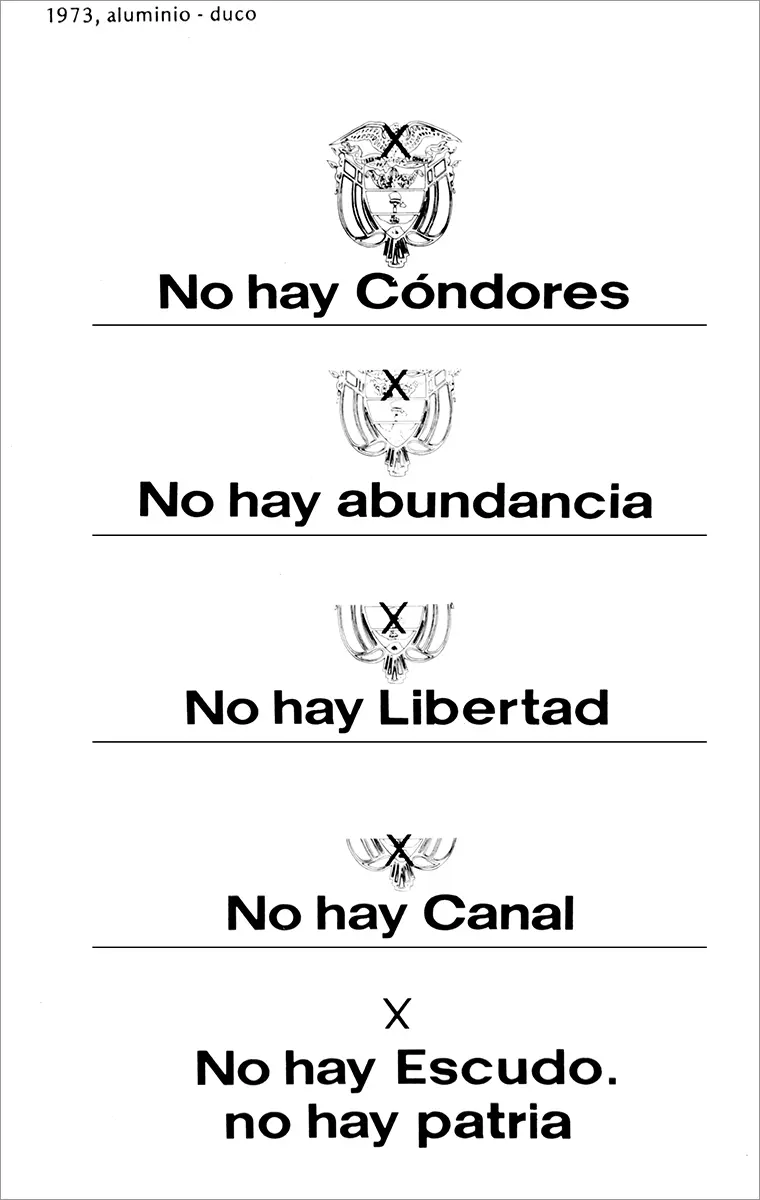
Three works that refer back to the beginnings of conceptual art in Colombia were also presented. Conceptual art, the first mode of artistic expression to abandon purely formal principles, possesses a clearly political intention. A pioneer work in this sense is Bernardo Salcedo’s Primera lección of 1970, a five-panel, serigraph on wood, billboard. In each of the panels, or bodies, Salcedo erases one of the symbols of Colombia’s national seal; by taking away, one by one, the condors, wealth, freedom, and the channel, the artist, with subtle humor, arrives at the inevitable conclusion that there is no such thing as a Colombian seal, nor is there such a thing as a Colombian nation. The different parts of Salcedo’s work were spread throughout the Museum of Modern Art, so that the visitor’s itinerary would begin and end with it. People were induced to remember the parts and recreate the whole before exiting the show. Also on display was Alfonso Caro’s Colombia, where the word “Colombia” is written in Coca-Cola lettering against a red background, just like the logo of the famous brand of soda. For its play of language and image, this work became one of the most memorable of the late 1970s. Also present was Río Cauca, by Alicia Barney, an interdisciplinary work created on-site and in collaboration with a biologist; Barney and her collaborator collected water from several points along the river and tested the contamination levels caused by the presence of nearby industrial complexes, especially oil refineries. Ana María Lozano points out that in these works, as in the whole of Barney’s oeuvre, the practice of art engages in a political reflection and makes political statements, and the artist’s intentions move beyond formal aspects.
Feliza Bursztyn’s Cuja is a point of reference in the history of Colombian sculpture because it was created at a moment when abstract sculpture was consolidating its position in the country; in 1968, Bursztyn not only used discarded materials but employed a bedframe to create an object with erotic connotations, rather than a sculpture in the conventional sense. With this clever and irreverent work, Feliza Bursztyn opened up new territories for Colombian art, territories that were more closely associated with the spirit of French New Realism, and signaled a distancing from the principles of modern art.
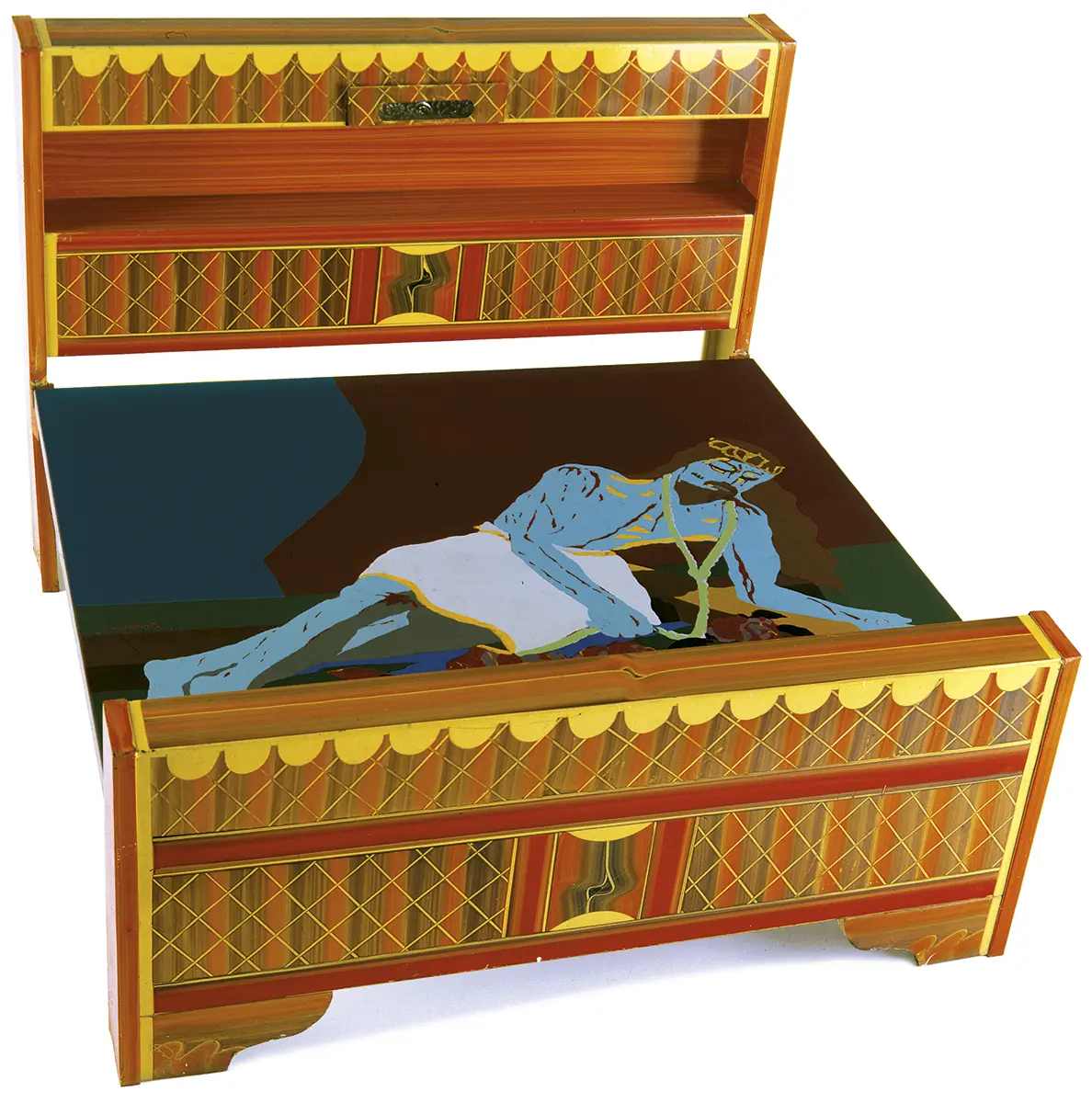
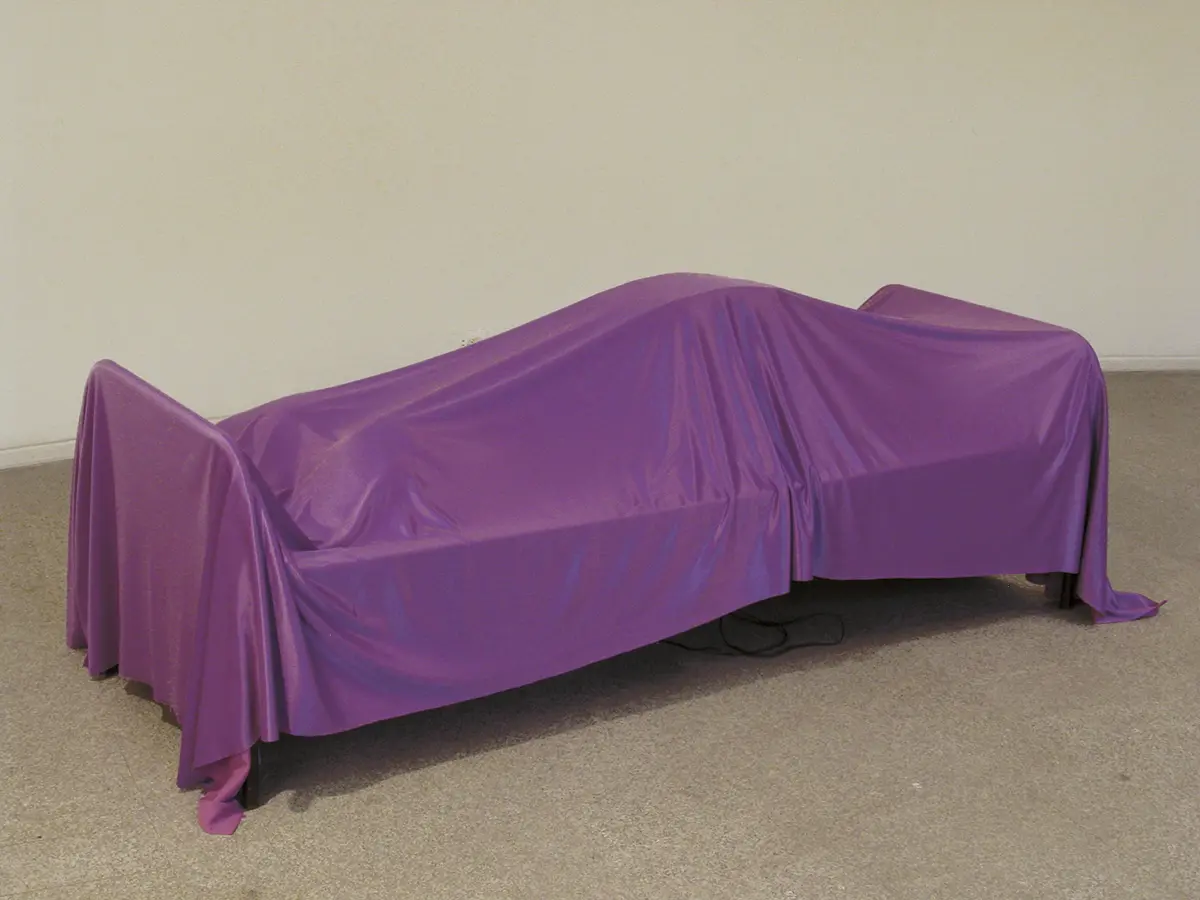
Beatriz González’s furniture, like her other works, is without a doubt an important marker in the history of Colombian art. For the Biennial, her Naturaleza casi muerta, a work in three dimensions that can nevertheless be categorized as a painting, was selected from the Museum of Modern Art collection. Naturaleza casi muerta is a metallic bed of the kind sold in mass-market stores, such as those of the famed Pasaje Rivas,6 on which a scene of the fallen Christ has been painted with polish. The title (Almost-Still Life), the support, and the iconography create a conceptual, humor-laden game in a spirit similar to that of Salcedo, Caro, and Bursztyn.
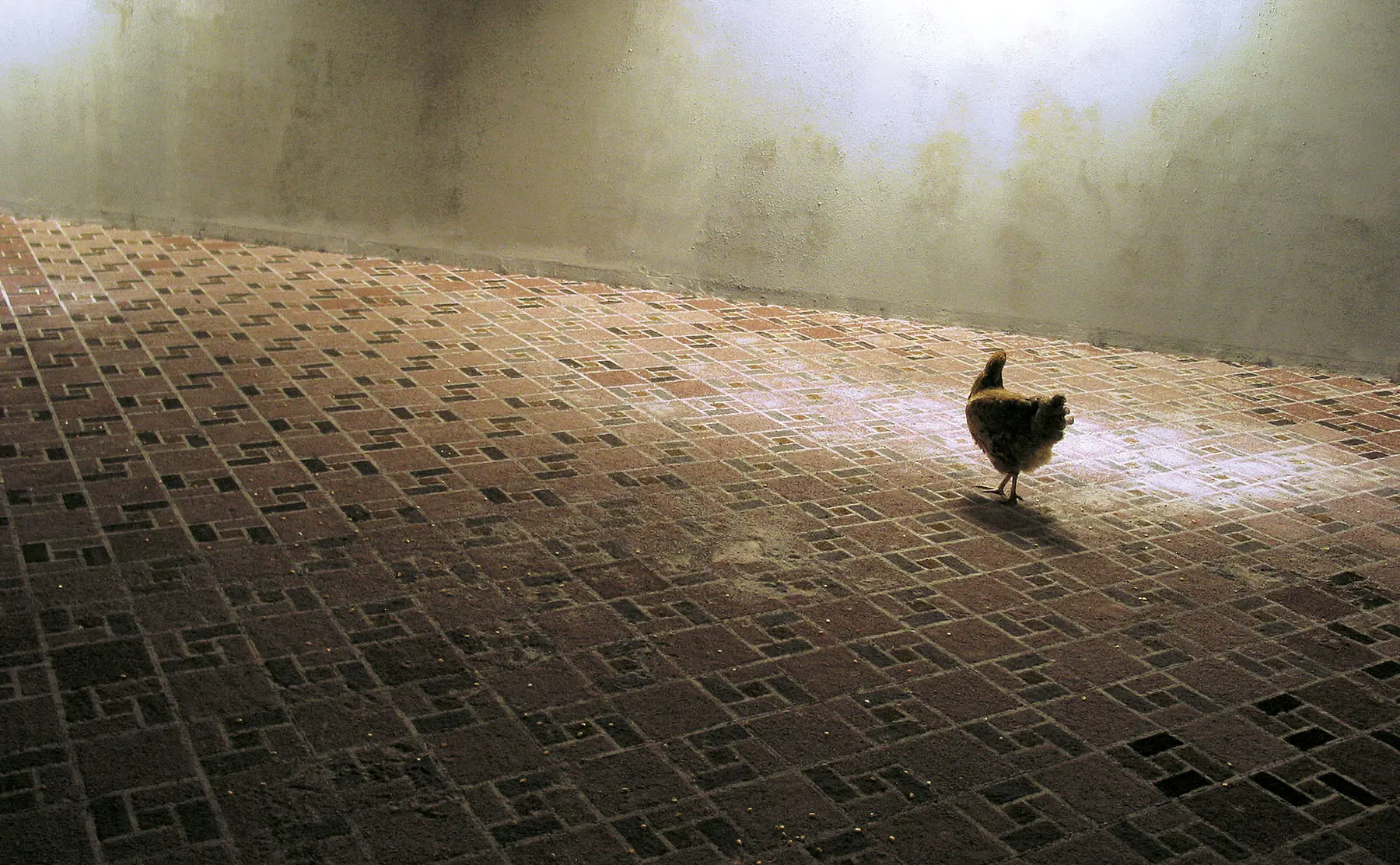
A new generation of artists working in the drawing genre emerged in the 1970s. Miguel Ángel Rojas and Óscar Muñoz belong to this cohort. These two artists have created many remarkable works, among which are Muñoz’s shower curtains. The Biennial selected Grano by Rojas, the first installation ever made in the history of Colombian art, and Aliento by Muñoz, which foregrounds the role of the viewer through a special mechanism that activates and completes the work. For those of us who saw Grano in its original 1981 incarnation, this hyper-realist representation of a tiled floor, drawing on the actual floor of the Museum of Modern Art’s Project Hall, had a lasting impact and pointed towards new possibilities for the art of drawing, beyond the use of paper as its only support. For the new version, Miguel Ángel Rojas uses reddish pigments instead of the original gray sands, but, like the latter, the pigments were taken from the artist’s native region. Óscar Muñoz’s Aliento was created for the Fifth Bogotá Biennial in 1997, and it is a work that can only be completed (thus, created) when the viewer approaches a set of steel rings and exhales on them; this action briefly makes visible a series of photographs taken from newspapers that are superimposed on the viewer’s face as it is reflected by the piece’s shining surface. The photographs show the faces and some information about people who have disappeared. The Biennial also included, as historical referents, two installations by Danilo Dueñas and Nadín Ospina that explore the contemporary situation of the work of art itself. As Ana María Lozano states, Fausto, the installation by Nadín Ospina takes away the notion of authorship from the work because it has been created from the fragmentation of another artist’s painting, Carlos Silva’s.
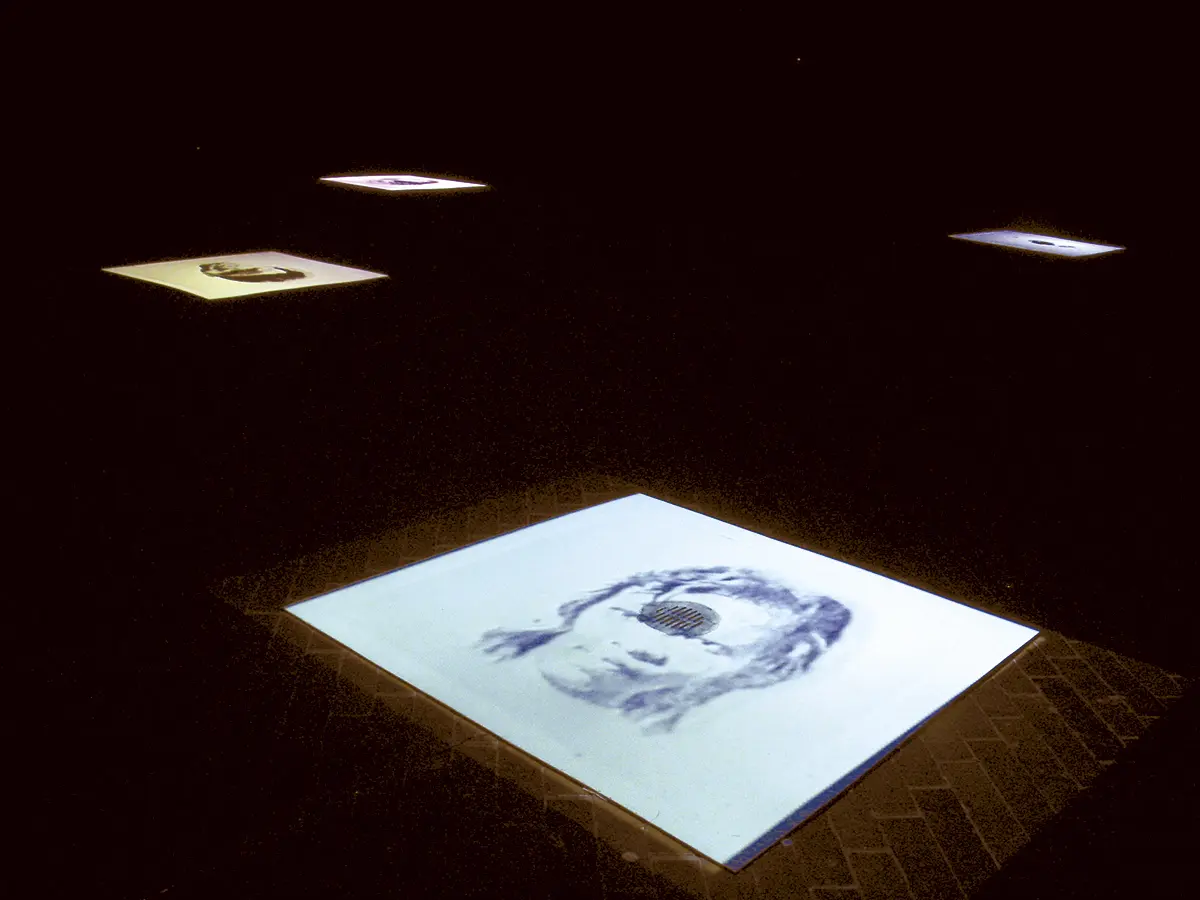
Besides being represented in the historical section, Miguel Ángel Rojas and Óscar Muñoz were also selected to show their recent work. The curatorial committee chose Rojas’s Nowadays (2000), which had already been shown at Galería Valenzuela y Klenner. It can be thought of as a drawing created from small circles of coca leaves, arranged to spell out the title of one of Pop Art’s most important works: Just What Is It That Makes Today’s Homes So Different, So Appealing? Again we find a use of language that, as in the Coca-Cola piece by Caro, speaks about Colombia through a foreign reference. Óscar Muñoz’s Biografías is an installation of five video-projections on the floor, at the center of which a drain has been placed. Images of anonymous faces are projected on the drain, to slowly dissolve and become nothing but a stain that disappears as sound emphasizes the image’s dramatic dissolution. This work continues an interest in the disappearance of the image already explored in his Narcisos, and not unrelated to what happens in Aliento.
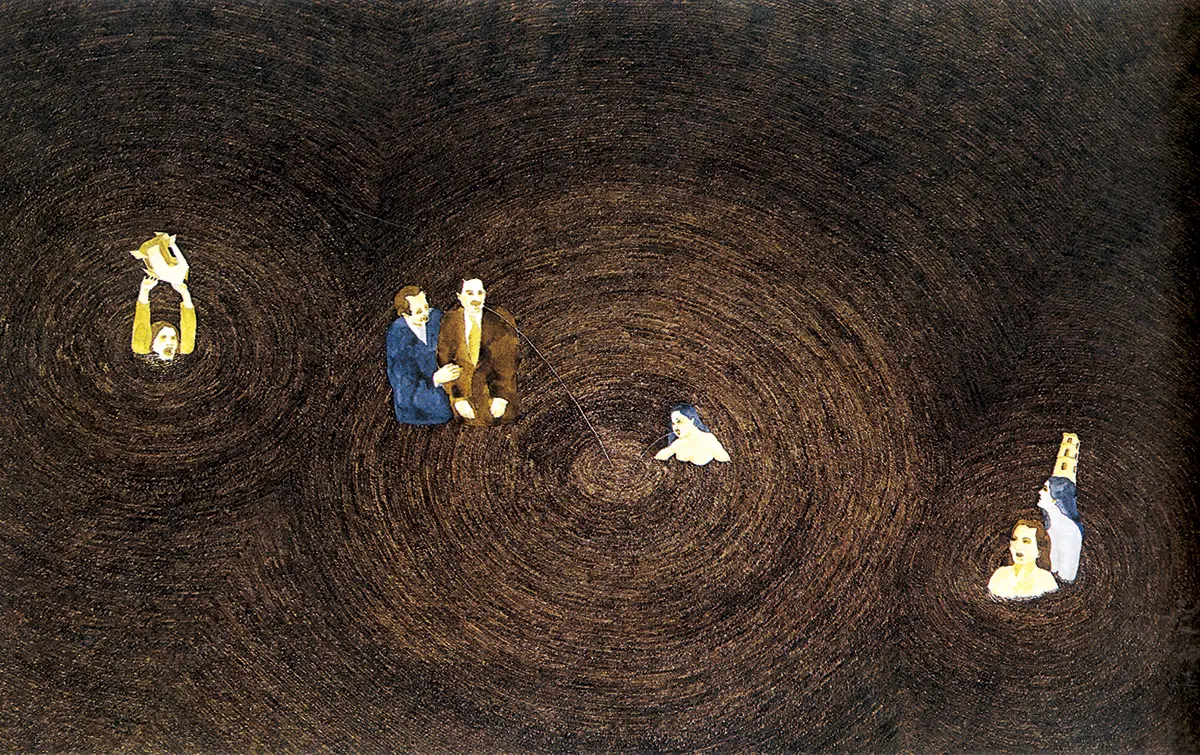
Johanna Calle, who like Muñoz often uses images taken from newspapers, had two works on display. At the Museum of Urban Development, she showed a group of drawings created with the imprint of wire on casein, very delicately showing the faces of children and adolescents who appear to sleep surrounded by what seem to be halos. It is impossible to determine whether these children, who in Colombia are subjected to mistreatment and abandonment, are really asleep or dead. At the Museum of Modern Art, Calle showed a long series of watercolors showing people outdoors carrying domestic objects and children in their arms to save them from floods—images that can be seen daily in the news and in the papers, as floods destroy villages and neighborhoods.
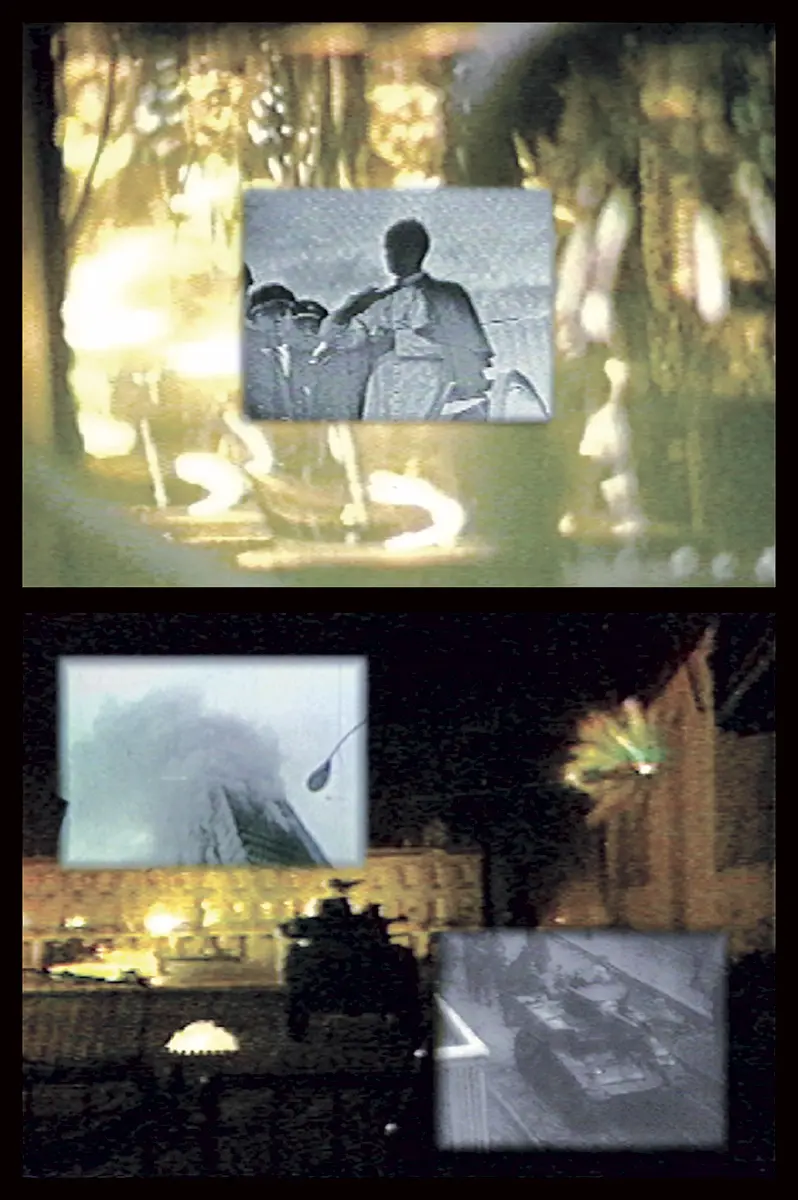
Andrés Burbano and Wilson Díaz used very different strategies in their video works, yet both pieces were very effective in showing different aspects of the Colombian conflict. In Sinfonía de entropía, a collaboration with Freddy Arias, Burbano does a sophisticated editing job to alternate images of various tragic events in the history of the country. Wilson Díaz’s 2002 video Retrato moves beyond the urban context and into rural areas. The artist traveled to the “peace zone” of Caguán and interviewed a young guerrilla, who gives us a spoken picture of his situation while Díaz creates an “academic” picture, a pencil-on-paper portrait that resembles the subject.
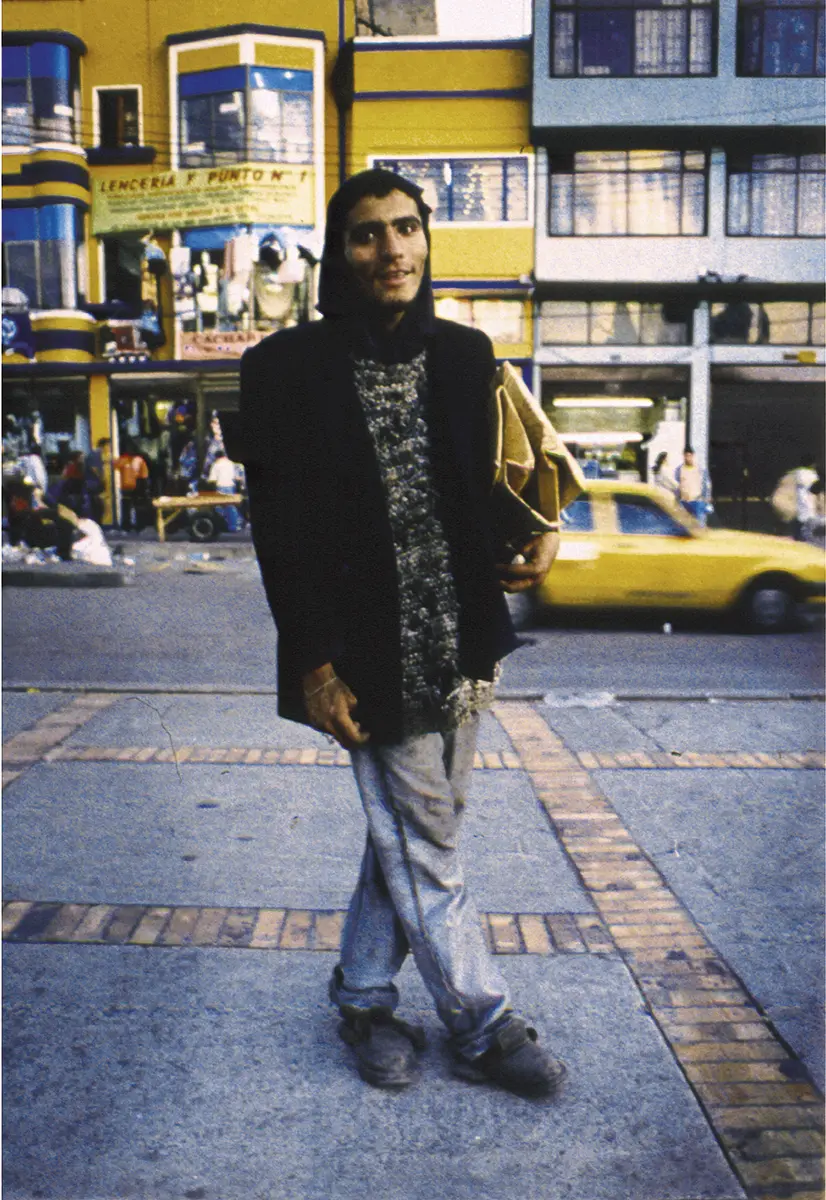
Jaime Ávila’s work, La vida es una pasarela, alludes to the city of Bogotá. It comprises eleven pairs of photographs, each pair presenting on one side the image of a street character and on the other a view of a lonely, shady city street; in every case, the second photograph was illuminated with the creation of small punctures through which light was made to pass. The light was sometimes red, sometimes yellow, and sometimes white. The street characters are in effect posing for Ávila’s lens, turning the street—the location of the harshest lives—into a sort of catwalk (the pasarela of the title) in which everyone shows off their ragged and dirty attire. Continuing with a series that looks at life in the city, Giovanni Vargas presented a mannequin created in collaboration with Juan Mejía. It is yet another street character, life-size, made in wood, and dressed in real-life clothes, holding in his hands a glass jar containing a strange-looking organ of animal or human origin—the viscous liquid that fills the jar doesn’t let us know exactly what it is. Now and then this character breaks into song but his words are as indecipherable as the jar’s contents. His presence is tremendously disquieting. The piece is titled Eufemismo, a term that implies a way of expressing in a soft, decorous manner an idea that is much harder. Vargas’s character moves between terror and tenderness, but we all understand that it refers to situations of grief, pain, and abandonment.
Delcy Morelos, Marco Mojica, and Ethel Gilmour were also present with paintings. Photography also had an important place in this Biennial, for instance in Gloria Posada’s installation, which creates a map of territory from the digitally amplified image of a displaced woman’s hands; or in Pablo Adarme’s work, where the artist is his own model in a chronicle of disaster; or in Marta Amorocho, who uses photography to refer to a body wounded by a needle; or Andrés Duplat, who ponders the containers of the gasoline that people in the countryside and in the city’s poorest areas use for cooking; or Javier Tarazona, whose interesting installation titled Subdesarrollo included an image of banana leaves magnified to their life-size proportions so that put to dry in front of two flimsy electric fans, they would initially confound the viewer with the illusion of reality.
The Tintal and Tunal libraries held two group projects. In the Tintal library, we saw Echando lápiz, a piece by Manuel Santana and Graciela Duarte that explores the relationship between nature and the city, focusing on those “cultural assumptions” that various representations of nature imply. This piece, like others by Manuel Santana, is “an attempt to revitalize and expand the function of art,” according to Jaime Cerón.
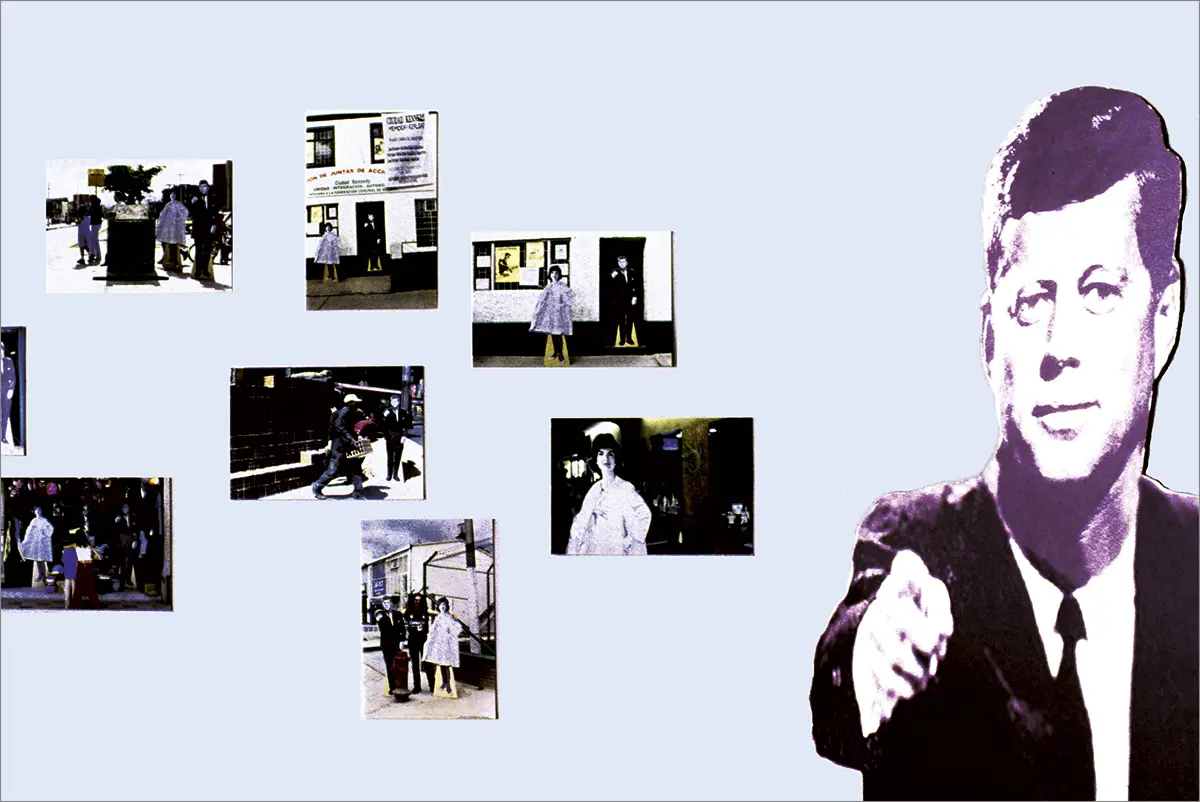
One of the most interesting works of the Biennial, shown at Tintal, was by the Proyecto colectivo de creación plástica group under the direction of Raúl Cristancho. The piece, titled Ciudad Kennedy memoria y realidad was financed with a fellowship from the District of Bogotá Research Institute, in cooperation with the National University. Ciudad Kennedy memoria y realidad starts with the reality of the Kennedy neighborhood, founded by U.S. president John F. Kennedy as part of the Alliance for Progress in the 1960s. The very existence of the place is a political fact related to social issues, and today is a part of history. The group of artists included both students and recent graduates from the National University, who sought to explore the memory of the neighborhood people, with the image of President Kennedy and his wife still vivid among the oldest of them. The result was a video that contrasts the “then” and “now,” and an installation showing how in the very décor of the neighborhood houses, the memory of John F. Kennedy is kept alive through photographs, figurines, plaques, and pictures. Other members of the group worked on a photographic record of the transformation of the neighborhood façades, the quality of its interiors, and the influence of Jacqueline Kennedy’s visit on the fashions among the neighborhood women. There was also an investigation on family albums. The project was initially presented in a neighborhood home, which allowed for a real interaction with the community, and activated the notions of identity, reality, and memory.
The catalog discusses the politics of the Biennial in essays by each of the four curators.
NOTES
1. Ana María Guash, Los manifestos del arte moderno, textos de exposiciones, 1980 - 1995 (Madrid: Ediciones el Akal, 2000).
2. Ibid., p.5.
3. Hal Foster, El retorno de lo real (Madrid: Editorial Akal, 2001).
4. Jaime Cerón, Pulsiones, síntomas y señales del arte colombiano en un nuevo siglo, catalog of the Eighth Mambo Art Biennial, Bogotá, 2002.
5. Ana María Lozano, Desde el arte y hacia lo real, catalog of the Eighth Mambo Art Biennial, Bogotá, 2002.
6. Pasaje Rivas is a traditional shopping area located in downtown Bogotá where furniture, clothes, and merchandise can be found at very reasonable prices, and where many objects of popular origin are also on sale.
MARTA RODRÍGUEZ
Professor in the College of Arts at the Universidad Nacional of Colombia, Bogotá.