In Elías Toro’s recent works, an interest developed over several years has been condensed in the figure of the juggler. Toro’s exploration of circus-like farcical situations is expanded now with the protagonist role given to this character, who has also been evoked in different periods of history, art, and literature.
An architect by profession and a teacher by vocation, Toro has been active for many years in the visual arts —in architecture, of course, and also in drawing, painting, and sculpture. Yet, it is through the techniques of sculpture that the artist has developed most of his expression. Inspired by archaeology and ancient myths, Toro has experimented with carved zoomorphic figures, and the female figure has also been prominent in his work. Toro’s bronze-and-cement female figures describe playful poses that are infused with a subtle everyday quality. His family groups of men, women, and children are similarly expressive, in their silent solemnity, of the solid strength that is found in the sculpture’s three dimensions. In his brief sojourn into painting, Toro showed a special interest in the qualities of light and the translucency of color, reinterpreting in a very personal manner the traditional theme of the still life, as we saw in his 1998 show Fuga en mí.
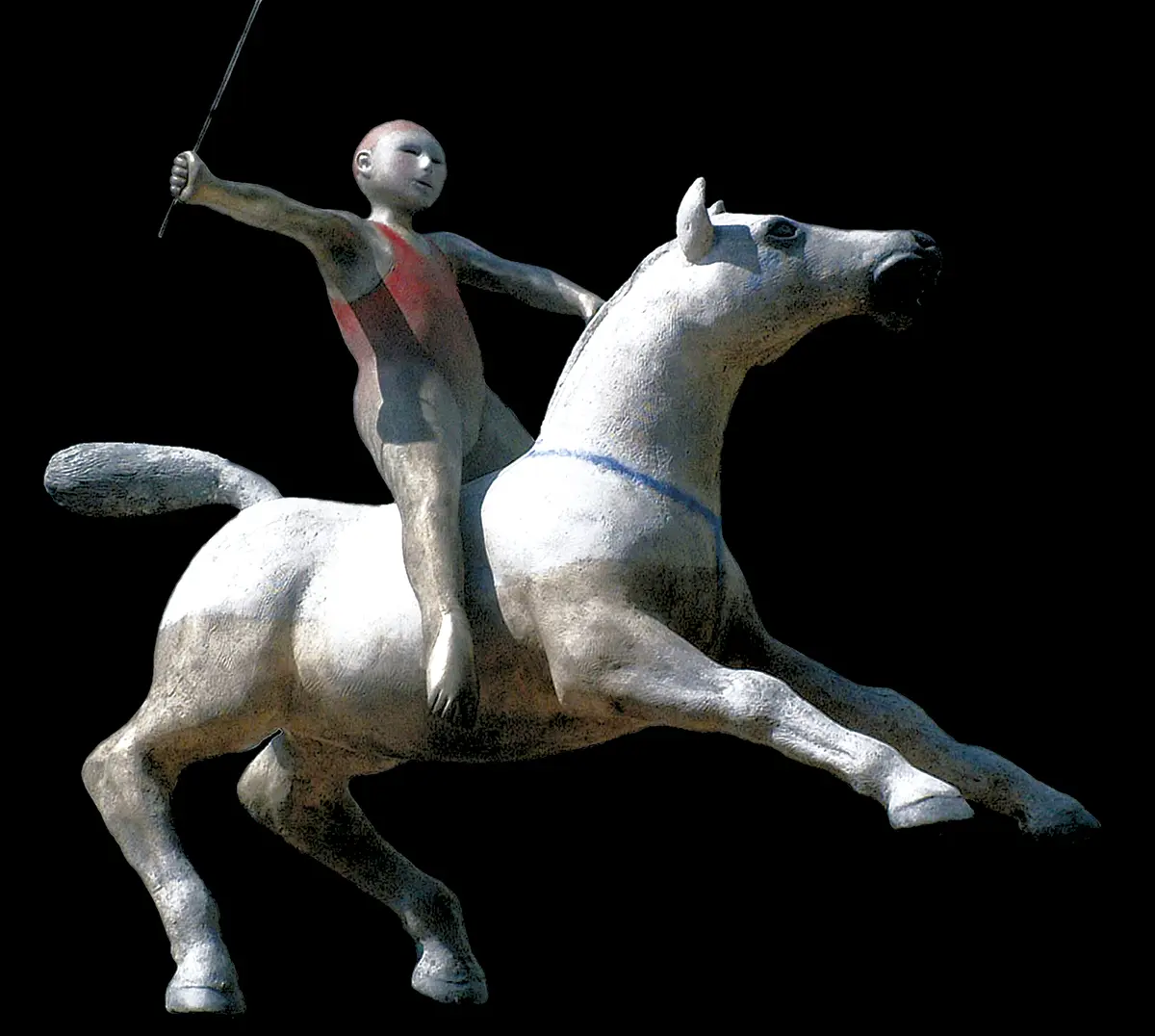
His interest in the human figure, that universal staple of the arts, has only deepened with time. This was confirmed by his 1999 exhibition Escultura polícroma, where the exploration of textures, colors, and materials acquired a corporeal character, emphasizing the reference to the circus. The theme, however, is a recent one in Toro’s career, and it has served as an inspiration to represent and denounce human comedy, characterized by the duplicity of the mask and the hubris of self-regard. Toro has distilled his forms, simplifying outlines and expressions and giving high priority to movement; through agile acrobatic flights, he attempts to represent the fragile balance of the Human Condition.
The juggler is presented now in a variety of poses: sitting with an umbrella in his hands, riding a horse, performing difficult aerial stunts. The figure’s playful and histrionic qualities make it irresistibly appealing to the viewer. Associated with the figure of the acrobat, the tightrope walker, and the puppeteer, the character carries different symbolic connotations. Liberated from the constraints of convention, the juggler inhabits a world outside the boundaries of our social order, potentially becoming an emblem of absolute freedom. As a tightrope artist, his stunts are resolved in a heroic climax that defies truncated situations; this is why the figure is seen as a symbol of “critical balance” as well as a “factor of progress.” But this picturesque character, so ingrained in our imagination, represents not only the burlesque but has in the past been interpreted in a moralizing sense: it was placed in the façade of churches as a warning against perdition since his performance would distract the public from the adoration of God. In this sense, the performance of Toro’s juggler seems designed to distract us from our overwhelming daily routines, bringing us closer to a spirit of playfulness. Yet the meaning that Juan-Eduardo Cirlot gives this character in his study of symbols (Diccionario de símbolos, Editorial Labor, S.A. Barcelona 1981, p. 51) would seem to justify the juggler’s sudden, seemingly inexplicable reemergence in today’s world. Cirlot defines it thus: “Because of his pirouettes and somersaults, which frequently change the normal position of the body, standing it on its head while the feet are flung upwards, the acrobat [or juggler] is a living symbol of inversion; this is to say, of the need that arises during any crisis (be it personal, moral, collective, or historical) to turn the ‘normal’ order of things inside out, turning idealism into materialism, passivity into aggression, peacefulness into tragedy, by disorganizing what was organized and vice versa...”
GLADYS YUNES