Photography has the virtue of showing us a slice of reality and supporting the veracity of a given fact; such is its primordial essence. It has value as a document if that is what we have chosen to do with it, and it allows us to learn or, given the case, to re-learn part of geography, history, or the context that surrounds certain specific subjects, among other things.
This is the case with Paraguaná. Herederos del viento y del sol, an exhibition opened in late 2002 in the Proyecto Centro Nacional de la Fotografía, before the regrettable death of its author, Félix Molina. Paraguaná, a peninsula in the Northeastern part of Venezuela, where South America begins, is characterized by its arid climate, its large and solitary plains, and its difficult environment of sun, sea, and dryness. Molina came from this region, and it was a frequent reference in his work.
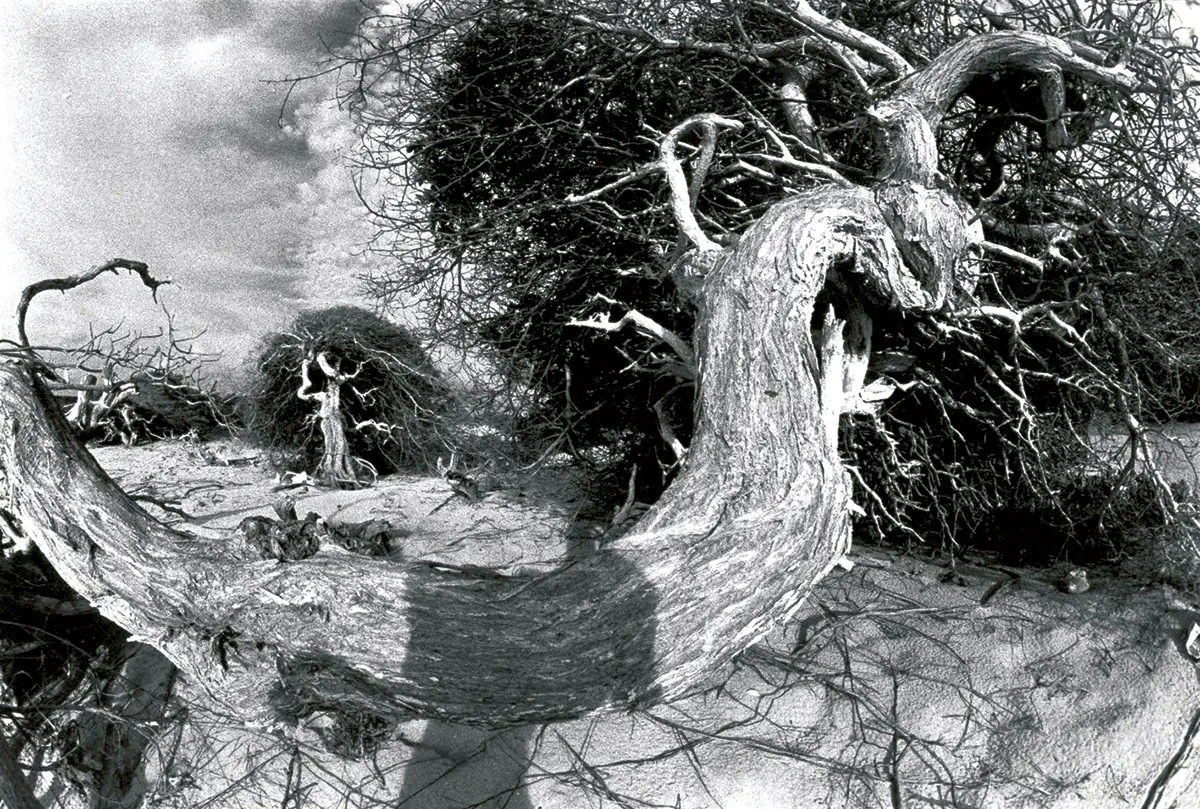
The series Paraguaná. Herederos del viento y del sol began formally in 1977, although Molina had been working on it internally after a series of visits to the region starting in 1959, after graduating as an architect in Caracas. Reunited with the region's people, with his own memories, and with the scenery of his childhood, Molina was able to create images of an intensely intimate character. These images are a faithful record of the real—to the point that the series is considered among the best of Venezuelan documentary photography—but it needs to be pointed out that, more than a mere register of facts, they constitute a kind of lived photography, made on the basis of the artist's own re-discoveries and internal processes. Paraguaná. Herederos del viento y del sol partakes of Molina's visual memory. Aware of the fact that the peninsula, and the state of Falcón as a whole, capture the visitors' interest with its special aura, Molina gives the viewer a fuller impression of the region in his photographs. In this way, his private memory becomes a collective, social one. It was in consideration of this that in 1981 Molina received the Photography Award given by Conac.
Molina's photographs possess the "flavor of the real." Their underlying poetic character is made manifest in the way each environment is delineated through contrasting lights. Molina's images of interior spaces and the characters that inhabit them (Manuel Ángel Molina, Caya, Alberto Díaz, etc.) are beautiful thresholds of light, something characteristic of and unique to his photographic style. Molina highlights, in the same vein, large and ample atmospheres as a way of expressing the vastness of the surrounding geography (Salinas, El Calvario, Chatarra), or the vastness of modern technology, as in the aerial view of the Amuay Refinery in Punto Fijo, Paraguaná. It is not in vain that Venezuela's landscapes, and in general its geography, have been so important in the work of so many of the country's greatest artists, as well as among foreign artists who have traveled through it. Molina, however, achieves a personal style. His use of wide-angle lenses allows him to distort the image and condense the largest possible number of elements in one frame. This reinforces the intimist nature of his affecting and engaging images.
The intimate character of Molina's work deepens when we learn that at various points the artist expressed that "man is his natural surroundings." This idea needs to be understood in its most profound implication: that the people inhabiting those desolate, austere landscapes are, indeed, part of the landscapes themselves. There is no distance between the landscape and the people. Goya, the sheepherder, is part of the region's history. In the throes of death, her limbs resemble branches of a dry cují. Absent, she remains in the environment's dryness, in its arid nature. We find similar relationships in images such as those of Caya and Mangles. Visions like these support the magical connotation that has been so often presented in Latin American literature.
The value Molina placed in rural reality was so profound that he never tried to impose on it an urban, more cosmopolitan vision. He never used his camera from a point of view situated above his subjects. According to Molina's own words, that would have been to adopt a disrespectful attitude towards the countryside. On the contrary, Molina places characters and scenes at eye level. Photographer and subject are equals, and the images capture the respect that reality always deserves.
SUSANA BENKO