We are tempted to think of Graciela Sacco’s work as infectious, an epidemic of powerful images that spreads from the private space to the public sphere, from the galleries to the streets, and from the walls to the skin. Her images seem to sprout from discarded objects and walls to confront us, tell us stories, and force us to acknowledge their silent and perturbing presence. While avoiding any formal narrative, the art of this photographer, professor, and scholar, born in Rosario, Argentina (1956), seems to navigate that no man’s land is situated between the domain of the aestheticization of politics and the politicization of art. Her poetic compositions are meditations on social struggles and social defeat, utopias and repression, suffering, rage, and despair. Far from being didactic or moralistic, Sacco’s work does not serve any ideology, nor does it preach, offer ready-made formulas, or dwell on the victimization cult, an indispensable element of propaganda. To deal with the heaviness of these subjects, she basically only uses light and shadows. Her most recent show, at Donald Taglialatella’s itinerant World House Gallery, included a selection of prints and luminous graphic environments from some of her newer series.
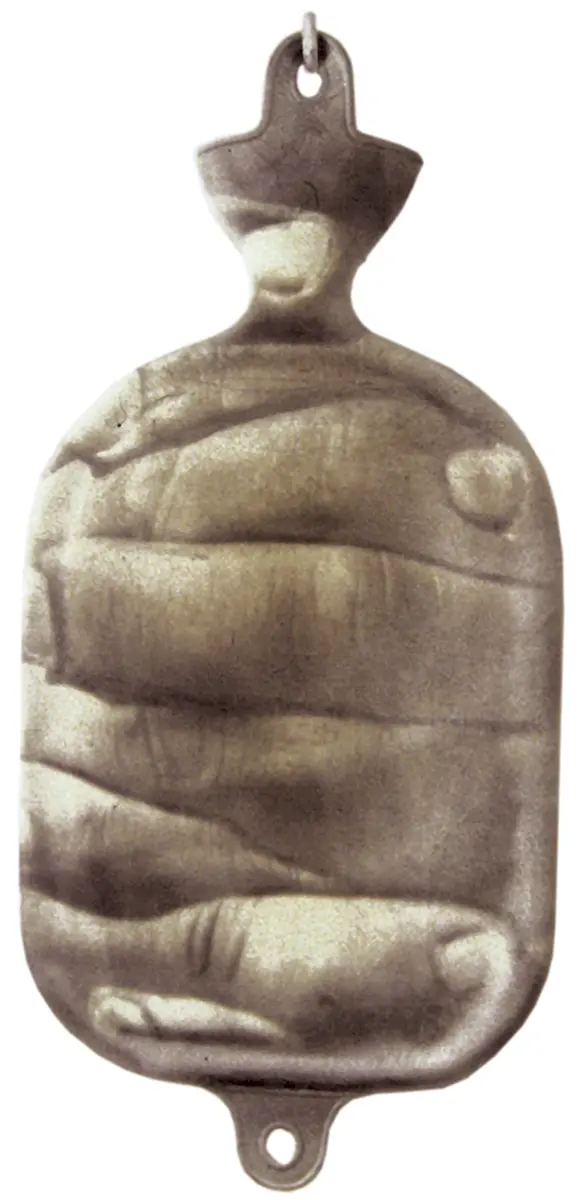
At a time when the trend in photography is to embrace the digital and abandon the darkroom, Sacco has reinvented photography by adopting, researching, refitting, and improving an ancient technique called heliography, literally painting with sunlight, a variation on cyanotype that consists of spreading a photosensitive emulsion on a surface and exposing it to light. Sacco is the author of the book Escrituras solares, 1994, in which she defines the historical and critical aspects of a technique that commercially has been relegated to making copies of architectural plans. In her work, she uses a controlled light source instead of the sun in order to get the very precise qualities she requires for her prints. By these means, any surface can become a canvas for her images, and Sacco is able to transfer images to old book covers, suitcases, Venetian blinds, water bottles, discarded wooden sticks, plastic, glass, and all kinds of found objects. No surface is safe from her reminders of social injustice, and indeed, the technique itself could be a metaphor for invasion, occupation, and colonization. Sacco’s political commitment appears to be, first and foremost, to keep alive the memory of the victims of totalitarian regimes and interventionist adventures, especially those who lived through the terrifying and dark days of the military dictatorship in her country. But her work also addresses the suffering of the victims of cruel bureaucracies and the pain of those who survive dysfunctional and sadistic relationships.
Sacco’s work consists of creating intense metaphors by recreating reproductions and twisting their meanings; establishing a dialogue and contradictions between content and form; and considering space as an integral part of the work. She uses appropriated newspaper photographs as well as her own photographs. By not crediting the images she borrows, she emulates the anonymous impersonality of the mass media and its formidable power to fuse news and myth, to blur distinctions between information, publicity, and entertainment, as well as to manufacture history according to its ideology and interests.
In the same way that Sacco rescued heliography, she also contributed to giving new meaning to other apparently outmoded forms like mail art and street interventions, where art slips into the “outside” world. This artist has brought street protests, the homeless, and the disenfranchised into the gallery. On the other hand, she has also infiltrated the domestic space and assimilated the lessons of the Situationists to compete against the relentless visual stimuli of publicity and propaganda in order to challenge their hegemony in public spaces with her urban interferences. She prefers that term to the more common urban interventions, “because it is a matter of a minimal, visual vibration that nonetheless never goes unnoticed.” These interferences usually take the form of posters placed alongside street ads that assault the unsuspecting public. So the street revolts of the past reappear in a spectral form as imprints of history, or as Sacco puts it, “the dematerialization of objects, materializes images.”
Some of her most revealing pieces are heliographies printed on found pieces of wood, from the series Cuerpo a cuerpo. Here we have images of popular demonstrations from the past, some easily recognizable as belonging to the May 1968 riots in Paris, each delicately printed on several long and thin planks of wood. The causes and claims of the mostly unknown demonstrators seem distant. The details of the struggle may be perceived in the process of fading away, but their hardened gazes, defiant poses, gestures, and body language are universal expressions of courage, determination, and hope. Sacco questions the present by exposing the latent, never-satisfied demands of justice. These ghost crowds are the remains of a lost world of unfulfilled political dreams. Nevertheless, the fact that the installation is made of individual pieces, which like a fragile puzzle, can easily be blown away, serves as a metaphor for the ephemeral nature and instability of social struggles. In other works, light passes through printed glass to project shadows on the walls and creates the illusion that the people in the demonstrations are either expanding or dispersing. The crowds and even individuals are fragmented into strips as if they are being forced through a shredder. Sacco does the same thing to parts of the body by isolating eyes, mouths, hands, and torsos, and using them as symbols for hunger, surveillance, alienation, abuse, and so on. These pieces can easily be modified or altered, in the same way, the historical document can be falsified or distorted, just as our memories themselves inevitably change with time. Sacco’s work may be confused with romantic and even decorative nostalgic pictures, but in these turbulent times, it also evokes the absolute horror of the atomic bomb. Her images are reminiscent of the thousands of people who, in a fraction of a second, were reduced to prints on the walls and ground. Sacco’s work establishes a circle from heliography’s life-giving alchemy to annihilating thermonuclear light.
NAIEF YEHYA