

The New Museum of Contemporary Art in New York presents a first viewing of Hélio Oiticica’s Quasi-Cinemas environments, including some Cosmococa pieces.1 Produced in the 1970s during his nearly ten-year sojourn in New York, the pieces continue Oiticica’s exploration of body and space, and body in space. Added to the echoes of the sixties drug culture are new elements suggestive of the influence of U.S. filmmaker Jack Smith. In fact, the title of the works is a reference Oiticica once made to a slide-sound performance by Smith. Though the works here are dated, they are endearing because they elicit a sense of nostalgia, but mostly, their importance lies in the fact that they complete the history and image of Oiticica as a frontier-breaking artist.
Oiticica (1937–1980) is a preeminent figure in Latin American art, not only because of his influence, both during his life and after his premature death, but also for the strange way in which very different traditions converge in his work. He started from a rarified constructivist aesthetic, but even as he inserted himself seamlessly into Brazilian high culture, he nevertheless managed to break down barriers between “high” and “low” culture, between art and everyday life.
Like Lygia Clark (1920-1988), an artist so close to him in interests and spirit that the work of each of them can sometimes only be understood in reference to the work of the other, Oiticica inherits the twin legacies of Brazilian constructivism and Concrete poetry. But also like Clark, he rebels against them. In 1959, poet and art critic Ferreira Gullar formed the group the Neo-Concretes which aimed at a renewal of the Brazilian Concrete poetry movement. Both Oiticica and Clark joined and became part of the visual arts counterpart to the poetic production.2
Ferreira Gullar, a former contributor to the early issues of Noigandres magazine, the publication of the Brazilian concrete poets, became increasingly critical of the excessively mathematical and graphic foundation of his colleagues. “Rationalism robs the autonomy of art,” he wrote, and he proceeded to embrace the non-object as a subject, and to advocate a nationality of language. The Neo-Concretes thus started with a manifesto in which they attacked the rationalism of the Concrete movement and, in opposition to “Pavlovian mechanisms,” advocated the re-introduction of expression. Much later, in words that illuminate Oiticica’s thinking, Gullar described his poetic process as follows:
I ended up disintegrating the discourse and reducing words to obscure conglomerations of phonemes and screams in an attempt to find a less abstract, non-conceptual, non-manipulated language as close as possible to the sensorial experience of the world... After that came the concrete, neo-concrete, and, finally, my commitment to political poetry when Brazil was agitated in the turmoil of the struggle for social reform.3
Though less politically explicit than Gullar’s work, Oiticica’s production has the same aesthetic goals. According to Gullar, the non-object, an ill-defined entity, was to be “pure appearance,” but also “transparent to perception, . . . waiting for a human gesture to be actualized."4 Following the path of Dada, the painting was declared dead and the non-object was neither to have any verbal significance nor be referenced to any possible use.
“[It] is not a representation, but a concrete presence perceived on the world’s real space and not on the metaphorical background of abstract expression.”
“Without a spectator the work exists only as potentiality, awaiting the human gesture that actualizes it."5
But there was another important ingredient in Ferreira Gullar’s thought that was important for both Clark and Oiticica—a turn towards a body-ness: “We do not conceive the work of art either as a ‘machine’ or as an ‘object,’ rather as a quasi-corpus, that is, one whose qualities are drained in external relations."6
Concrete and Neo-Concrete poetry movements had a strong impact on Brazilian visual artists, those who went into the direction of performance, as well as those who integrated the use of language into their art. Neo-Concretism, much more interdisciplinary than the previous movements, generated performances and environments for which both Clark and Oiticica were crucial. Both had been inspired by Malevich and Mondrian when they first started out in the fifties, and both became the most prominent representative figures of the passage between media.
While the break with constructivist formalism in the work of Oiticica and Clark becomes clear when their own bodies and life experiences come to the fore in the 1960s, it is easy to see today that even before their Neo-Concrete period Oiticica and Clark were not really orthodox constructivists. British art critic Guy Brett quotes a revealing statement by Oiticica prompted by Malevich’s painting, White on White (1918): “The drive towards absolute plasticity and suprematism are drives (sic) towards life, and they lead us to take our BODY (to discover it) as [life’s] first probe."7
Many of Oiticica’s constructivist works, while rigorous in their geometry, hang in positions that only make sense with reference to an interaction with the viewer and so cannot be taken as the product of pure research into rationality. Both Oiticica and Clark seem to have adopted ultra-rationalist imagery to mesh rationality with subterranean forces they consider much more fundamental. In that sense, their work reminds one of the way practitioners of Santería used Catholic saints: changing form by the attribution of meanings. The disguise offers protection from contamination. In this constructivist period, the work of both artists seems to inhabit a space between hedonism and magic. The work is not presented for the viewer but happens with the viewer.8
By the mid-sixties, both Clark and Oiticica had allowed the body to completely displace geometry. Oiticica became the lead dancer of the Mangueira School of Samba (Carnival of 1964), an activity and experience that shaped his subsequent works, including the quasi-cinemas. Meanwhile, Clark shifted to an aesthetic form of psychodrama and therapy, and her objects (as far as that word still applied) became props for interaction. A collaborative piece, Dialogue of Hands (1966) sums up their respective evolutions. In it, two hands (one of each) are held together by an elastic Moebius strip (as an homage to Max Bill’s constructivist sculpture) and take on the appearance of a frozen dance.9 Paradoxically, even while honoring him, this piece also emphatically contradicted Max Bill’s principle of strict rationality. Rather it illustrated, and recycled, Brazilian poet Oswald de Andrade’s “anthropophagic” arguments made in the 1920s about the digestion and reutilization of other cultures. In their hands, the Moebius strip ceased to serve as a mathematical symbol, becoming instead an emotive, even irrational space, suggesting a circulation without end, a linking without links. These are points Oiticica would pursue in subsequent installations.
Oiticica’s involvement with the School of Samba led him to design a specific form of costume—capes—that he named and made famous as Parangolés. They were to him what Merz was to Schwitters: a supple word with many possible connections, which he invested with very private meanings (one of which was “messy situation”). Combining these garments with his neo-concrete spatial productions led to Oiticica’s next step: the construction of tents and environments that involved the public in active participation in the production. This activity reached one of its peaks with Tropicália, an installation in the Museum of Modern Art in Rio de Janeiro in 1967 that gave its name to the subsequent arts movement involving musical luminaries like Caetano Veloso, Gilberto Gil, and Maria Bethania.10
The savage dictatorship Brazil endured after 1964 led to the questioning of the paradigms of the establishment. Many of the Tropicália musicians were jailed or forced into exile, and under the new circumstances, there was ambivalence about circulating art through the traditional channels. In 1966, Oiticica summed this up by writing:
Anti-art, in which the artist understands his/her position not any longer as a creator of contemplation, but as an instigator of creation... There is such a freedom of means that the very act of not creating already counts as a creative manifestation. An ethical necessity of another kind comes into being here... since its means are realized through the word, written or spoken... This is the social manifestation, incorporating an ethical (as well as political) position [s], which come together as manifestations of individual behavior. [This position] is against everything that is oppressive, socially and individually—all the fixed and decadent forms of government, or reigning social structures... it is the retaking of confidence by the individual in his or her intuitions and most precious aspirations.11
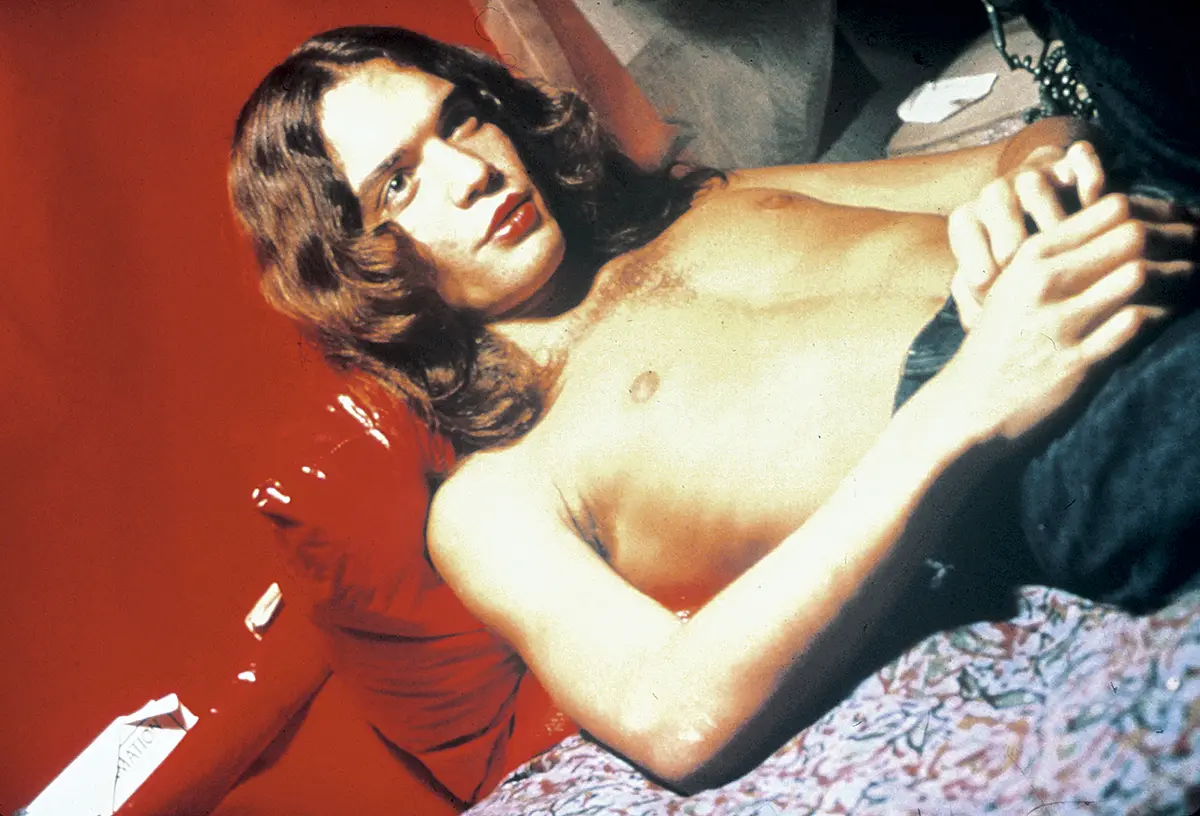
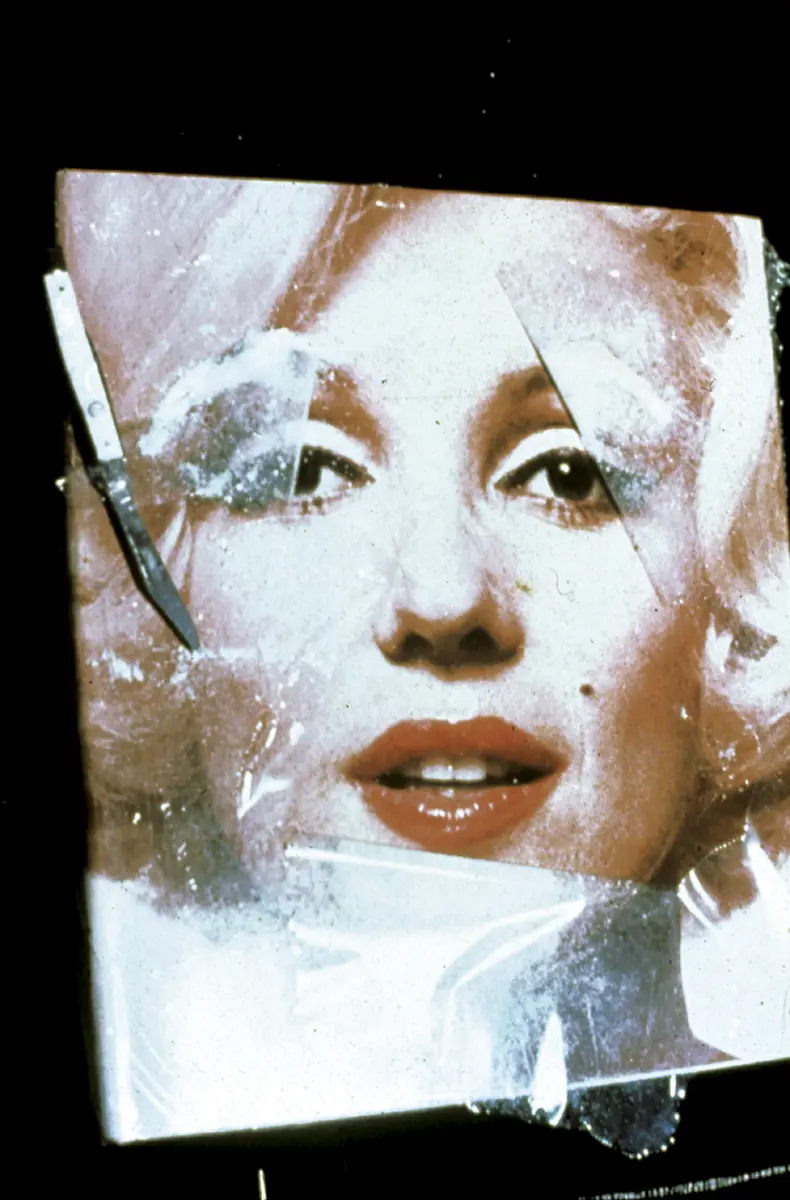
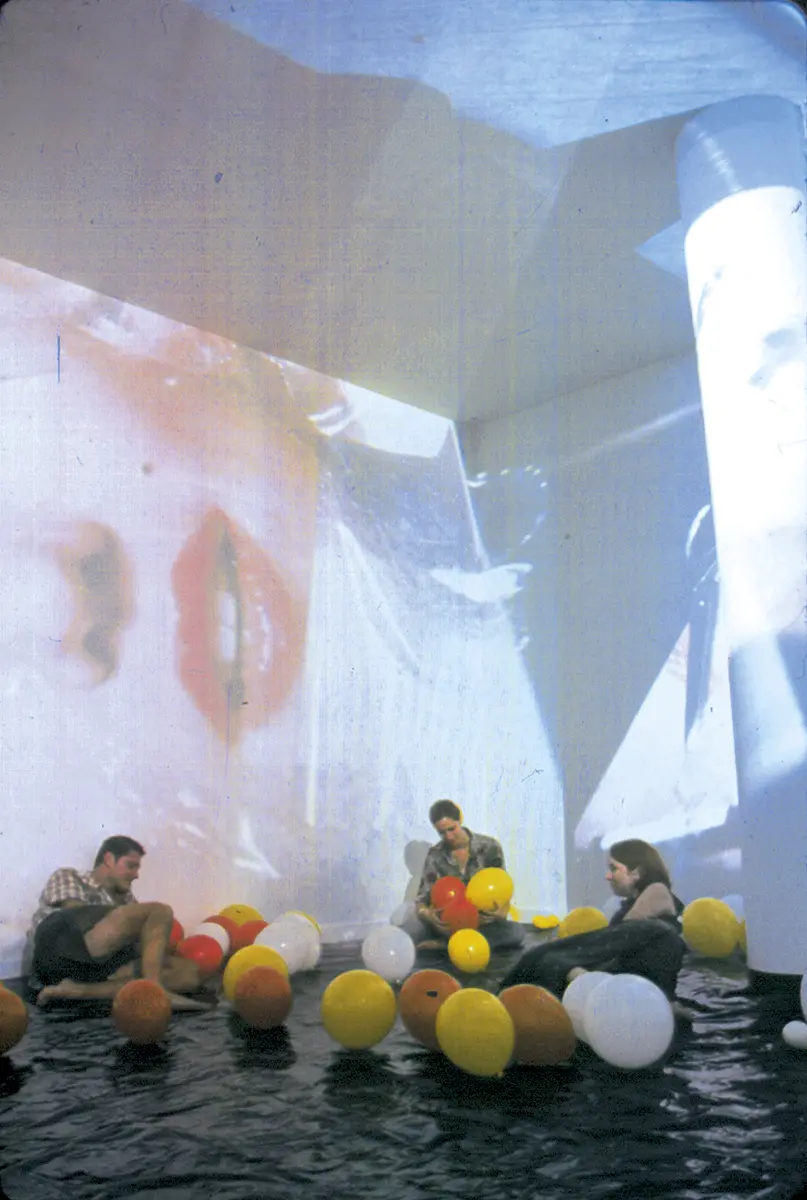
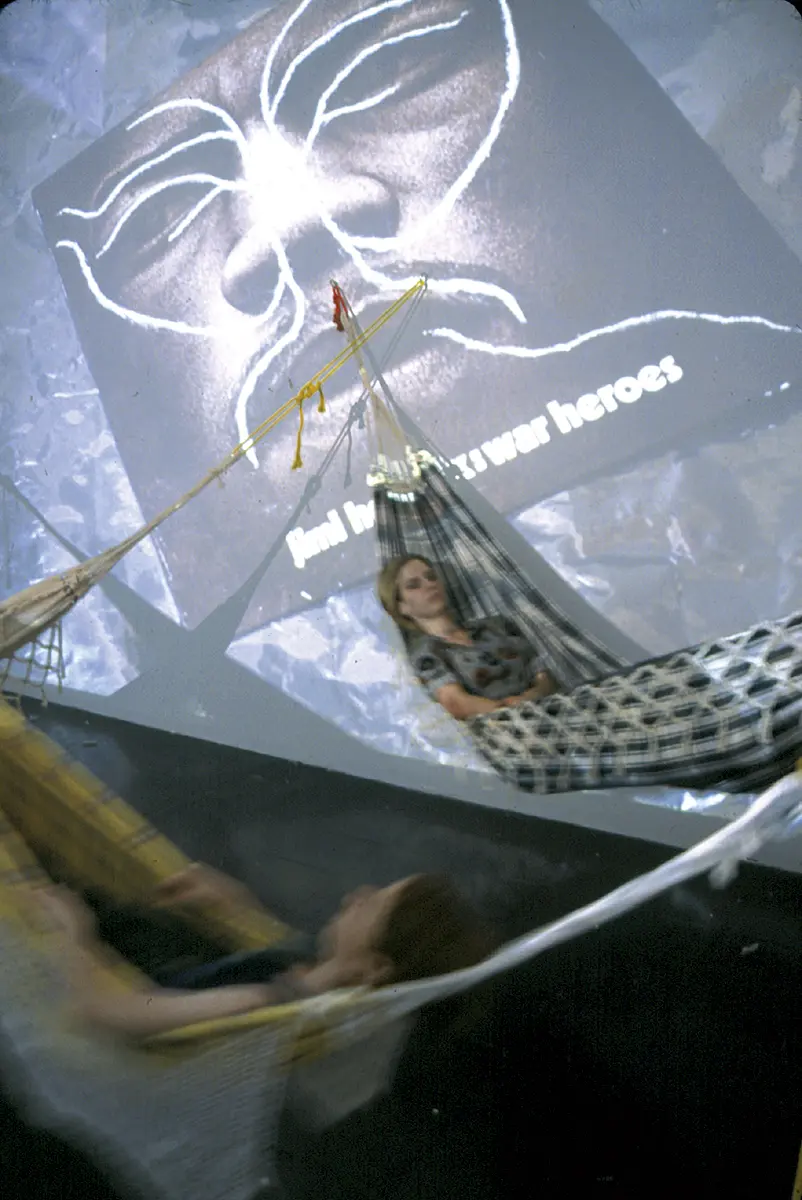
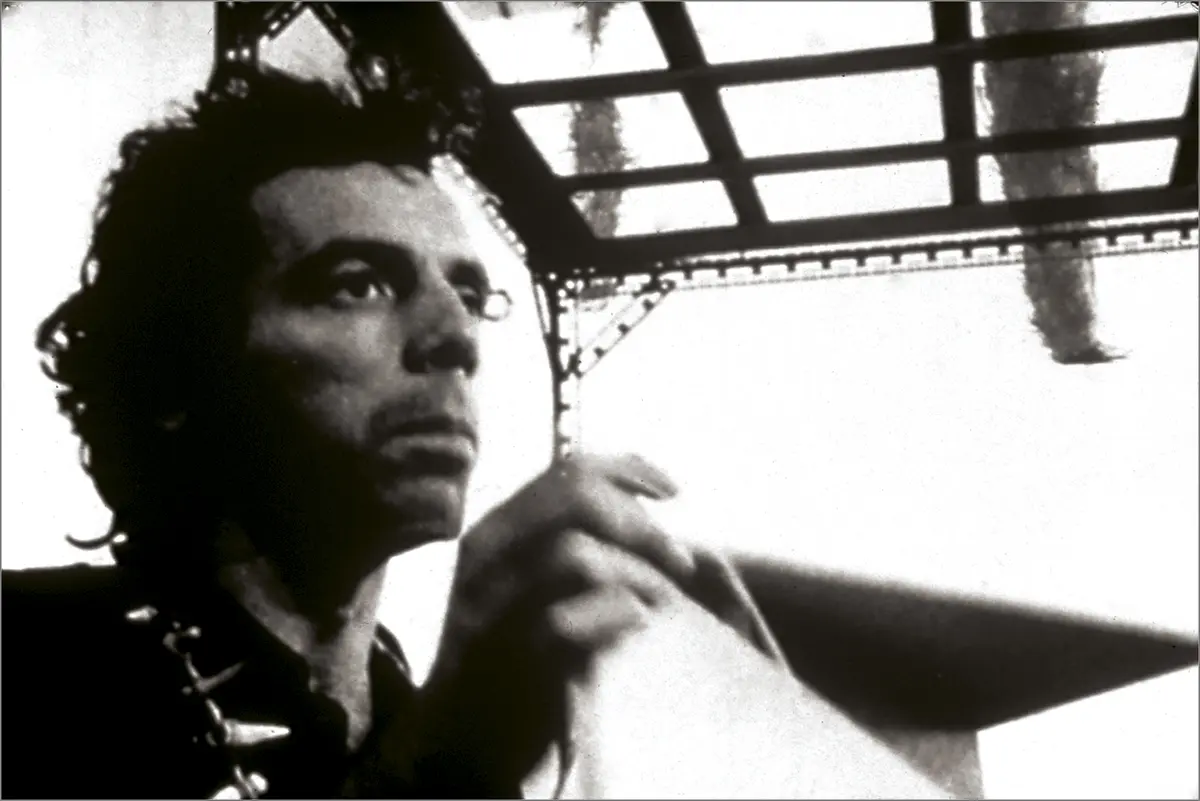
Oiticica’s pieces in the exhibition at the New Museum seem to extend the ideas and aesthetic of his work of the sixties, merging these, however, with more private and autobiographical concerns. The more ambitious pieces, mostly from 1973, are big environments where the public is invited to play with balloons or to lie down in hammocks while listening to soundtracks and viewing slides projected on the walls. These environments mostly reflect attitudes made fashionable in the 1960s in the United States through hippy culture and the Esalen Institute. Emphasis is placed on the therapeutic significance of the touch/feel experience, on the disco ambiance, and on the use of “recreational” drugs. An attempt is made to induce an experience in the visitors comparable to a “high.” Varying with the piece, the slides offer images of gay friends (Neyrótika, 1973), or of his heroes Marilyn Monroe, Jimmy Hendrix, and The Rolling Stones (Block Experiments in Cosmococa, 1973).
Unfortunately, even at the time these pieces were produced, they offered little in the way of aesthetic or political innovation. Thanks in part to Oiticica’s own work, the ground-breaking changes in installation format had already been made in the preceding decade, as had the breakthroughs associated with independent filmmaking—in Brazil with Glauber Rocha; in the United States with the Mekas brothers and those sponsored by them, including Andy Warhol. The mix of installation with slides therefore seems, by Oiticica standards, a bit timid in terms of art development. Their deeper meaning lies in the more personal and intimate exploration in which the visitor is invited to share.
Oiticica’s environments were done with the help of filmmaker Neville D’Almeida, who is amply credited as a collaborator. Beyond technical considerations, however, the pieces seem to owe their character and force mostly to Oiticica himself rather than reflecting teamwork. Oiticica’s presence is so strong, in fact, that even though the viewer is called on to participate, he or she cannot help but feel like an intruding voyeur. Historical distance accentuates that feeling. In the New Museum show, the strongest images are those that have coke drawings, where he carefully outlines the features of his most admired characters with white powdered lines. But today, the drug scene, partly because of greater scientific knowledge but also due to changes in social attitudes, appears much less benign than it seemed several decades ago. One cannot help being reminded that Oiticica died prematurely and that no explanation for his heart failure was ever given.

During the early 1960s, Oiticica worked on small poetical environments he called Bólides (meteors or fireballs). The objects and situations were modest in their presence and inspired a feeling of intimacy and shared private knowledge. More than the production of artifacts, the pieces were acts of reversal. He was subverting the traditional concept of art, in which the art object is conceived as permanently housing an artistic essence. In the Bolides, the object was a provisional resting place or transient container; the “essence” (whatever that might be) was in the human interrelationship with the viewer, the object being left behind as an empty shell. The Bólides are best described as small poetry environments, as effective today as they were in the time they were made, because though unassuming they are rich in evocations.
The Bólides start by looking like one-liners and then become large with complexity and reverberations. With the Quasi-Cinemas at the New Museum, this trajectory seems reversed. The Quasi-Cinemas installations are initially experienced as complex, but in the end, the work leaves the impression of being smaller than at first glimpse. Drawn to feel closer to the artist—an interesting experience in itself, we are also distanced.
NOTES
1. Hélio Oiticica: Quasi-Cinemas, The New Museum of Contemporary Art, New York, July 26–October 13, 2002, curated by Carlos Basualdo.
2. The neo-concrete manifesto was signed by Amilcar de Castro, Lygia Pape, Lygia Clark, Reynaldo Jardim, and Theon Spanoudis.
3. “Ferreira Gullar por él mismo,” in El País Cultural, No. 295, 1995, Montevideo, p.5.
4. Ferreira Gullar, “La Teoría del No-Objeto,” cited in Clemente Padín, “Las vertientes del concretismo,” La Revista del Sur, No. 11, March 1986, Malmö, p. 22.
5. Ferreira Gullar, “La teoría del No-Objeto,” in O DOS, No. 1, 1982–1983, p.21.
6. Ferreira Gullar, “Manifesto Neoconcreto,” Jornal do Brasil, 22 March 1959, reprinted in Continente Sul Sur, No. 6, pp. 115–120.
7. Guy Brett “Lygia Clark and Hélio Oiticica,” Latin American Artists of the Twentieth Century, The Museum of Modern Art, New York, 1992, p.101. The quote is not dated. Also, while at first sight Clark’s classic series of the Bichos (Creatures or Animals) seem to be just geometric plays and a consequence of Bauhaus and Ulm School of Design formalist guidelines, at closer reading, they impress as organic beings. Though reincarnated in metallic origami, the sculptures remain sensually alive. The use of the title becomes extremely important both as an explanation of intention and as a way of breathing life into the sculptures.
8. In that sense their work seems more connected with the tenets of the Uruguayan/Argentinean group Madi than with European constructivism. According to artist and historian Mario Sagradini, one of three Madi members, Arden Quin, had visited and been in contact with the Brazilian concrete poets.
9. The Moebius strip had been popularized in Brazil thanks to the work of Max Bill and thus became a fitting homage to what seemed to be their formalist past. Max Bill won the Grand Prize in the first Biennial of São Paulo in 1951, immediately becoming an influential figure in Brazil. With his fame, the ideas of the Hochschule für Gestaltung (School of Design) in Ulm, which he had founded and initially directed, also became influential. This, in turn, brought to Brazil the ideas of another member of the Ulm faculty, the philosopher Max Bense, who emphasized the rationalization of the analysis of forms.
10. In music, it was an attempt to find an alternative to Bossa Nova by going back to the “Antropofagia” ideas of the 1920s and opening up to samba, indigenous music, Jimmy Hendrix, and The Beatles.
11. Hélio Oiticica, “Position and Program,” Hélio Oiticica, July 1966, pp.100-103.
*Edited by Selby Hickey.
LUIS CAMNITZER
Emeritus Professor at the SUNY College, Old Westbury.