Isabel de Obaldía’s current exhibition at the Contemporary Art Museum will surprise those who haven’t followed her career since the first Panamanian show of her works in glass, presented in the same space back in 1993. It has been a decade of work and development for the artist, from those initial, simple figures of people and animals and those carved-glass receptacles, followed some years later by her first molded-glass sculptures, to the large-scale human figures that characterize her present work.
Under the title Fragmentos de guerreros, the show comprises some twenty sculptures of human figures that are, spiritually as well as visually, removed from previous “guerreros” (warriors) presented by the artist. Against a black and white background, inside a space usually divided into two rooms, her works display intense colors and a transparent luminosity. Alongside these sculptures, De Obaldía presented a number of large drawings, focused also on the human form, which worked as a complement to the three-dimensional pieces and reminded us of the years the artist devoted to drawing and painting. The show’s montage is excellent, reflecting the professionalism of this Panamanian artist who, after training in the Pilchuck Glass School in the US and in the Czech Republic, has achieved international renown among experts and collectors.
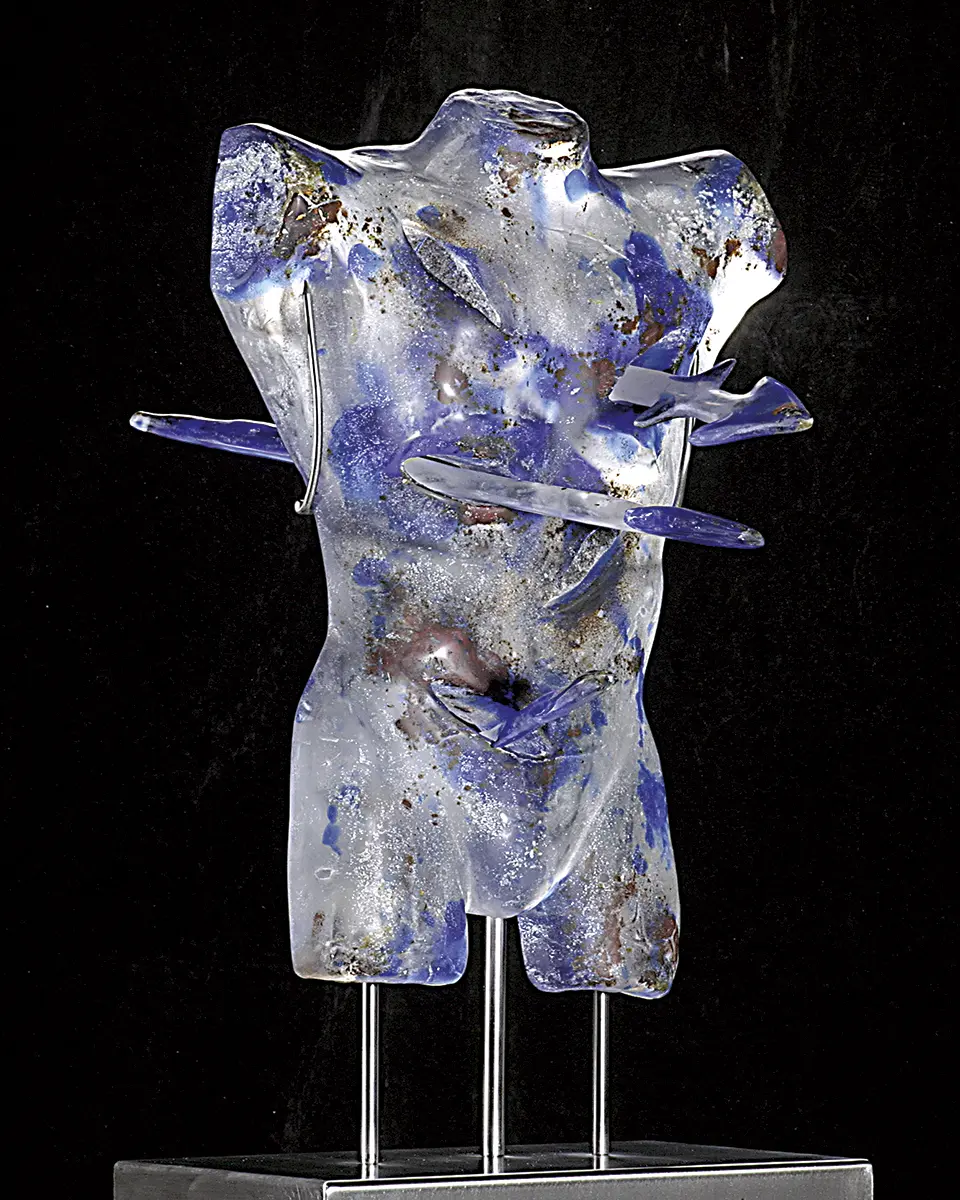
Upon entering the exhibition space, our attention is grabbed by an imposing torso in blue translucent glass, with openings that resemble wounds through which three glass spears pass. This work is titled Sangre azul and it announces, straightforwardly, the pattern the show will follow: high quality, color, translucence, bold shapes, and technical originality. In Sangre azul, the truncated neck, arms, and legs suggest the strength of the absent limbs and generate the feeling, common throughout the show, of this being both an archaeological and a contemporary artifact, realistic and abstract at the same time. Another characteristic common to all the pieces in the show is their androgyny; they represent human beings that are neither men nor women, an interesting detail in the work of an artist who over the years has focused almost exclusively on the representation of the male figure. With the exception of her drawings, these are figures of a marked sexual unspecificity but of an imposing physical presence, almost athletic in their muscularity and tacit energy.
Across from Sangre azul, as if in an altar, we find a series of small and luminous kneeling figures arranged in a semicircle, tiny people in a praying position. The piece is titled Orantes. If they are warriors, they look defeated, as if imploring in front of their victors. The front of these figures is flat and their backs are muscular, with well-defined gluteus and strong limbs. Although they share the same basic shape, each figure presents unique colors, carvings, finishes, and expressions. One of them, in gray and black, is ridden with bullet-like holes around the chest and head. The chests of two more figures, these ones in shades of yellow, are carved with shooting targets. Unlike the rest of the pieces in the show, these have heads, although not faces.
Hanging on a wall in single file formation, we find a series of glass torsos that end not in truncated limbs, but in a female V, in clear contrast with their muscular chests, emphasizing once again the sexual ambiguity of the show as a whole. These bodies possess a contained energy and surfaces that are rich in textures. Opulent colors—blood-red, oxide, intense blues, watery greens, blazing yellows—can be perceived in their interior (something that could have been highlighted, by the way, with more appropriate lighting).
In contrast with the limbless torsos, El ausente is a representation of the body exclusively through arms and legs suspended by wires, like fragments of a marionette, which can be arranged and rearranged in a variety of positions. On the one hand, they appear as lyrical shapes with a silvery shine and small red lacerations; on the other hand, they bring to mind the consequences of war—cold, blood-stained bodies drained of life. In Los brazos de Irga Tara, the artist achieved a splendid union of drawing and sculpture, and of limbs and torso, by hanging two bulging arms in clear sand-molded glass in front of the schematic drawing of a headless body, done in white against a black background. The lighting contributes to emphasize the glass’s translucency and three-dimensionality, in contrast to the spare lines of the sketch that serve as its backdrop.
Towards the back of the room, De Obaldía brings the show to a conclusion with an homage to classical antiquity in works that, at the same time, reveal a bold contemporaneity. These present the artist’s own version of the ancient Mediterranean statuary sculpture—as Angela de Picardi points out in her introduction to the catalog—or of the huacas of pre-Columbian cultures, with their characteristic combination of the human and the animal worlds. Imamá is a body with legs from which the chest emerges the head of a jaguar with carved eyes and fangs, reminiscent of the surging feline heads found in pre-Hispanic artworks from Costa Rica and Panama. Imamá (meaning jaguar in the language of the Chocó Indians) is a translucent glass body on which the tones of the jaguar’s skin have moved to the figure’s interior. The piece’s very material contains, like only fire could, an amalgam of golden yellows, reddish ochres, and black stains.
Finally, like Greek kouros or Etruscan statues, two splendid human figures titled Mica and Cobre show a balance of form and a serene classicism such that we are moved to silence in their presence. In the former, De Obaldía incorporated aluminum sheets into the glass to produce a shine similar to that of mica, of a subtly silver color. The piece’s rough surface plays with the metallic decoration, creating an abstract beauty in contrast with the figurative character of the work. Working in a medium where mistakes cannot be fixed and where the danger of ruining the piece lurks permanently throughout the process, De Obaldía shows impressive technical mastery. Also impressive is the care with which she designs stainless-steel (and less often, iron) pedestals for each sculpture, as well as the metallic rods—lately in copper—that support each piece internally. De Obaldía also uses copper for the bolts of different sizes that attach limbs to torsos in her figures of human proportion. The problem of attachment is resolved in a different way in Mica, where the rods that spring from the pedestal support the pieces as if floating next to each other so that the eye connects them at the same time that the vacuum, an essential element in the art of sculpture, is recreated.
Besides her mastery of a great variety of glass molding and carving techniques and her attention to detail, De Obaldía displays a dedication to her work and a willingness to experiment that is equally deserving of mention. In Cobre, she places diagonal bands on copper sheeting across the torso and thighs of a human figure represented solely by its torso and legs, generating red metallic reflections that make the surface shine and give a solid aspect to an otherwise ethereally luminous piece. At the same time, the flatness of copper and its textures create a visual interplay in interaction with the glass’s silver-blue translucency, the figure’s raw material. Isabel de Obaldía’s glass sculptures fascinate with their contrasts of light and opacity, texture and shine, but also with their paradoxical combination of fragility and strength, femininity and masculinity, archaism, and contemporaneity.
MÓNICA E. KUPFER