
Despite being part of a tight circle of artists from Tijuana that is electrifying the contemporary art scene, Marcos Ramírez, a.k.a. ERRE, is a humble, blue-collar type of guy. He also happens to have an infectious and powerful voice. His presence in major art exhibitions like inSITE and the Whitney Biennial has helped illuminate Tijuana’s important voice in visual art, especially concerning issues of global hybridity. As technology and migration facilitate shrinking geography, the clash of conflict and progress that is the reality of daily life in Tijuana is becoming increasingly analogous with the rest of the world.
Ramírez’s recent show at Intersection for the Arts seems to slow down the chaotic mess of nationalistic agendas and government ideologies and focuses its scope on individuals as global citizens. The Multiplication of Bread (La Multiplicación de los Panes) cuts through the vast bureaucracy of foreign relations to examine its effects upon the individual: the human being born in Kabul, the human being born in the United States. How do these individuals see and understand each other through the blurred lens of war?
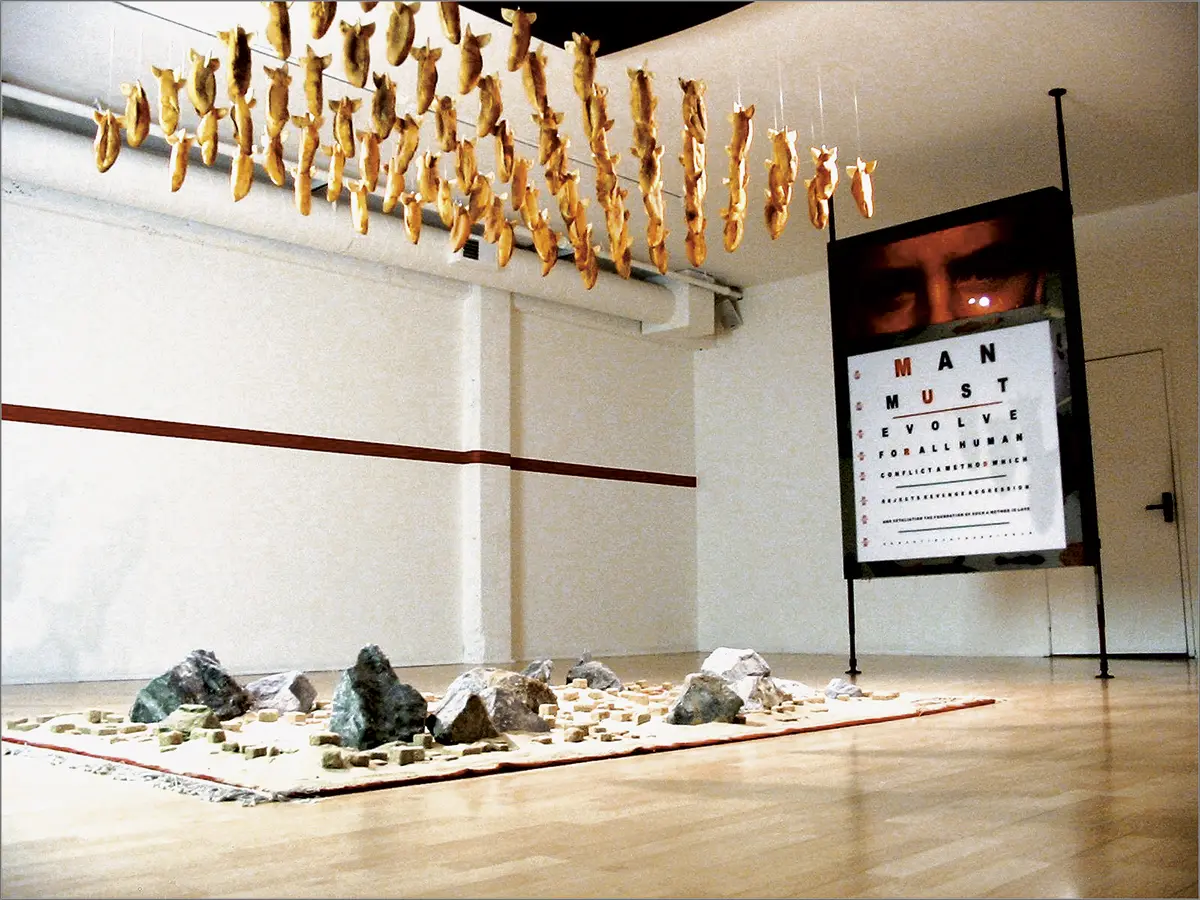
A desert city the size of a child’s sandbox rests in the center of the gallery floor, bordered by two large, opposing lightboxes. A galaxy of bombs hangs in a crowded grid above the city, freezing the moment before impact. Made of bread and crackers, the bombs are both the destruction and the so-called humanitarian aid: the violent hole ripped open by war and the band-aid sent to repair the civilians.
The viewer, whose aerial perspective is decidedly outside of the city, is forced to understand it from a towering distance. The virtually monochromatic landscape furthers the disconnection between the viewer and the city, where hills become homes that become hills again. But by getting closer to the ground—shifting perspective—the cultural fabric of the city is discovered. Glimpses of color creep out from under the sandy landscape, revealing the intricately detailed carpet upon which the city lies.
The two large light boxes that border opposite sides of the city mimic the aesthetic of an eye exam chart and start with large lettering at the top, followed by consecutively smaller lines of text toward the bottom. Each light box has a photograph of a different pair of child’s eyes above the text. One child has dark, olive-colored skin; the text below, written in Arabic, is a passage excerpted from the Koran about equality. The other child has light skin and watery eyes; below, written in English, is part of a speech given by Martin Luther King, Jr. that mirrors the sentiment of the Koran passage. The two seem to be staring at each other, saying similar things, yet a war stands fixed and frozen between them.
On the gallery walls a continuous red line, referencing the red on the eye charts, bisects the room and puts the audience inside the installation. Ramírez explains that most adults would view the installation from above the line, whereas a child would see it from below the line. Essentially it is our line of vision that will determine whether we are closer to the bombs or closer to the details of the city; our perspective determines our borders.
SARAH LIDGUS