
Interested in historical events, Mariano Sapia (Buenos Aires, 1964) situates his figurative narrative in Argentina at the end of 2001. December was the title Sapia chose for his last exhibition of 22 paintings that recall the events of that month when the era of false convertibility came to an end and the country fell prey to unprecedented levels of decadence and poverty—to the point where it became absurd to talk about a “risk country,” since those willing to risk anything in Argentina had all but disappeared. December 2001 in Argentina acquired a tragic notoriety, covered on the front pages of the international press because of the wave of noisy protests, the looting, the blocked roads, the parade of Presidents assuming and leaving office, and the ham-fisted repression. For many, this was the beginning of a new country, a cartonero country. (Cartoneros are those who forage the garbage for usable items.) Up until a short time ago, there were only a few cartoneros. Now there are thousands who pick through the garbage looking for food, cardboard, paper, and other discarded objects that can later be sold.
To this emphasis on a recent historical situation, Sapia adds past personal experiences, those of his early life in a diverse Buenos Aires neighborhood. “I lived in a house full of books and paintings, on a very ordinary street in the city. But just a few blocks away there were numerous housing projects, poverty-stricken shanties, vast manufacturing complexes, and well-to-do neighborhoods with chalets. Over time I realized that it was not all that common to live in such a heterogeneous neighborhood.”
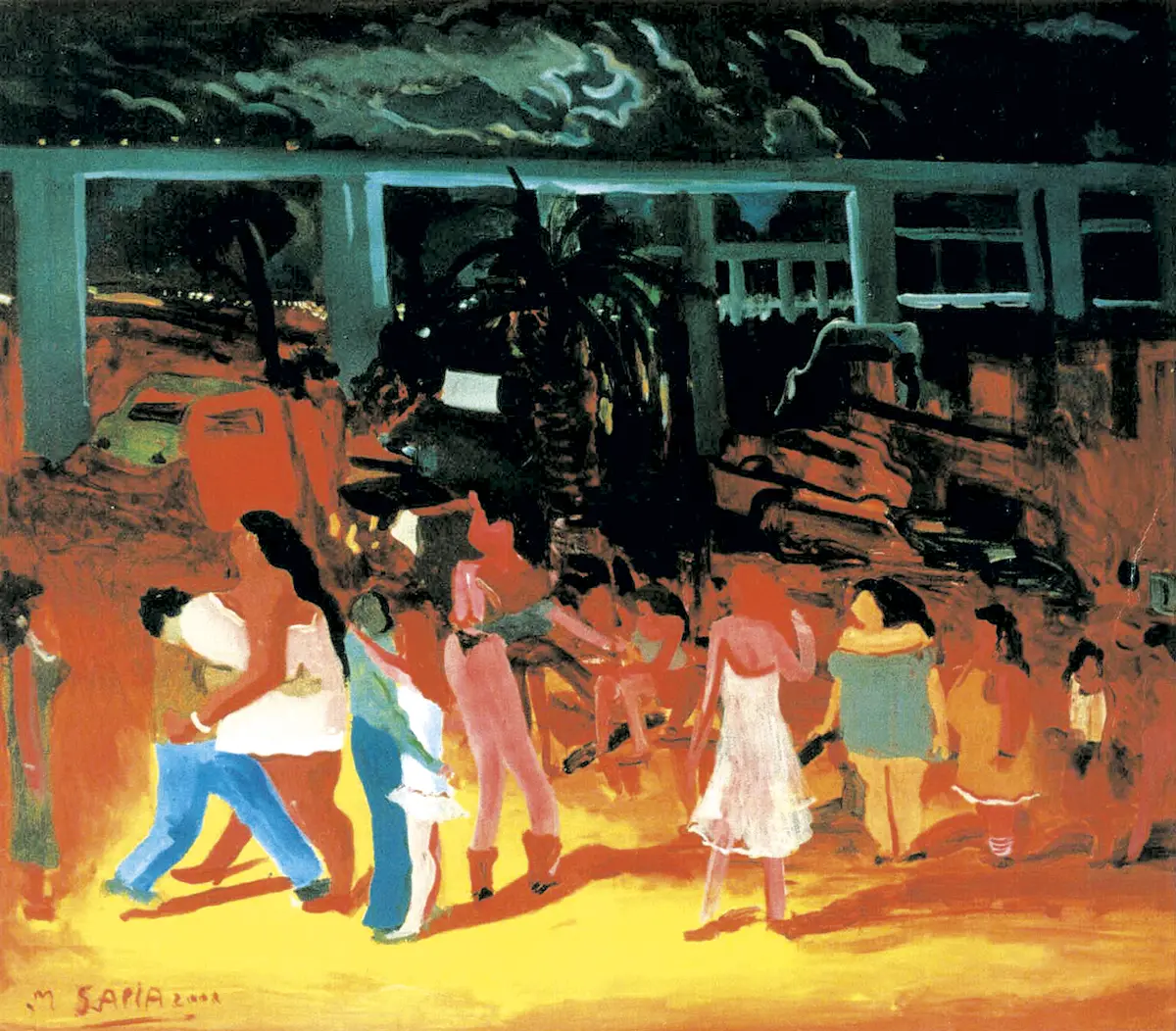
From this diversity, Sapia retains the experience of marginal groups. But despite what one may think, his vision is not tragic nor pessimistic; humor and, above all, amazement is always present, as if the extraordinary were not in the distance, but in proximity. As Hamlet observed, “There are more things in heaven and earth, Horatio, than are dreamt of in your philosophy.”
Moving away from critical-realist models, Sapia has discovered, without ideologisms, that marginality can also be synonymous with vitality, joy, and celebration. Given this, the protagonists of Sapia’s works are not melancholy characters defeated by their circumstances. They are covered in warm, intense colors; they are often in movement; they are attentive to some immediate happening or accident that threatens to destroy the entire scene. One can imagine them being guided day after day by the need to invent new ways to survive. Today they are called cartoneros, or in the most violent version saqueadores (looters) or piqueteros (picketers) who block access routes in order to get people’s attention. This is the result of a new impoverished class, a sector of Argentina’s (ex) middle class.
In Sapia’s epic of the exyrbs, current hardships do not hinder the ability to be active, nor the invigorating feelings of togetherness. Nobody is alone in the scenes that Sapia constructs. They not only share the organizing of a picket line or a looting raid, they also participate in dances, picados, or in get-togethers around a fire. Sapia’s night scenes are characterized by something like the enchantment of magic realism, which originates in the suggestions of a virtuosic brushstroke. This in turn generates a restless, saturated, and luminous mass of colors that delineates soft shadows and contours figures that are barely discernible from their background, which demands a careful reading. In addition, repeated symbols that demand decoding appear; Argentine flags—alluding to patriotism and unity—bridges, turbulent environments, stormy skies, and moons.
Sapia not only paints marginality; he has developed an aesthetic that is in some sense marginal. When he established himself as an artist, in the 1980’s and 1990’s, Sapia did not adhere to any of the current vogues. He has always been true to the tradition of painting, having more faith in empathy than in irony or parody. Sapia’s diction is the result of a rebellious consciousness, as far from expressionist pathos as it is from any residual intellectualism.
ELENA OLIVERAS