
The other begins where our senses meet the world. This was the title of the first monographic presentation of the works of Dias and Riedweg, curated by Catherine David, which included ten of the video installations created by these artists since 1993 when they began working. Dias and Riedweg’s exploration has focused on various ways of perceiving and how they relate to imagination and memory, presenting groups of people that for one reason or another can be seen as "other."
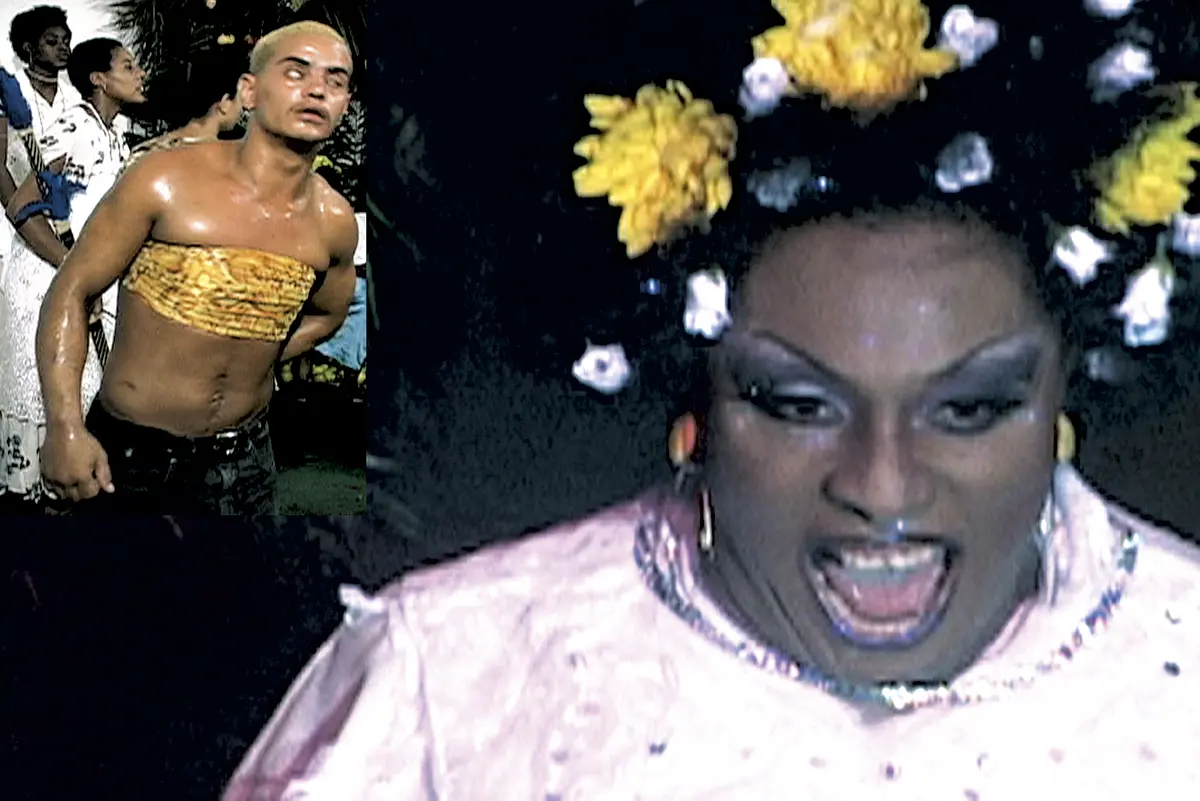
Mauricio Dias, from Brazil, and Walter Riedweg, from Switzerland, have found in the video an effective tool for documenting the activities they suggest to their subjects, and for these "others" to record their own way of looking at things, whether by constructing a fictional narrative or capturing a slice of reality organized by a script. Their deep understanding of the medium’s potential is evident in the diverse forms adopted by the image-in-movement in the video installations presented at CCBB: a simple TV monitor shows a three-minute video in which a child, with much gesticulation, tells how his father will sacrifice a sheep for the feast of Baihran (A festa de Mustafá, 1999); three huge projections take over an entire wall, building an intricate narrative based on 11 small stories (Isto não é o Egito, 1999); mouths repeating the names of lovers are projected on a bedsheet sewn to a strip of other bedsheets (Meu nome na tua boca, 2000). In their recent Deus é Boca (2002), four retro-projections surround the viewer with scenes that change continually and at great speed, showing singers, TV shows, candomblé rituals, Catholic priests, and a list of phrases identifying God with other words that have the same number of letters (in Portuguese, that number is four). Towards the back of the room, a woman dressed as Baianas, in religious rituals or tourist displays, draws numbers, as in a game of bingo. Surrounded by four glass walls and moving only when the light hits her, the actress resembles a digital presence. The same complex understanding the artists have of video allows them to realize the medium’s limitations and to differentiate between a repeated real action, on the one hand, and a projection, where the drawing of numbers would lose its casual dimension, on the other.
Certainly, this complex utilization of video, both as a resource and as a matter, stems from the very situations in which Dias and Riedweg work and from the complex mechanisms characteristic of their videos. Their projects involve a number of individuals or groups, as well as a number of procedures. Often, they use video at different times, for different purposes, and in different ways. A good example is Belo é também aquilo que não foi visto (2002), created through a series of workshops at Rio de Janeiro’s Instituto Benjamin Constant, which serves people with vision problems. The artists recorded three months of experimental situations where the institute’s students were asked to relate tactile, olfactory, and auditory sensations to their memories and imagination. A selection of this material is shown inside a drawer—one of the several in the three dark pieces of furniture that comprise a large portion of the installation at CCBB, duplicates of the one that has been used at the institute for the study of Brazil’s geography for the past 148 years. Among a series of relief maps of the country’s states, which give visitors the unusual opportunity to recognize their country through the sense of touch, we find the students’ astonishingly visual recollections and descriptions. Also, four projections on a wall show, from different angles, a repeated scene: a blind woman reading Braille editions of Homer and Borges (both of them also blind) in front of Rio de Janeiro’s National Library. A fifth projection shows, with a fifteen-second delay, images from a surveillance camera located in the hallway that leads to the installation so that the viewer encounters his or her own image from the moment immediately before their present experience.
Each installation by Dias and Riedweg results from a similarly complex mechanism: a series of encounters and activities carried out with various groups of people who are united by economic reality, social function, physical challenge, wishes or needs, circumstances, or conditions. Each work comprises a series of stages, from the identification of the group in question to the definition of the way in which the results will be presented, so that the public is positioned in front of alterity, with intermediate steps such as activities that deal with the subject’s perception and expression. Each project takes place in the experience of those individuals and in the experience of the public when the results are presented. Often, although this is not the case with the show at CCBB, the exhibition itself becomes part of the process of constructing the work of art, functioning as a new site for the recording of images or narratives and for the compilation of materials that add layers of meaning to the piece in progress.
It needs to be said that, despite the impeccable selection and presentation, encountering these ten projects together and in sequence is an obstacle to our understanding of the complex and respectful process through which they have been created, either because a long time needs to be devoted to absorbing each work, given their length, or because the space—necessarily darkened as required by the projections—erases the distance between the individual pieces. Moving in and out of rooms that condense experiences such as the ones described, we find ourselves feeling like tourists. It is difficult to avoid a sense of curiosity towards otherness, a kind of anthropological distancing that accompanies us to Switzerland, Brazil, Egypt, Mexico, or South Africa, along with a certain anxiety as we witness not only where the Other begins, but also where the Other ends.
Perhaps the best way to show a significant body of work such as that of Dias and Riedweg, one whose complexity requires heightened levels of alertness and concentration, would be an exhibition in which one installation followed the previous one in time, not in space. A series of sequential presentations, separated by enough time to absorb and understand each work one by one, with the same respect the artists show for each community, and with the same care they put into their approach to the real, could allow for the kind of deep understanding that these works demand.
CARLA ZACCAGNINI