
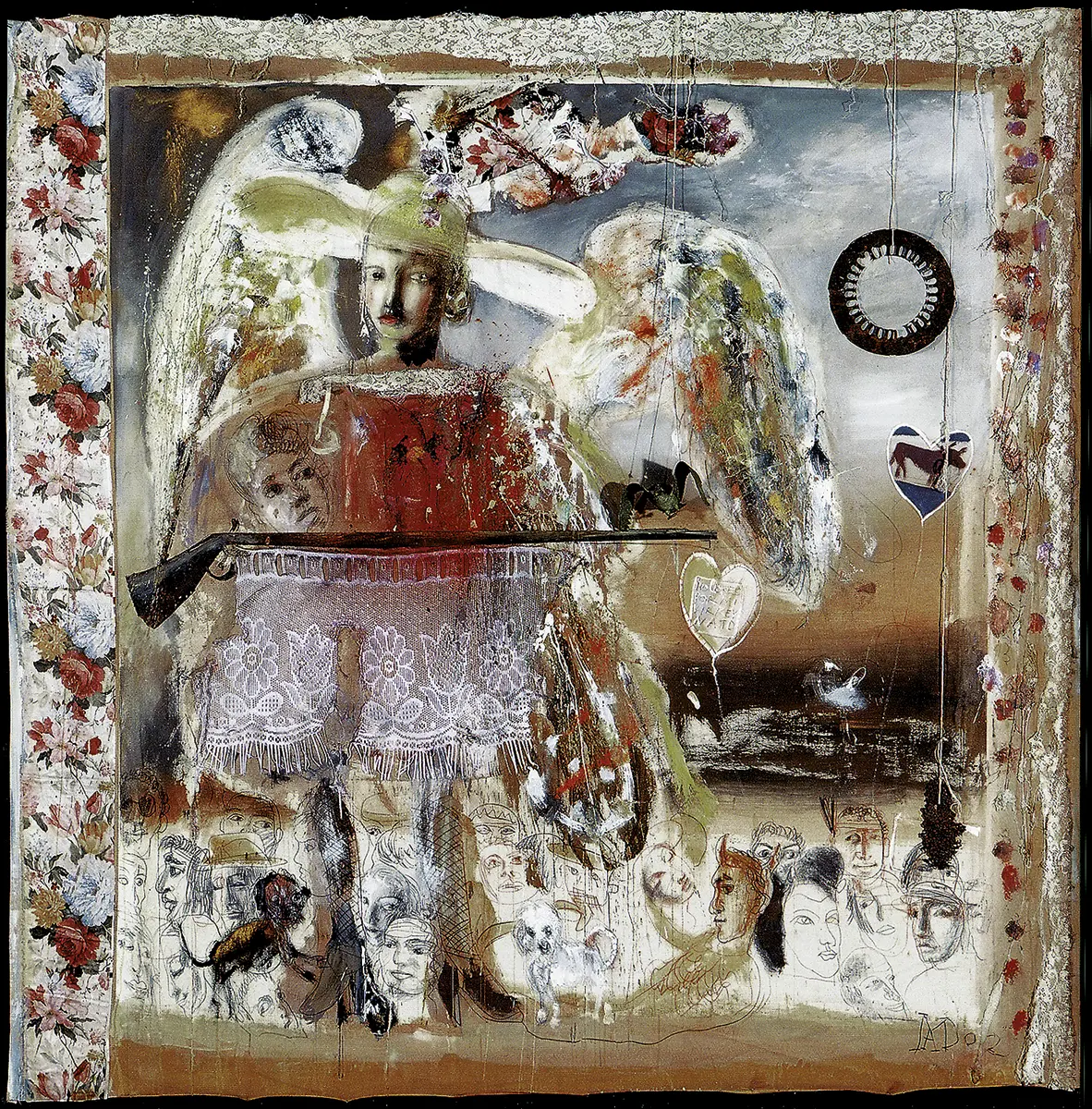
Angels carrying harquebuses, anonymous workers, sad female burlesque performers, tango dancers, and the ineffable figure of Evita are among the characters that the Argentine artist Miguel D’Arienzo puts on stage in the paintings on exhibition at the Modern Primitive Gallery of Atlanta. Sometimes these de rigueur members of the Argentine iconography escape the clarity that stereotype demands and exist in a state of permanent transformation. Eva Perón lives a multiple existence in Eva arcabucera (Eva with Harquebus, 2002), in which she is simultaneously political myth, armed colonial archangel, and singer in a musical. Next to her equivocal figure a text reads no llores por mi virreynato (Don’t cry for me Viceroyalty), which suggests an additional incarnation as the subject of more recent colonization. In Tango y presagios (Tango and Portents, 2000), two tango dancers become Rudolph Valentino and Pola Negri, leading players in a now mythical romance, transformed respectively into a gaucho forced to dance tangos by Hollywood and a fortune-teller announcing the disasters that have already become part of the Argentine past.
Miguel D’Arienzo studied art in Argentina and Italy, where he developed most of his work. In 2001, at the Centro Cultural de la Recoleta in Buenos Aires, he presented an installation entitled Los cartonautas (The Cardboardnauts) that was dedicated to exploring the reality of a certain extremely poor sector of Argentine society. The cardboard collectors, like the ancient Argonauts, travel through Buenos Aires in search of articles necessary for survival, in their case, cardboard and other discarded materials that they search for in the trashcans of the city and hope to transform into meager profits. Using cardboard, wax, and other found materials, D’Arienzo created a kind of stage design of urban poverty in an eight by twenty-meter space. Undoubtedly, the concern with social issues is an important aspect of the work of D’Arienzo, and has also determined the artists with whom he has established a dialogue in his works, for example, Antonio Berni and Luis Felipe Noé.
In the Atlanta exhibition, this dialogue is reflected in works such as Il arcángel al Luna Park (The Archangel of the Luna Park, 2002), which combines the colonial figure of the armed archangel with a reference to Noé’s paintings—Introducción a la esperanza (Introduction to Hope, 1963) is an example—from which he cites the anonymous and grotesque faces of the public holding signs together with a textual mention of Luna Park (the Argentine version of New York’s Madison Square Garden). While the connection between the expressive figuration of D’Arienzo and Noé is unavoidable, the presence of Berni is felt more diffusely in the references to popular culture and urban folklore. D’Arienzo avoids Berni’s direct social criticism and instead employs a parodic distancing and skepticism more typical of the postmodern spectacle than of the disillusionment of the Left. In his present works, D’Arienzo also introduces certain discarded elements such as collage, but “¿perhaps more for issues of transport than poetic intention?” without the tenderness towards trash that Berni demonstrated in his collages about Juanito Laguna, and that D’Arienzo himself explored in Los cartonautas.
D’Arienzo’s complex creative process sometimes contradicts the emotional distancing of the social as carnival spectacle. His paintings are made with tempera; that is, the artist mixes synthetic resins, egg, casein, or enamel with various natural and mineral pigments, including metal to give some of the works a rather precious tone. The artist works on unprimed raw canvas, which favors the absorption of the pigments more than their suspension on the surface. When his paintings have little texture, D’Arienzo folds them for their transportation and the marks of the folds become an additional element of the work. This way of working lets him achieve interesting transparencies and emphasize drawing, always balancing the strong presence of brushstrokes and stains. In some cases, both the brushstrokes and the use of collage can become referential and not just elements of technical interest. For instance, Eva arcabucera, a work that sets out the formal problem of unifying different kinds of collage elements and techniques, includes: an area with a clear reference to Pollock’s dripping technique, a small bronze sculpture hanging from a thread in homage to Rauschenberg, and a piece of glued lace that suggests the texture achieved by Berni in his intaglio prints.
Both Eva arcabucera and La conquista (The Conquest, 1999) are presented as histrionic acts. In La conquista the artist assembles a cast from the history of art: to the left, a harlequin by Picasso, Queen Mariana by Velázquez, and an equestrian portrait of Philip II by Titian; to the right, the subjects of colonization—the Indians. The melodrama of the conquest is resolved as a love-hate relationship that includes an Indian woman dancing with a Spaniard, and written references taken from a love song by Fito Páez, the Argentine rock singer. The atemporal and hybrid action takes place on a stage; it is a frame of reference that appears in many of the exhibited works and that contributes to transforming D’Arienzo’s paintings into a theatrical version of reality.
FLORENCIA BAZZANNO-NELSON