
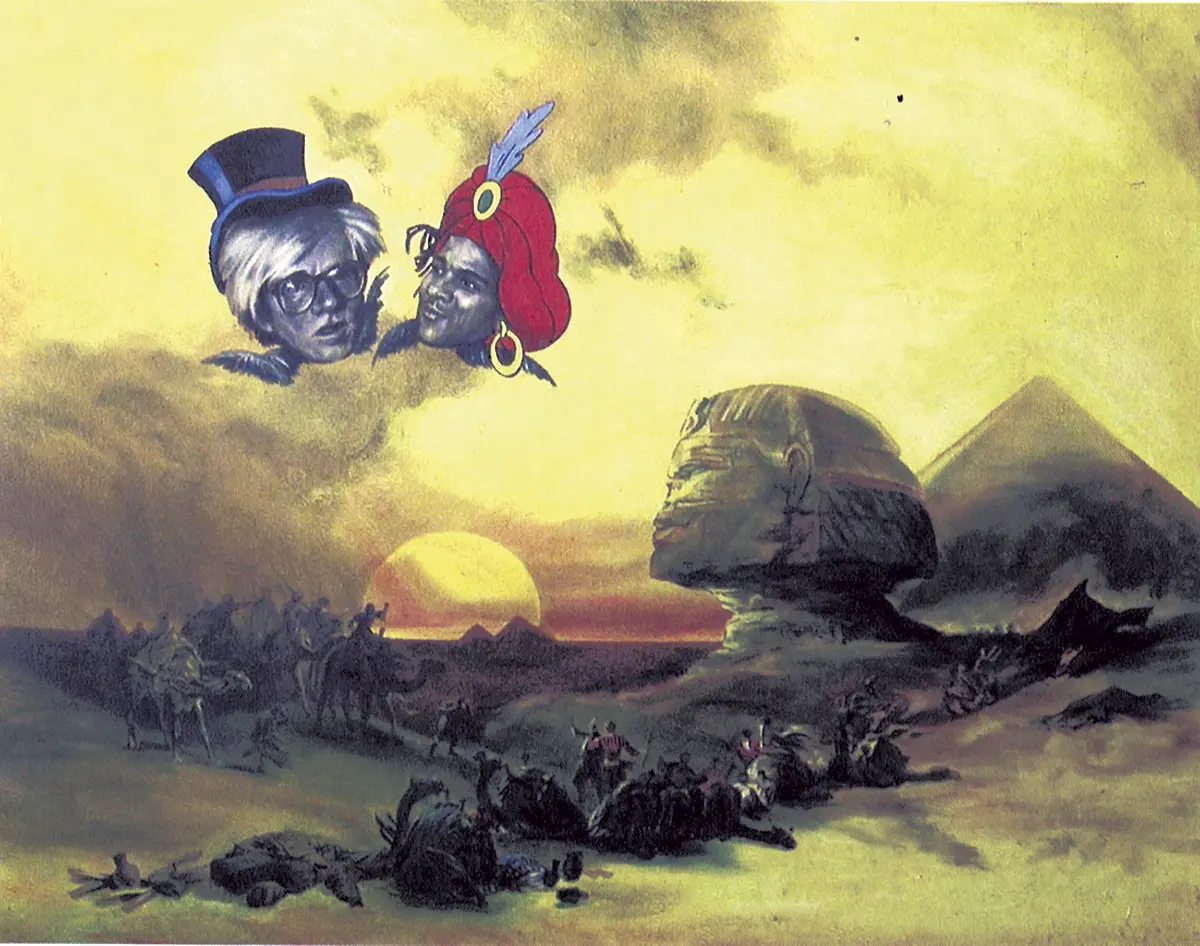
Two well-known faces from the artistic worlds appear to engage in an aerial dialog, like angels, while below a caravan of camels lies strewn about in the African desert, under the vigilant gaze of the Gizeh Sphinx. We are talking about Andy (Warhol) & Jean Michel (Basquiat?) discussing values as ephemera, the first painting the visitor encountered in African abstract y otras pinturas, an individual show of works by the young Cuban artist Pedro Álvarez (Havana, 1968), held between January 17 and February 17. In another of his scenes, the historical figures that appear on US currency were made to share the space with groups of Native Americans or Africans, and/or the White House, and/or the Capitol, and/or old cars... It is his series The romantic dollarscape, which is best described, like all the work this artist has presented over the past decade, by the axiom about every act of creation being nothing but a collection of quotes.
In his paintings, Álvarez tends to bring together symbols of power, allegorical figures, and fetish-objects of the consumer society. With them he composes parables of a trans-historical projection, which displace their sense of time and space; he gives them the appearance of a mise-en-scène that “objectively” distances the viewer. In his more recent works, Álvarez does not focus on a specific scene through baroque, almost theatrical lighting, but he does retain and even accentuate the darkness of his colors, submerging all his actors and scenes in the shadows.
Although he also has a degree from the Academia de Bellas Artes de San Alejandro, in Havana, Pedro Álvarez represents a generation of graduates from the Arts Education program at the Pedagógico Enrique Varona, located as well in the Cuban capital. His work has many common characteristics with the early works of those artists, who became a substantive part of the local artistic elite in the 1990s, an elite still headquartered in the Instituto Superior de Arte (ISA).
Álvarez's painting uses high-culture references from the history of art, as well as enlightened metaphors and an oblique gaze; it is conceived in grand, theatrical neo-baroque terms. Álvarez's craft tends towards an academic techné, but it also shows a predilection for a certain technical playfulness in its construction and its finish. It is the ambivalence of an art understood as “higher,” to whose seduction he is not indifferent—the ambivalence of an art that feels a “fatal attraction” towards that it parodies. Álvarez even makes “high art” forms from a popular graphic and literary tradition, infusing it with new connotations.
Faced with Vitral c. 1962, shown in this exhibition and painted in 2001, our sociological eye feels the tug of an image representing a bus destined for Miami, adorned on its side with the image of a bear (a polar bear? A Soviet bear?), crossing a bridge under which there is an abstract work of art (by Cuban painter Mario Carreño?). This canvas, along with three more painted the same year, seems to articulate a second moment within the show, in terms of the vision from the “other side.” One of these paintings is La amenaza del fantasma, where an abundance of cars from the 1950s and 60s, as well as the store signs in English, refer to a different time and a different space, while a number of flags fly from countries that, with the exception of Cuba, are all ex-Socialist Republics. On its part, Words Across Miami presents a nocturnal landscape, a view from the Bay, with the word “Latinamerica” across the dark sea.
In works such as these, Álvarez has taken as his point of departure a representation of urban spaces, charging them with socio-political connotations through the insertion of attributes and symbols. In his series The romantic dollarscape, however, Álvarez builds a social landscape by way of collage. This modus operandi becomes highly explicit in African Abstract, the 2002 piece that titles the show. It is a collage of images and texts about Africa, comprising six parts, of which making a coherent reading is extremely difficult.
Álvarez belongs to a generation adept at the use of pastiche, homage, and visually intertextual as a strategy for the articulation of an oblique discourse about social reality. Yet, one wonders whether this artist structures his works so as to incite a rational reading, or whether he puts together images in a purely aleatory manner.
At any rate, one element appears as a possible thread communicating the various works: the medium of transportation. In the paintings shown in the Havana Biennial in 1994, Álvarez already showed that symbol of the passage of time, its stillness or coexistence, and its speed of slowness. This element is key for Pedro Álvarez's trans-historic discourse.
ISRAEL CASTELLANOS