
Just as The New York Times was reporting that Hispanics have become the largest minority in the United States, the Museo del Barrio —now with a new director, Julián Zugazagoitia— presented the first show of its new era, expanding its meaning and its relevance as a museum devoted to Latin America in the US. The gradual proliferation of Latin American artists in New York and other US cities has been documented only occasionally and in a limited way in a few shows, and it wasn’t until the emergence of the Museo del Barrio’s Biennial (formerly known as S-Files) that a team of curators undertook the task of researching and gathering this body of work in a more systematic and careful way; often, this has been the first museographic exposure and the first curatorial essay for the work of these artists. Thanks to this event, we have gained a more general understanding of what a whole generation of artists is proposing, and this understanding will be, in time, an extremely valuable point of reference. Organized by curators Deborah Cullen (from the Museo del Barrio) and Victoria Noorthoorn (from Buenos Aires’ Museo de Arte Latinoamericano), the show gathers works by artists born between 1951 and 1977, representing the same variety of artistic trends that characterize all group shows in New York.
Despite the fact that this show does not attempt to establish thematic connections of any kind, to a remarkable degree the selected artists share the same kinds of artistic, intellectual, and in some cases political interests, as well as the same kinds of conceptual strategies. At the level of their aesthetics, this comes perhaps as not much of a surprise for a group of contemporary artists living in the same city; yet, it is interesting to note that such commonality extends to the ways in which they deal with other issues, such as the danger of falling into specific references to the ”Latin American,” a particularly problematic matter given the context in which these artists find themselves. In general, the selected artists have followed an introspective, personal direction. The original material of their work is, ultimately, a sincere presentation of private explorations, with their many complex aspects, which nonetheless produces fascinating commentaries on their cultural condition, in reference as much to the history of conceptual art as to the artist’s historical and social circumstance.
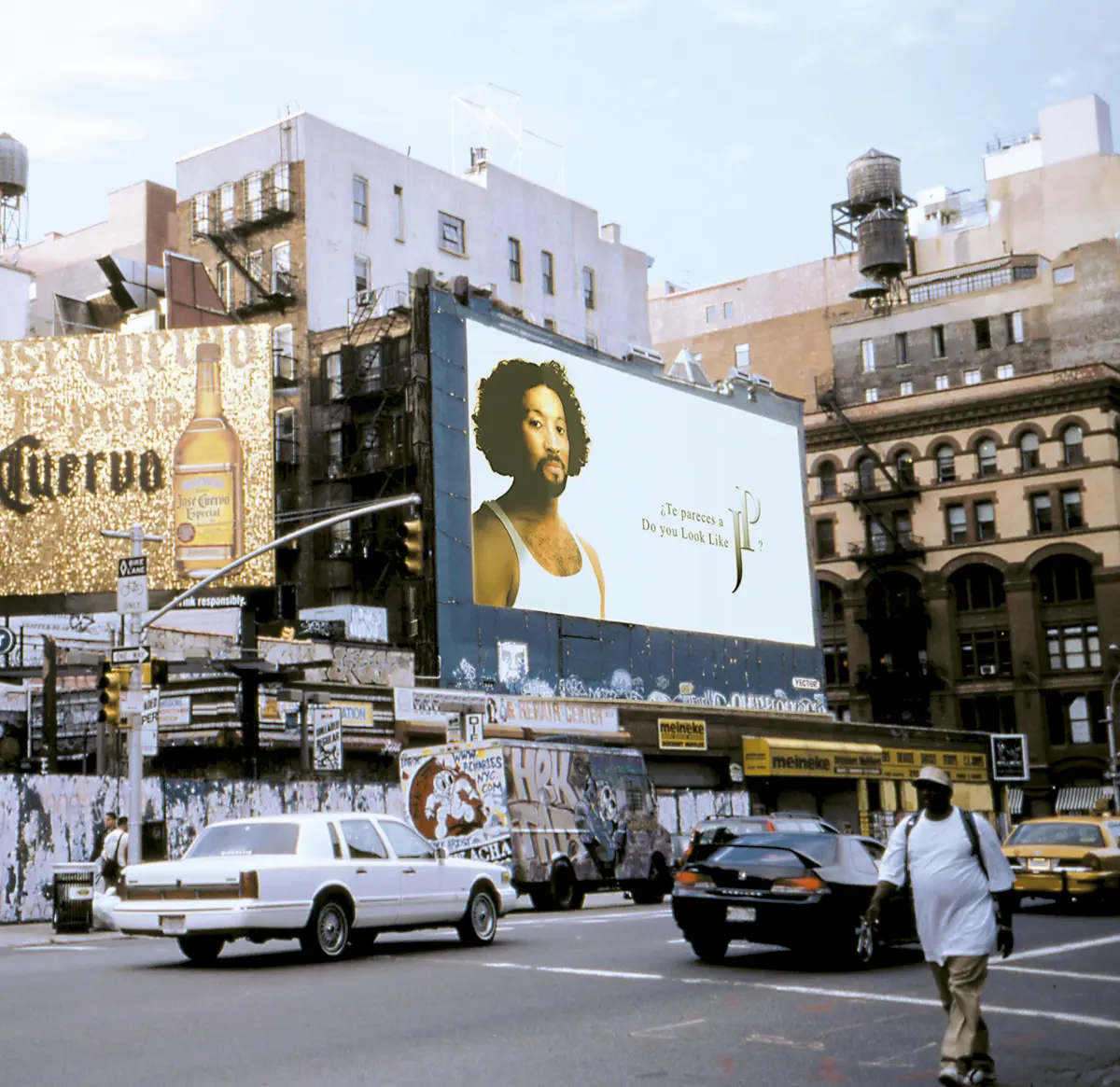
From Spanish artist Paco Cao, who mostly works on the basis of ad campaigns under a conceptual thesis, the curators selected an elaborate —and magnificently executed— competition for lookalikes to an imaginary character, JP, who in reality is a digital recreation of Juan de Pareja, Velázquez’ character. In this project, Cao parodies advertising ”hooks” in order to direct our attention towards the history of art as a paradigmatic canon and to highlight the superficiality of mass-media culture, in particular its obsession with physical appearance as something that can be translated into commercial value.
Nicolás Dumit Estevez and María Alós also use promotional strategies but to different ends than Cao. Their works (mostly performances) are interactive and engage the public —passers-by, collectors in their homes, and visitors to a museum— in various activities. Alós tends to incorporate museographic strategies —such as the idea of collecting collectors, while Dumit creates public rituals, often of an absurdist character, like distributing potatoes in the street while dressed in a golden suit, or serving fried bananas in the gallery sporting a surgeon’s coat, which help emphasize the intertwining of sensorial, cultural, and gender experiences.
Popular culture is a common thread running through this show, and it reappears in the work of Miguel Luciano, who juxtaposes the iconography of American ads with that of Puerto Rican ads. On its part, Rigoberto Torres, an artist known in New York for a number of years, is an important reference to the collaboration between artists and the community at large, something from which the area surrounding the Museo has benefited.
It is possible to trace connections between the works of artists who include, in sophisticated ways, text that combines commercial culture or collective memory with poetry. Judi Werthein’s urgent piece, shaped as a cardboard sign reading ”Happy Birthday,” hangs in the gallery to offer an unanticipated message with the words: ”Imagine the state of a man who cannot see that, compared to his ignorance, the insignificance of his knowledge is beyond measure.” Alejandro Cesarco uses a Scrabble board to collect quotations from past thinkers, from Wittgenstein to Prince and Maurizio Cattelan; their accumulation becomes unreadable, a symptom of the paralysis provoked in today’s artists by informational saturation. Similarly, Claudia Joskowick’s repetition of words that end up conspiring among themselves is based on the script for the film Harriet Craig; the artist translates into Spanish and then back into English a number of dialogs that, in this way, lose their original meaning. Finally, Yucef Merthi combines technology with an interest in poetry to place a poem in the fence that surrounds the museum, so that it can only be seen by using a telescope situated inside the gallery; this work establishes a dynamic of interior/exterior spaces, and it can only be completed by directing our gaze outside the institution.
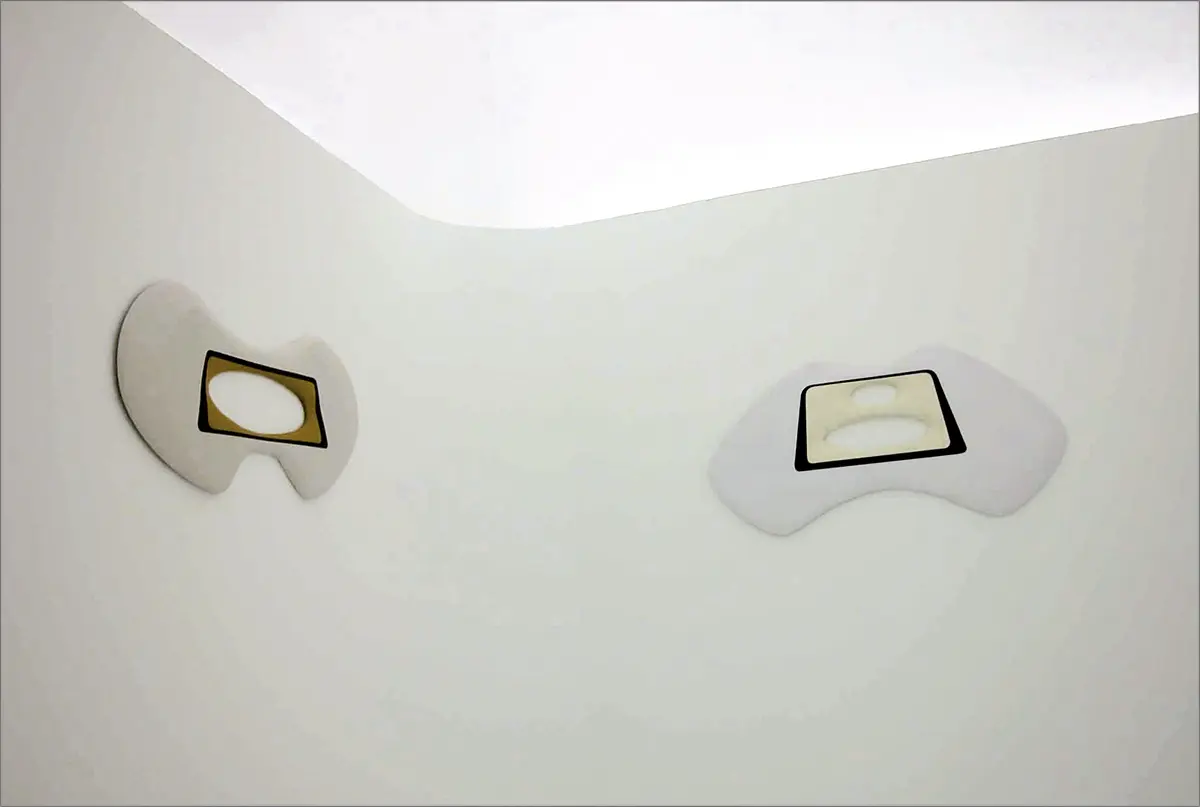
Reflections about architecture have figured prominently in contemporary art in recent years, and they play an important role in the work of some of these artists, as a way of reflecting on the issues of memory and of personal, physical, and psychological space. Salvadoran artist Carlos Cárcamo builds ”commemorative” walls behind which he hides recordings chosen by a family member. Javier Cambre, from Puerto Rico, uses in his video installation a fictional architectural space in order to carry out a narcissistic dialog where psychology, the metaphor of personal space, and French film noir come together for a parody and a critique of modern life. Isidro Blasco’s work is an architectural model with photographs of his own apartment’s interior, and it functions as the three-dimensional explosion of a bi-dimensional documentation of a space, documenting the psychological fragmentation of a personal habitat. In an extreme of this kind of relationship, as far as being in a museum goes, Nicolás Giannini creates a whole interior space that oscillates between high design and the sterile and fictionalized sets of movies like 2001, with highly designed objects in reference to psychological models, emphasizing the artificial character of the museographic context.
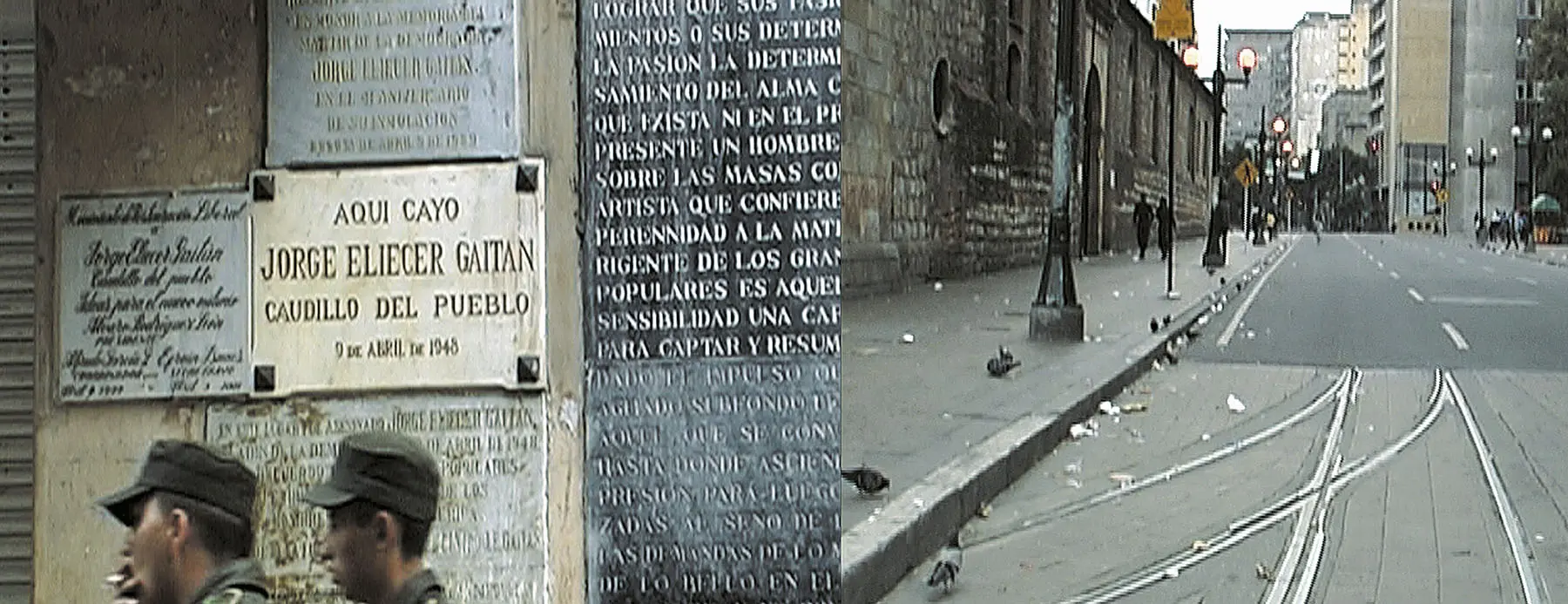
In general, political positionings in the show —less common than one would have thought for an exhibition of up-and-coming artists—relate, in one way or another, to collective and personal histories. Colombian artist Francois Bucher’s work, 1948, deals with the still unresolved killing of a popular leader, Jorge Eliécer Gaitán, turning it into a metaphor for the open wounds that afflict Colombian society in its unending descent into violence. At a more personal level, Ryan Rivera presents a series of self-portraits in video representing different stages of self-inflicted suffering, pushing in this way the limits of sensation and self-awareness.
Through the multiplicity of its themes and through each piece presented, the Museo del Barrio Biennial offers a revealing view of the variety of strategies, the plural imagination, and in a way the subtle humor that these 30 artists impart to their work.
PABLO HELGUERA