
There is an air of mysterious confusion that pervades the exhibition of Walter Goldfarb’s latest series of works, Far Beyond Dreams, which is as disturbing as it is alluring. The paintings are dark and large and immediately evoke Baroque sensibilities and Art History traditions. The subjects are certainly recognizable and as they drift in and out of the deep shadows, it is as if they are indeed traveling through a world of dreams conceptualized by an artist obsessed with the significance of their forms and iconographic meaning. They lure the viewer closer and invite submersion into the black depths of what soon is revealed as a surface layered and rubbed with charcoal interrupted by passages of tempera and, most extraordinary, embroidered threads of wool. The technique is as disconcerting as the aesthetic associations they convey.
Goldfarb begins with an untreated raw canvas and then covers the surface with charcoal, not just as the medium for drawing the images or designing the composition, but as the background as well. He then immerses the canvas in a solution of chlorine that dilutes the media and causes streaks and other aberrations. The images are redrawn with new charcoal for another concentration of saturated and intense description, and then the canvas is submerged again. The wash results in more streaks and shadows and more charcoal is applied to reinforce the images. This process is repeated six or seven times and an intense mood of darkened reverie emerges from his construction-deconstruction of the media and the message. The final transformation of the canvas takes place with the application of multicolored tapestry stitching to enhance the details of the images and contrast with the black-and-white values of the surface.
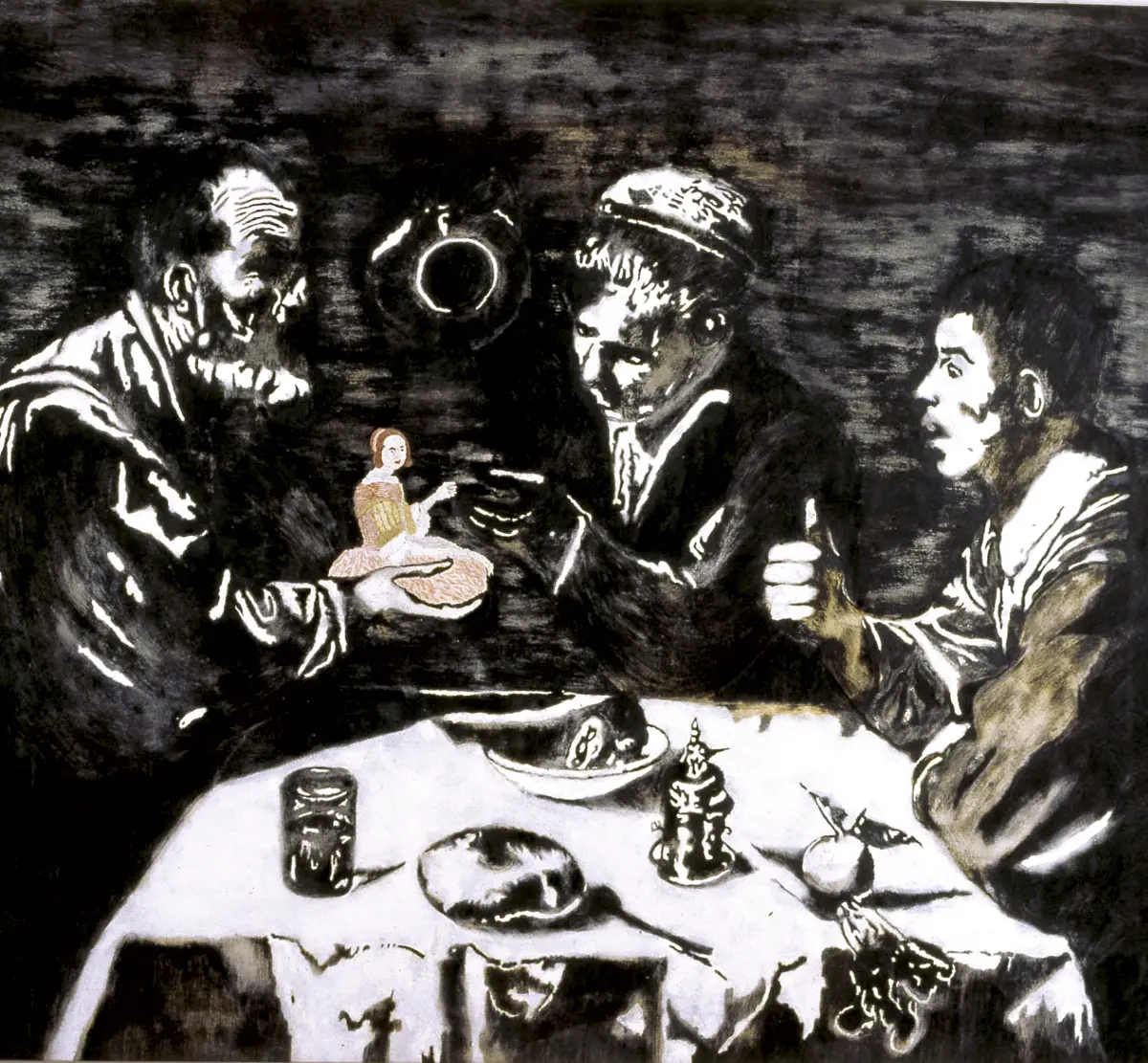
This contrast of technique and texture reflects the postmodern contrast of neo-expressive painterly surfaces with scenes drawn from traditional Art History; past and present merge together in the ghostly images barely obtainable after the washing and the clear emergence of the subjects described in opaque white contours and thread. People and places drift in this nocturnal atmosphere. The masterpieces of Vermeer, Velázquez, and Rembrandt are fragmented and floating in somnolent reminiscence of the Golden Age and the Gobelin Tapestry workshops brought into the modern world. There is psychological and aesthetic manipulation that results from his appropriations. He takes possession of drawings, paintings, and architectural plans that are icons of the past and forces them into the present by a most labor-intensive and time-consuming technique, and then he manipulates and distorts them conceptually and contextually as well.
There are mythological and religious subjects, architectural renderings, and dramatic reinterpretations of Baroque masterpieces transformed from their original context and material splendor to indistinct and eerie figments of the imagination, or dreams. It is as if they are the negative responses to a photographic inquiry left incomplete. In On Summer Time of Venus and Metamorphoses, 2002, the three graces dance as muted contours barely distinct from the chiaroscuro of the background shadows. Suddenly, a “scarf” is transformed into a blaze of yellows by embroidery. No less theatrical is the ritual gathering of three figures around a table in Give Her to Drink, 2002, in which a small female figure created from threads of pink and white is presented as an offering. The expressions are equally astonishing in The Equilibrist and Juggler, 2002, which offers a miniature embroidered female to two familiar Velázquez protagonists.
Architectural constructions, elevations, and drawings also translate especially well through Goldfarb’s unique technique. Spanish palaces and cityscapes emerge out of the darkness to float in eternal space in complex renderings in which stitches of white thread appear to indicate time and place as commemorative markers. The real and the imaginary join with the lost and the long-forgotten splendor of the Age of the Baroque to come to life and memorialize a period of great significance to every artist. For Walter Goldfarb, the Golden Age also has the potential for introducing other ideas beyond those of masterful technique and artistic accomplishment. He sees it as a point of departure for the exploration of concepts about gender, conquest, rulership, patronage, and class that were not open for discussion then, but can be approached today with freedom and imagination. Thus, the past comes to life and invites our contemplation and reevaluation.
CAROL DAMIAN