Argentine sculptor Alicia Penalba, whose death has just passed its twentieth anniversary, is brilliantly and thoroughly represented in the exhibition of works from her workshop displayed at Buenos Aires’ Daniel Maman Gallery.
This show is yet another argument in favor of paying attention to this artist, who was born in San Pedro, province of Buenos Aires, and relocated to France in 1948 after winning a scholarship.
On the occasion of her death, La Nación published an article titled “Alicia Penalba’s Oeuvre And An Unforgivable Failure of Argentine Memory,” denouncing the country’s lack of a cultural policy geared towards the recognition of its greatest artists, such as Penalba, whose works are conspicuously absent from local museums.
Over the following years, this situation was partially ameliorated thanks to Guido Di Tella, who, as Minister of Foreign Relations, International Commerce and Religious Affairs, acquired for his Department’s collection two extraordinary large-format pieces, now located in front of the Department’s new building.
The show at Daniel Maman Fine Art is then part of this wave of recognition.
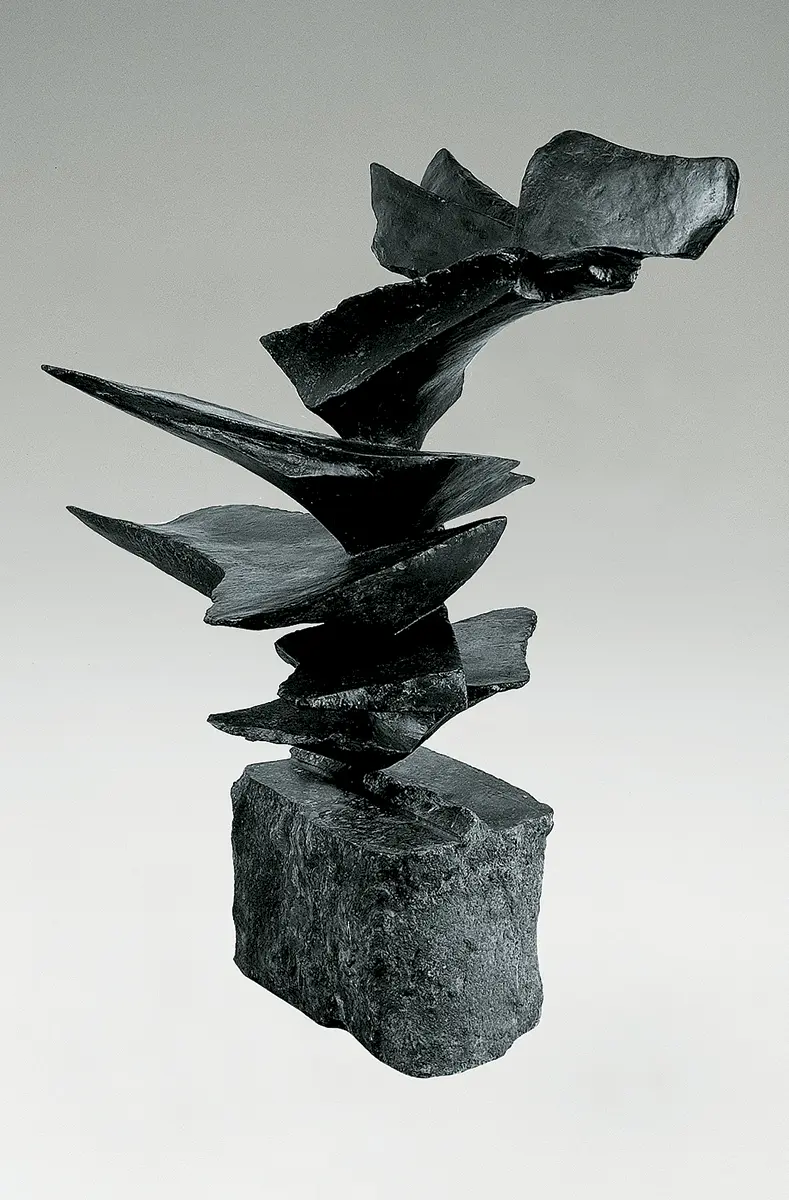
The earliest pieces in this show date from 1953, the moment when Penalba defined her career by choosing both sculpture (she had tried painting and printmaking) and abstract art as the paths to achieve her artistic goals. There are several examples of Penalba’s totemic pieces from the 1950s, those “idols of an ancient religion, or perhaps (examples) of a vaguely pantheistic feeling for Nature,” in the words of Damián Bayón.
Penalba’s feelings for Nature cannot be doubted. In the case of her totems, the link is perhaps with the ferocious character of Argentina’s Patagonia region and the artist’s own childhood experiences.
In later pieces, well-placed botanical metaphors are almost a constant. Herta Wescher, a student of Penalba’s work, has written that the totems evoke petrified exotic plants and that the botanical and the architectonic crossed paths in her art.
From the same decade are examples of her Grand Domble, also vertical in development but featuring an upward-moving double nucleus, a theme that Penalba continued to explore in the monumental 1972 piece for the new MGIC location in Milwaukee, and the piece she made the following year for the gardens of the University of Bordeaux. According to the artist, “these works were the final installment in a theme first touched on fifteen years before.” A theme, she explained, is which “two parts separated through the center of an axis come together, fuse, unite in their ascent—an ascent that is not exactly symmetrical, but the unfolding of a specific shape.”
In these works, the dialog between the sculptural elements, or between volumes and empty spaces, allowed Penalba to carry dynamic impulses to the limit. Because her awareness of that dialogue is not confined to the sculptures but flows from them into the surrounding space, be it a natural space, an architectural one, or both. I will never forget the impression it caused in me to see the 12 sculptural blocks Penalba created for and interspersed in the parks that surround the École des Hautes Études Economiques in Saint Gallen, Switzerland, which became the gravitational focus for the appreciation of both the landscape and the buildings.
Penalba was able to develop yet another theme—last but not least—before her tragic death: her winged sculptures. Comprising “homogeneous elements with a foliage-like appearance” that superimpose on each other, these pieces take possession of space, opening themselves to it in an exquisitely graceful interplay of convergences and divergences that is always animated and always exciting. In this series, Penalba diversifies variations and contrasts with unmitigated daring.
Michel Seuphor, the French critic, pointed out just this ability of Penalba’s to multiply differences within a single series. “In view of how rich, how well-endowed her temperament is, there is nothing as admirable as the reserve, the methodic rigor with which this artist manages her elements, limiting herself to two or three themes—like Brancusi, like Pevsner—that are continuously refreshed. Great art always insists on the same points; it moves from well-expressed item to well-expressed item, from love to love, achieving infinite variations on a single theme, which is always new, never fully owned.”
This show of works by an artist who won the First Prize in Sculpture for Argentina at the 1961 São Paulo Biennial was curated with precision by Martha Nanni, and it boasts a good catalog in three languages.
NELLY PERAZZO