Daniel Guzmán (Mexico City, 1964) is primarily known for his drawings. Yet he has developed, in parallel to his work in that field, a tridimensional language that combines a variety of strategies: the use of found elements (or rather, elements sought intuitively as the necessary key to complete the sequence of ideas that will become a “series”), the recourse to certain sculptural “moves”, and an ever more accurate articulation of the exhibition space. Guzmán focused on these strategies for his most recent individual show, presented by the Kurimanzutto gallery in the artist’s own studio.
Guzmán’s work brings together a kitsch sensibility, incisive irony, social allusion, and post-adolescent winks to the audience. This show is perhaps the one where his works are more intrinsically linked to the surrounding space. It is not the first time the artist has shown his work in the same studio where he has worked and lived for years, in a vecindad of the Escandón neighborhood that the process of land speculation threatens to obliterate completely. It is not the first time, but it will be the last.
The space itself has not been modified. Even some of the furniture has been incorporated into the pieces through which the artist expresses his grief, his farewell gesture to the site. Guzmán’s good-bye becomes a pained confession, and, as such, a melancholy and intimate work of art—one that, fortunately, does not fall prey to unfruitful self-referentiality.
The building’s long and narrow corridor, filled with gas containers and hung laundry, puddles, and caged birds, is an appropriate preamble (rite of passage, decompression chamber) to a heartfelt and ironically unkempt vision of the artist’s private world.
To place the first piece visitors will encounter, the artist chose a laundry area on which the phrase “I want the world for a home” can be read; it has been written with wire, and above it hangs a “mobile” of plastic bottles, letters spelling the word ama (“love,” stated as an imperative), and various objects tied together with wire.
Upon our entering the studio, one piece functions as a central element, positioned as the axis and point of articulation of the space and our movement through it. A large object covered with a brightly colored canvas, like the ones that typically protect the stands of street vendors. What is hidden in this huge package? What is this canvas intended to protect? From inside the piece comes the music that will accompany, and in some ways determine, the show as a whole. It is a Flaming Lips song titled, like the show, Sleeping on the Roof. Rock music is a constant presence in Guzmán’s work, through multiple textual references, images, as ambient music, and even as an objectual item (in one of his previous shows, Guzmán presented a pile of cassette tapes with the words “only the false remains,” while a video showed the artist singing). Here, music is a kind of anchor for the meaning of the object from which it emanates: the precarious, transitory nature of the canvas cover and the implication of having to sleep without a proper roof.
Another piece incorporates the artist’s bed, placed in its usual space. On top of it, there is a lighted sign where the following phrase, inscribed between little stars, can be read: “Journey to the end of my night.” With subtle irony, Guzmán ambiguously indicates a direction for a reading of his work, at the same time warning us that the different parts, despite their stand-alone individuality, belong in a whole that cannot be divided.
The end of the night is the end of a difficult time, but it is also the time when dreams come to a halt. On top of a table, we find the figure of a heart formed with beer bottle caps; in the center of the figure, there is a skull. Around the skull, several plastic stars that present female names are formed with wire. There is also a mirror and a plant. This piece is perhaps the show’s rawest, most direct intimate vision: What can be clearer than the names of those who caused us pain? Guzmán comes close to kitsch pastiche; however, the cut-up of a known brand of powdered detergent saves us from melodrama by displaying a sense of irony: through this exorcism of sorts, we can “cleanse” our memory...
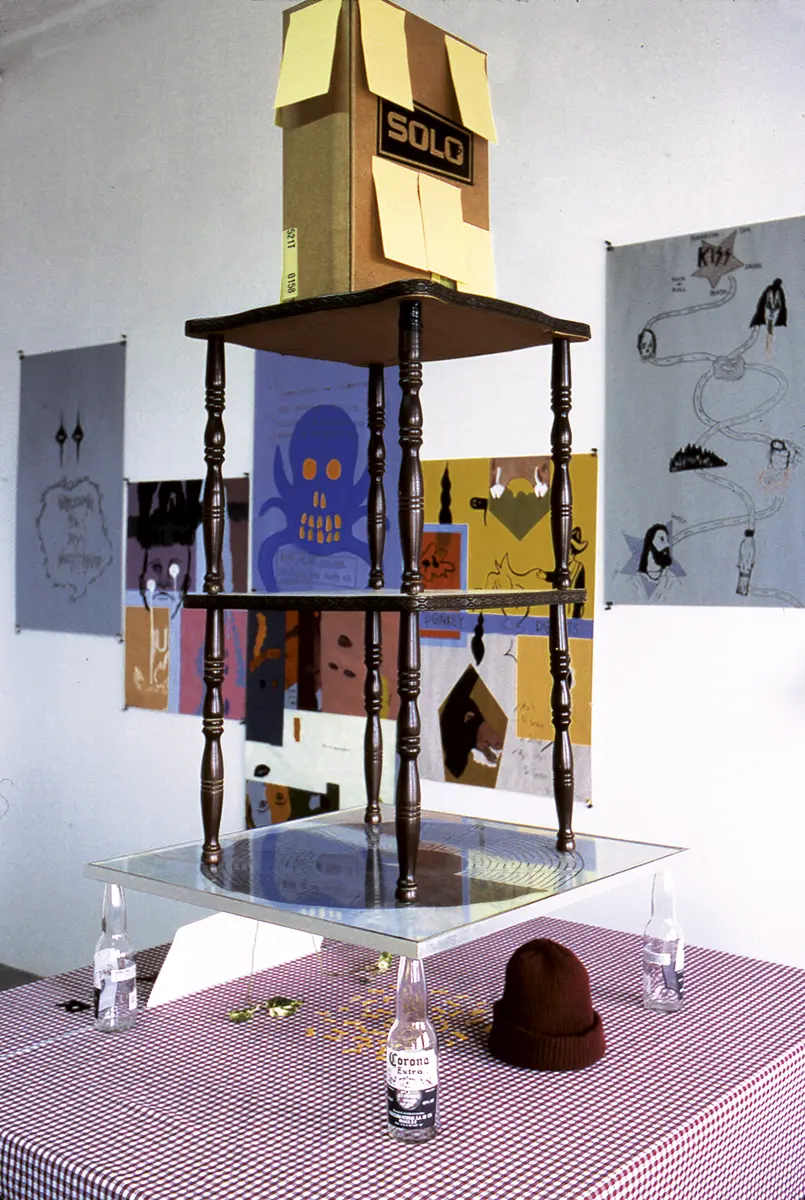
Guzmán’s work possesses an intense, unflinching autobiographical charge, but it is possible to derive a mordant social commentary from its melancholy, intimist vision. On a wall, the artist has hung several fake gold chains, each with a letter on each extreme; together, they spell the words “infinite sadness.” In the next corner (following the route imposed by the central object), three beer bottles support a cardboard box from which an artificial plant emerges.
This ironic reference to social conventions through ornaments and household decorations turns again towards the artist: Guzmán’s own bookshelf is incorporated into another piece, which also includes two images presented in lightboxes. This object was part of the artist’s daily life, of his private space. Visitors can continue with their voyeuristic tour of the show by examining the books in Guzmán’s library, while the images seem to summarize the show’s general mood: a resplendent sky slowly closes up and, as if in a sordid still-life, we are left with a beer bottle, some ice, some cigarette butts—the end of the party, and of the night. Another reference to alcohol, helps us forget.
The last (look), and we leave. The music by the Flaming Lips comes with us briefly along the corridor. These works by Guzmán leave us with a strange aftertaste, a certain heartbreak combined with laughter. We reach the street, the world we would like for a home...
ENRIQUE JEZIK