
There is in contemporary art a line of exploration that focuses on biological identities, making the body and life itself visible, and revealing the element of mystery in their mechanism.
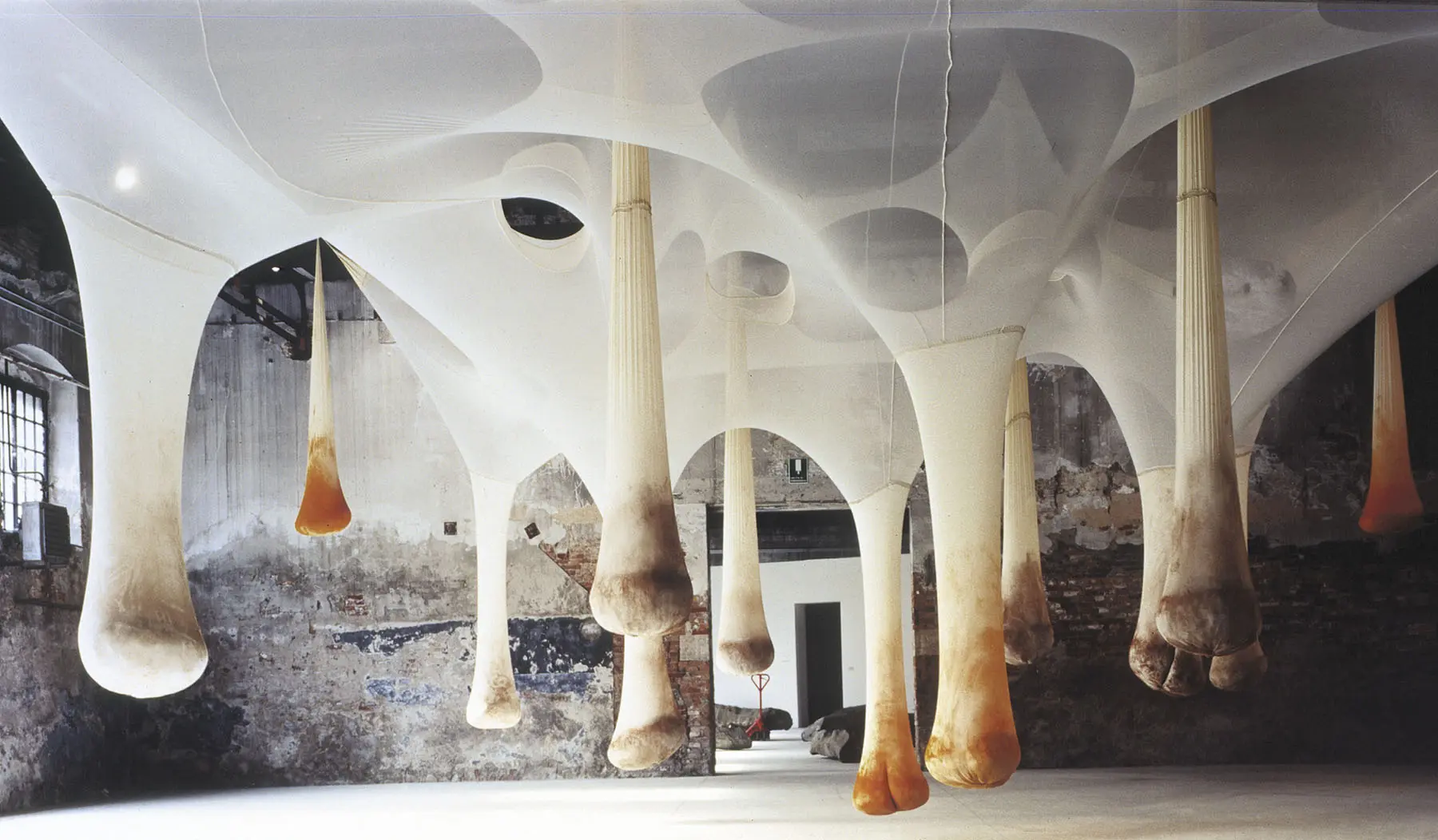
Brazilian artist Ernesto Neto works precisely along those lines, creating aesthetic constructions that, even at first sight, seduce us with their organic character. Neto’s creations involve every one of the viewer’s senses: sight, touch, and on occasion, smell and hearing. The material employed by the artist is a fine weaving of Lycra gauze, white in color, with a texture that suggests lightness and creates transparencies. Neto also uses polyamide stockings, stretched, perforated, or stuffed—partially or wholly—with lavender flowers, cloves, and cúrcuma,2 among many other olfactory elements. There are also works that incorporate stretched polyurethane balls, as well as stones, sand, and assorted rubble. As a whole, these works result in the creation of seemingly ethereal and enchanted environment installations. We see or enter them and are immediately surrounded and impacted. Slowly, after an approximation of the shape’s corporeal character, we are able to identify a situation that is new and at the same time familiar. A careful exploration of each piece awakens various memories as we move through the piece’s interior and our senses are engaged. The visualization of shapes drives us to a labor of Gestalt structuring. The effect of the material used, of its translucency, is to activate our sense of touch and, when the shapes are filled with various substances, our sense of smell is activated also. All of this brings forth memories, influencing our physical, mental, and spiritual state.
Reflecting on his work, Ernesto Neto has observed that he wants to offer the viewer “a place where the realities of an intellectual universe and those of a sensory universe can be reconciled, where we can breathe freely at least for a minute.”
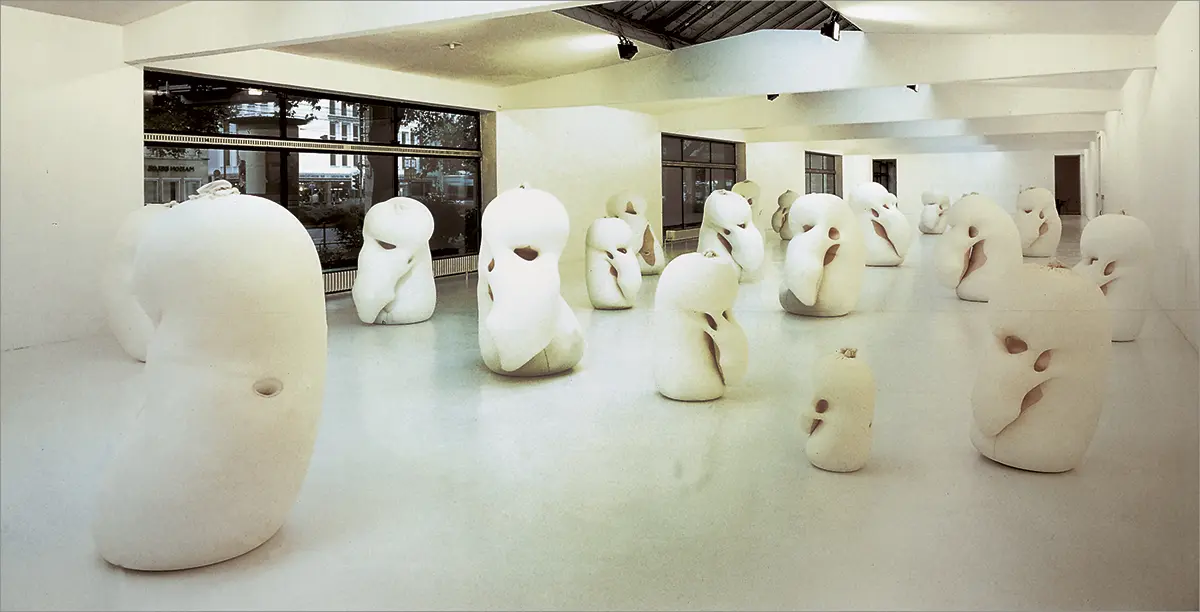
In her analysis of Humanoides, a piece presented at the 2001 Kunstverein in Cologne, Germany, Elizabeth Schlebrügge pointed out that Neto’s oeuvre promotes a continued exercise of perception. She described Neto’s art as “an art of space, an odyssey in which the artist,” simultaneously “extracts something from the continuum of space” and “places something in it,” creating corporeal formations that work as puzzles, puzzles that our perception will put together to find various references. Schlebrügge noted an important fact: the contours of Neto’s constructions play a fundamental role, creating surfaces, relationships, and oppositions—weight v. lightness; inside v. outside; transparency v. opacity; fragility and a compact format; and more. She also pointed out that, besides this, the body appears in Neto’s work as a challenge; the artist, she said, works with the corporeal nature of emotional states, of psychological processes, of sensations that involve body and mind.
Other critics have found in Neto’s work a strong erotic charge and they tend to highlight the role of desire and sexuality as the forces that drive the artist’s creative gesture. They also point out, however, a more meditative, more spiritual side that coexists with his scientific outlook. In Neto, references to the mechanics of life abound, as if the artist strove to know life through fundamental facts, such as the generation of beings. Those installations of Neto’s that address this question appear as mysterious spaces; uncovering their meaning requires profound meditation.
At the 2002 exhibition of Neto’s work in the Basel, Switzerland Kunsthalle, Peter Pakesch saw the artist’s Cuerpos espaciais as “formations from an organic world,” with strong utopian content. Ernesto Neto was presenting Pie de sueño, which originated from a suspended structure and rose all the way up to the hall’s ceiling. From there hung “formations” that resembled oversized bags filled with cúrcuma.2 One of them was filled with sand and reached down to the floor. Pakesch found a Gestalt meaning related to fundamental structures in the corporeal character of this shape and noted the incorporation of philosophy and science in the artist’s work.
It would seem that Neto takes the libidinal drive from philosophy, and he seeks the plasmatic reason that permeates life in the realm of science. “I don’t think only about the history of art; I want to know what we are and what it is that we are doing here, amidst everything,” the artist said in a 1998 interview with Katya García Antón. He is interested in the process of life, in the shifts in energy that occur at the cellular level. “There are certain elements that come to play according to a code; if [the element] fits, then it is decoded through an exchange of information,” he told Adriano Pedrosa in a 1999 interview. Neto noted then that, as he creates his works, he is not only attempting to sculpt organic forms, “but to establish a process that possesses that organic relationship.”
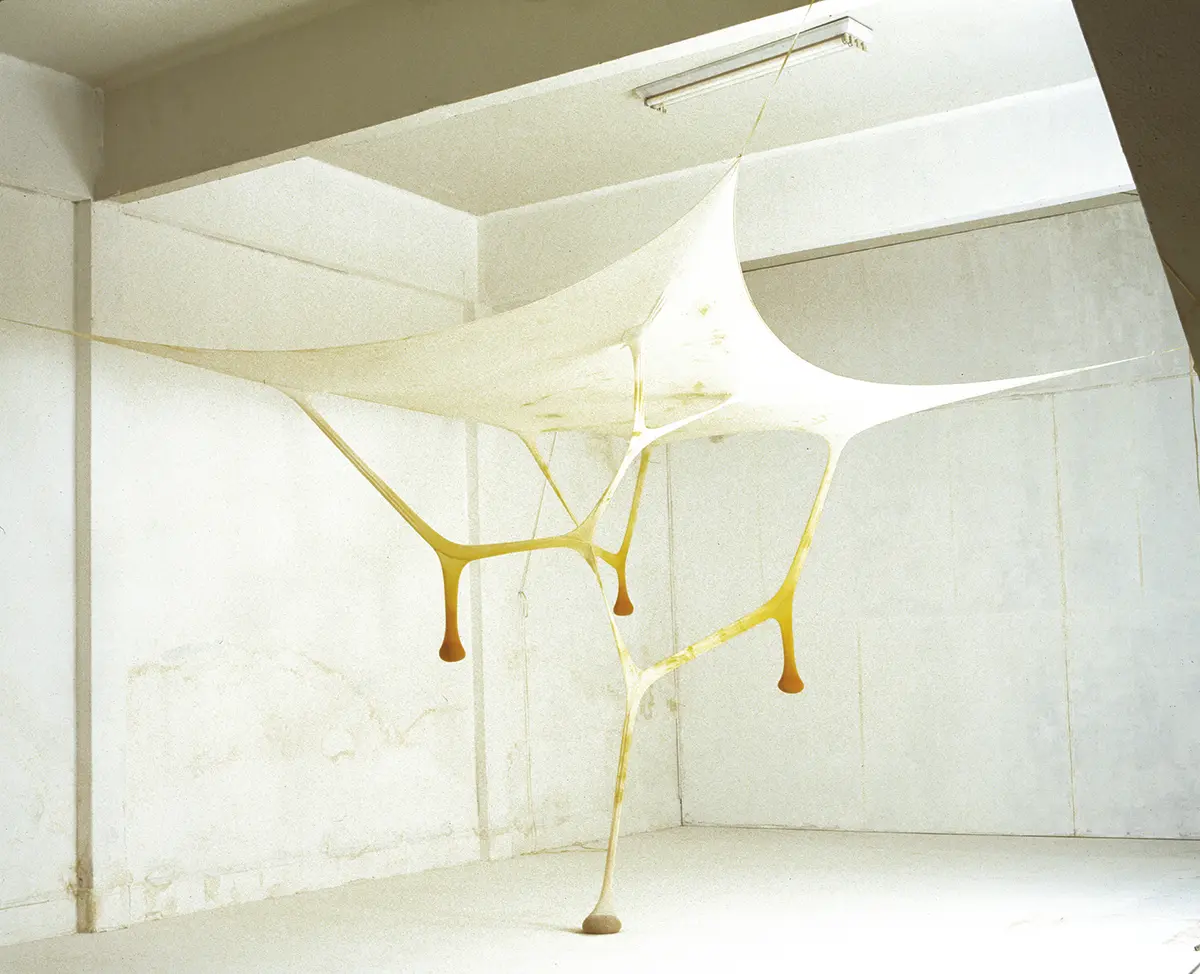
Since the late 1990s, Neto’s investigation of this process has become markedly evident. This is confirmed by his series Naves, among others. Think for instance of his 1999 Nhô Nhô Nave, presented in Helsinki’s Museum of Contemporary Art. In this installation, the artist creates a variety of situations for visitors to experience as they move through the piece in the suggested direction, for instance, they play with their perception of time even as they first enter the space.
Nhô Nhô Nave appears as a maze. Its three entrances lead to the same point where visitors will find a bag filled with ground clover, hanging at nose level. The aroma of the clover generates sensations and associations, replenishing our energy and awakening our remembrances. Afterward, we must walk through a narrow passage, using our hands to open up the space in order to advance.
This narrow passage leads us to a point where yet another bag, this one filled with sand, hangs all the way down to the floor. We must be careful not to step on it. The sequence of our movements through the installation then continues towards another space, where we find a bag filled with small stretched polyurethane balls, which are very inviting to the touch. After this pilgrimage, we must retrace our steps in order to leave the installation. What an intense sensation it is to walk through this maze! It feels like entering an underground cave, a uterus, an organ filled with life’s pulses. We feel the sensuality of its form, the fragility and delicate nature of the membrane that envelops the space organism; we feel its biomorphism. We are led to ponder human nature. Neto’s aesthetic discourse generates a full body-and-soul experience in its receptor.
Ernesto Neto sees the Naves as an organic continuation of the body. For him, “every one of them is part of a larger body, a para-body, something that belongs to the body but goes beyond. Each of them is its own universe and, at the same time, a study of a larger organism.”
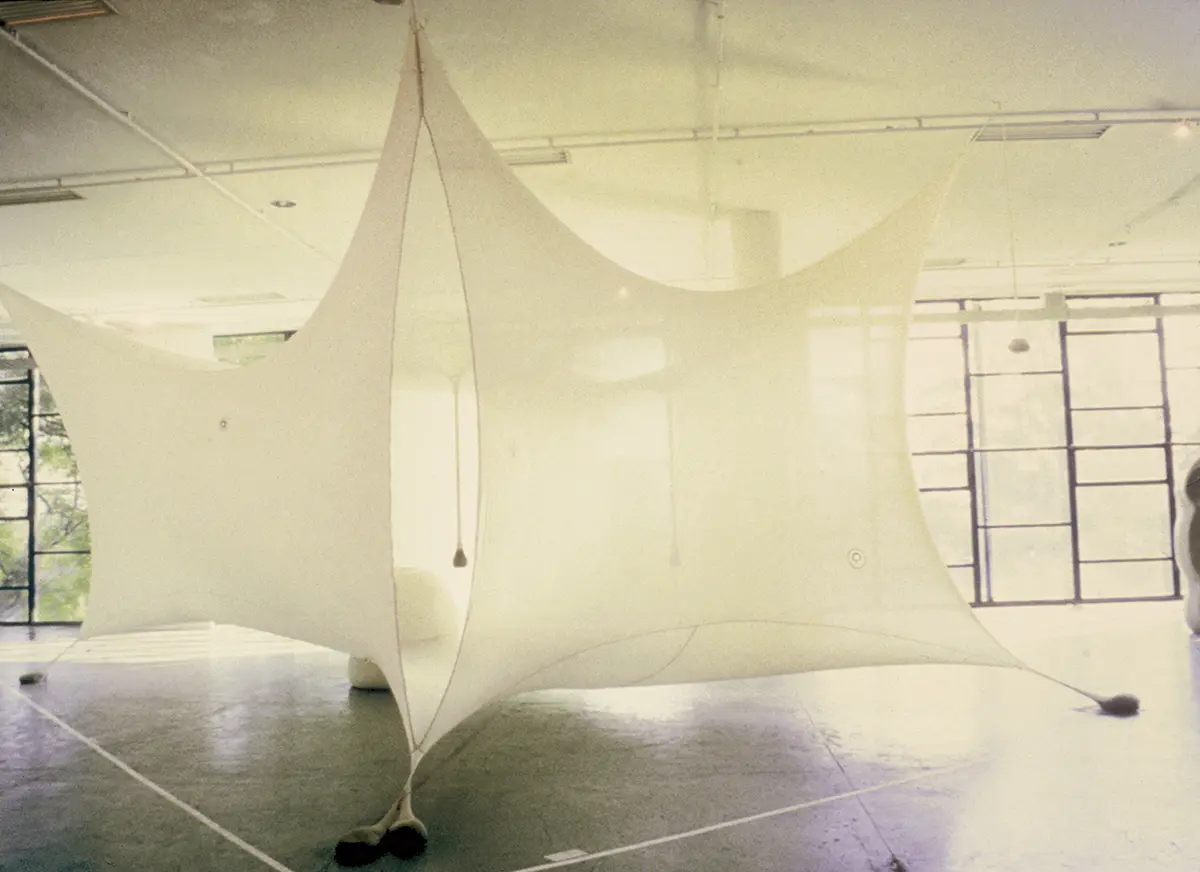
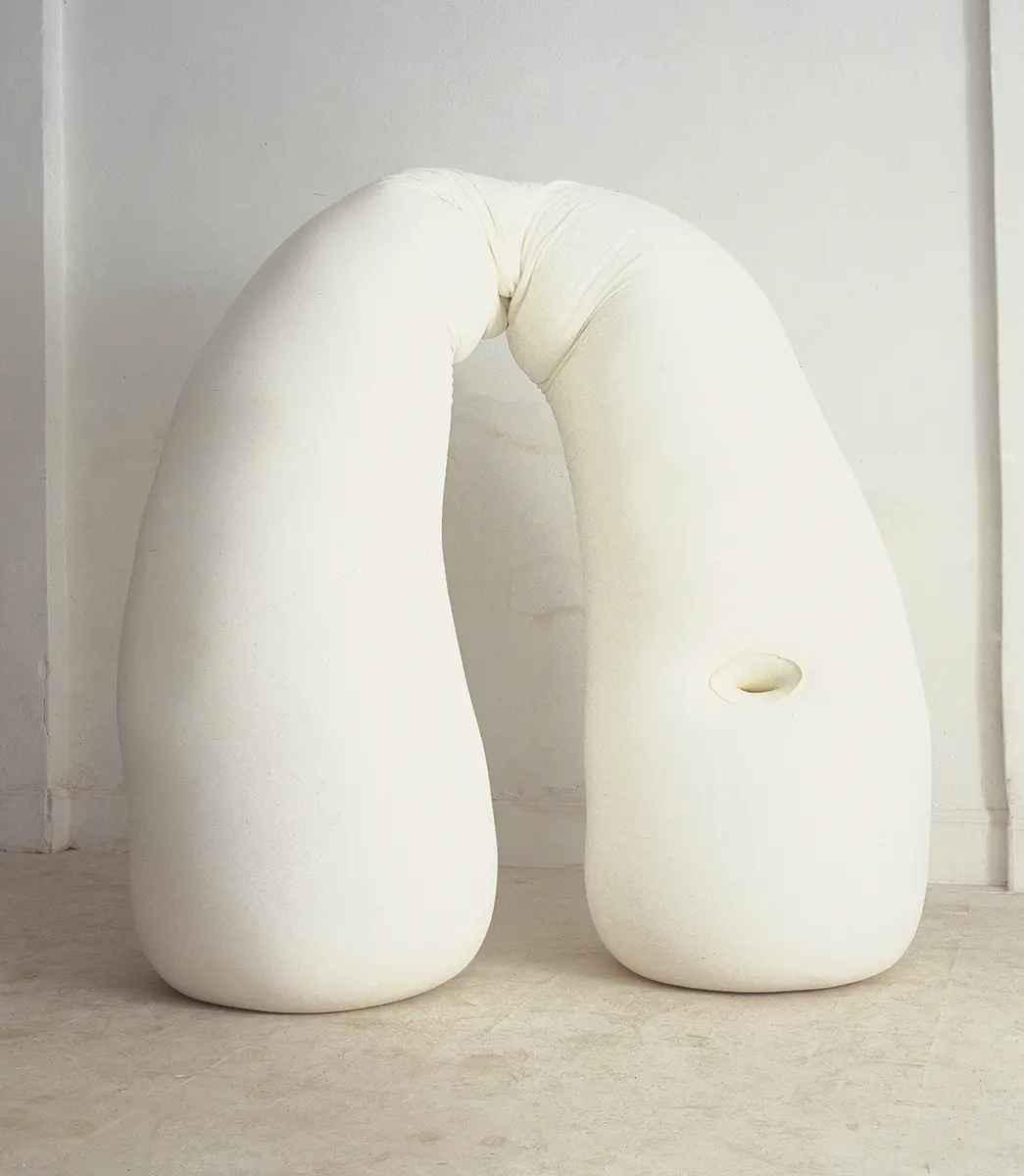
Other works of the same period have addressed the issue of the body and of sensuality. In Arco vientre, is a space where the body of one standing person could fit (in the photograph, it is the body of the artist), and there are also gashes and perforations. The latter appear as well in works like Nana Glip, Sonámbula, and El encuentro de los ovaloides. These gashes and perforations suggest the body’s natural orifices—they resemble vaginal or anal cavities.
Yet there is another significant element in Ernesto Neto’s aesthetic project, one that needs to be understood in relation to his philosophical and scientific interests. It is the element of time. It is indeed possible to establish an analogy between Neto’s Naves and the spaceships of popular science fiction, which journey forth in search of knowledge of “other worlds” and promote our experience of alternative temporal dimensions. There are also ships in the lore of UFOlogy that come to our planet and land in the middle of nature, on fields or in the woods; these are supposedly manned by extraterrestrials in search of contact with, or knowledge of the Earth and its inhabitants.
In the works of Ernesto Neto, those stretched and translucent lycra structures, traversed by light, which are sometimes torn, and from which large bags sometimes hang, generate organic spaces that put us in mind of another space filled with fundamental energies: the cosmos, a universe of sidereal forces and counterforces. Neto has said that “I try to think of space as a hyperspace, as if it could be worked on in a different dimension. . .I want people to get lost inside this transparent maze, a maze of time.”
Arnold Hauser, the renowned historian, noted that in art, time is also the way for us to get in touch with our own memories, in our spiritual life. A work of art exists in time and is caused by time, as much from the point of view of the artist who creates it as from that of the viewer who watches and experiences it.
In modern philosophy, time is an intuited movement, the starting point of the ego, the true consciousness (Hegel). Time is mobility; things happen in time. Lived time is a fluid current on which every instant moves into the next, in an uninterrupted continuity. Time is absolutely new at every point; it is a continued process, but also the conservation of accumulated experiences (Bergson). Every lived experience is, by necessity, lasting, and it is inserted in a “continuum of plenitude” (Husserl).
Time in the work of Ernesto Neto is transitory, in-process; it is an accumulative kind of time, one that remains in permanent transformation, one of substantive re-signification.
Ernesto Neto was born in Rio de Janeiro in 1964. He lives and works in Rio. Since 1988 he has presented numerous individual shows and participated in many collective shows in galleries, museums, and biennials. His work has been shown in many countries: Austria, Belgium, Denmark, England, France, Germany, Italy, Portugal, Spain, Switzerland, Australia, Japan, Korea, the United States, Chile, Mexico, Venezuela, and Brazil. He was, for instance, one of Brazil’s representatives at the Forty-Ninth Venice Biennial, and his work was exhibited at the 2001 Barcelona Triennial, in the Institute of Contemporary Art of London (2001), the Basel Kunsthalle (2000), Washington’s Hirshhorn Museum (2002), Tokyo’s Watari-um Museum (2003), and the Museum of Contemporary Art in Los Angeles. This young Brazilian artist’s long curriculum makes him a prominent figure in the Brazilian scene and in the international circuit.
NOTES
1. Comments by the artist on the occasion of the exhibition En busca de identidades: Arte contemporáneo brasileño (2000), curated by Peter Weirmaiar at the Kunst Rupertorium in Salzburg, Austria, and later at the Galleria Comunale D’Arte in Bologna, Italy.
2. Cúrcuma, also known as “land saffron,” is a local spice used in both salty and sweet concoctions. The plant is used in herbal therapy for its mental and physical strengthening properties. It is also considered an aphrodisiac.
LISBETH REBOLLO GONÇALVES
Professor at the University of São Paulo, President of the Brazilian Art Critics Association (AICA, Brazil Section).