
Federico Uribe is known for his humorous works of art, which produce ironic, enigmatic, and dislocated results. In his most recent show, he continues to explore the theme of limbless, headless human bodies sculpted in telgopor and penetrated by clusters of everyday materials (such as pencils or pins), articulating specific points. His latest work moves into the terrain of the installation, with a multitudinous clustering of back-turned and frontal figures that are like active inhabitants of a counterculture that nobody any longer rejects. Uribe, who was born in Bogotá, Colombia, in 1962, has lived in Mexico and in several US cities, and now makes his home in Miami. As an artist, he has managed to keep youthful aesthetics even as he deals with the subject of the body, the oldest subject in the history of art, by approaching it as a referent for social history. His individual figures are not preppies or hipsters; they are the antithesis of the world of Madonna-like divas—extremely colorful, mostly of a diurnal character, and referred to non-aggressive, gracile sexuality. These pieces, carved in telgopor, transfer generic industrial mannequins to an individual thesis filled with anti-fashion connotations, connotations of the intentional riddle, of three-dimensional creation, revealing the development of volumes and of light and shadows through infrequent media—infrequent save for a fashion designer’s pin cushion. They are, in themselves, the object and the subject of sculpture. Resolved in sizes that are barely larger than natural, they are independent of the mannequin as much as of traditional sculpture and of the combined art-and-fashion shows that were launched a couple of years ago by the most famous boutiques in New York’s Madison Avenue.
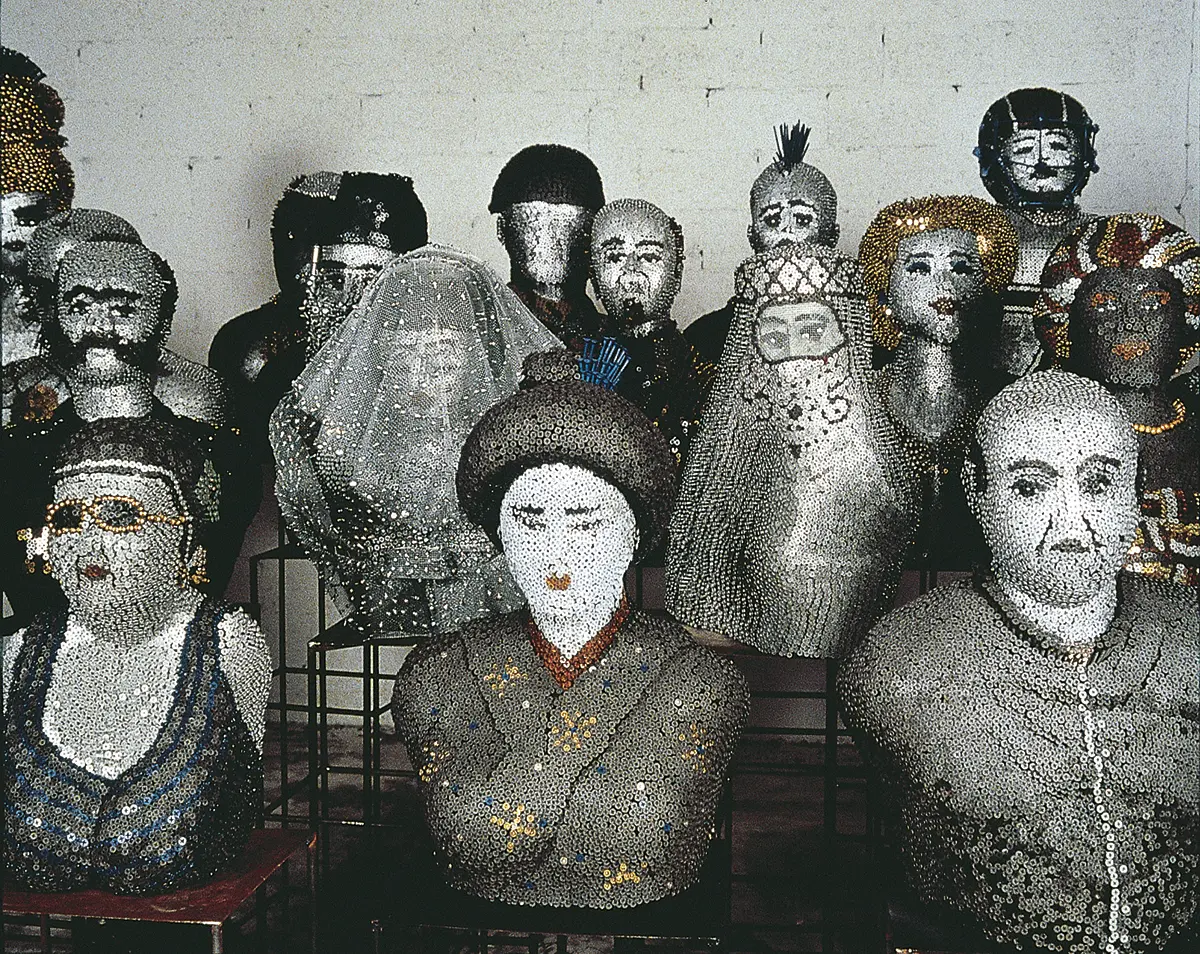
Uribe’s installation Unknown Citizens brings us face-to-face with representatives of the various human groups that are seen daily in TV news programs. The 27 pieces in the installation, as well as the individual ones, are in a heightened state of expectation. The perception of ethnic enclaves surpasses any possible view of the whole; the installation is of great impact and will not let itself be ignored. As they move around the characters, visitors seem to be taking gigantic steps over the globe, going from country to country and from ethnic group to ethnic group. The individual figures in the first room and the 27-piece installation in the second room seem conceptually opposed, but, even if it’s difficult to admit it, they are a single vision of today’s fragmented world and of the coexistence in it of the most virulent opposites. The installation gives the show a kind of dual title, Unknown Citizens/Ciudadanos Desconocidos, meaning people who are ignored and remain anonymous, stereotyped cultures and generic occupations (Jewish, African, Muslim, Palestinian... soldier, tailor, rabbi...). It represents a variety of exploited peoples, the different kinds of pariahs that populate the Twenty-First Century like they populated, in different ways, the age of the Roman Empire or the Spanish conquest of the Americas.
Everybody Gets Screwed (in English) is the exhibition’s second title, seemingly also to emphasize the social reference to the dispossessed. Yet, it also admits a literal reading in reference to the technique employed, since every one of the sculpted figures is traversed by screws and nails, pins, pencils, forks, and a variety of objects.
Post-conceptual art has expanded the range of its appropriations, and in a way, it has certified the artist’s right to partake of elements from the most diverse fields. It should be remembered that screws ceased to be the exclusive domain of carpenters, sculptors, and framers a long time ago; neither are pins, fabrics, and telgopor the exclusive property of the fashion designer. The interbreedings are multidirectional in materials and techniques, resources, and the expression of ideas. Contemporary fashions have incorporated aspects of the visual arts, while the visual arts have exchanged media and languages with film and photography. Also in this system of appropriation, which from a different perspective corresponds to an erasure of boundaries—cultural, geographic, moral, or related to production—we find science and art, industry and individuality. This is why Federico Uribe’s individual pieces strike us with their originality, even if they occasionally refer to the use of multiple components, or to characters from a Peter Sellers film.
From a distance, the works in the first room—as happened with Uribe’s previous shows of individual works—will only allow us to identify their volume and color. Close up, however, readings multiply and interconnect, exciting the viewer’s curiosity. In these works, the mannequin-body, the embroidery (an art that Uribe has mastered), and the conception of canvas and text constitute support as much as matter, as allusion and reality. The use of screws, pins, pencils, pot-cleaning supplies, brushes, plastic forks, horse hairs, glue, and telgopor incite the viewer to touch, to test the boundaries and the materials. These are adult provocations—for the freest among them as much as for the most self-controlled.
GRACIELA KARTOFEL