
The work of Félix González-Torres (1957-1996), a Cuban-born artist who relocated to New York in 1976, has become increasingly well-regarded and popular. Critics from many countries have expressed great interest in González-Torres (Nancy Spector, Robert Storr, Peter Schjeldahl, Simon Watney, Eduardo Pérez Soler, Gerardo Mosquera, Carlos Basualdo, etc.), and there have been many shows, even posthumously, dedicated to his work. González-Torres is popular not only because of the clarity and simplicity of his work, or because of the ease with which it can be reproduced, but also because of its potential for shifting meanings. Pérez Soler has written, González-Torres’s work “is all the more interesting when it reconciles, in such an impeccable way, political and social issues with the will to create pieces endowed with a strong charge of poetry and metaphor.”
On the basis of the catalog for his show De viaje—the idea of traveling as a metaphor for transformation—presented in 1994 in versions prepared for three different cities (Chicago, Los Angeles, and Washington), Félix González-Torres’s oeuvre can be grouped by series according to the different media used: photography, starting in 1983 and with continued relevance after that; word portraits, from 1986, where language is what drives the viewer to create the image; piles of paper, starting in 1988, with loose sheets of paper printed in limited editions that are removable but always replaced, and contain equivocal and disquieting texts and images; billboards, beginning in 1989, either with images—a bed with silky pillows and sheets—or words; beaded curtains, from 1991, signaling a demarcation (or a transformation); and strings of lights, also starting in 1991, with common light bulbs that can be installed in many different ways.
González-Torres’s art turns the viewer into a participant, allowing the public to take with them parts of the work of art (such as the sheets of paper, or bonbons). It questions the notions of originality and of property and instead emphasizes fragility. It gives place of pride to language, thus relating to one of the most significant trends in late twentieth-century art, which includes Kosuth’s philosophy of art quotations and dictionary definitions to Jenny Holzer’s commonplace statements; Lawrence Wiener’s phrases written in the order of what they say about real objects; Tom Phillips’s word painting (one among many works with language by this important British artist) in which a jumble of superimposed letters quote Dante’s line about a “dark forest;” or John Baldessari and Robert Barry’s numerous conceptual sentences (“Everything that I know but I am not thinking about at this moment, 1:36 p.m., June 15, 1969”), among others.
In González-Torres, words do not have a single, unitary meaning. They work on the viewer’s memory, and they have been deployed carefully in order to provoke associations and metaphors. They appeared for the first time in word portraits that, according to Mónica Amor, were “created on commercial billboards or on walls, listing together historic public events and intimate private events, along with the dates in which they occurred. The enumeration of these events follows no particular temporal or spatial order, and in this way, the work subverts linear narrative logic. Thus, González-Torres invites us to create our own history in relation to the events listed, a history that will be molded and determined by our own particularity, as we generate a personal interpretation of the public events suggested by the artist” (ArtNexus 61, 1995). Words also appear in González-Torres’s piles of paper, for instance in Sin título, a 1989–1990 work that comprised two reams of paper, one printed with the phrase “Some place better than this” and the other with the phrase “No place better than this.” Finally, words are present in the billboards that González-Torres began producing in 1989.
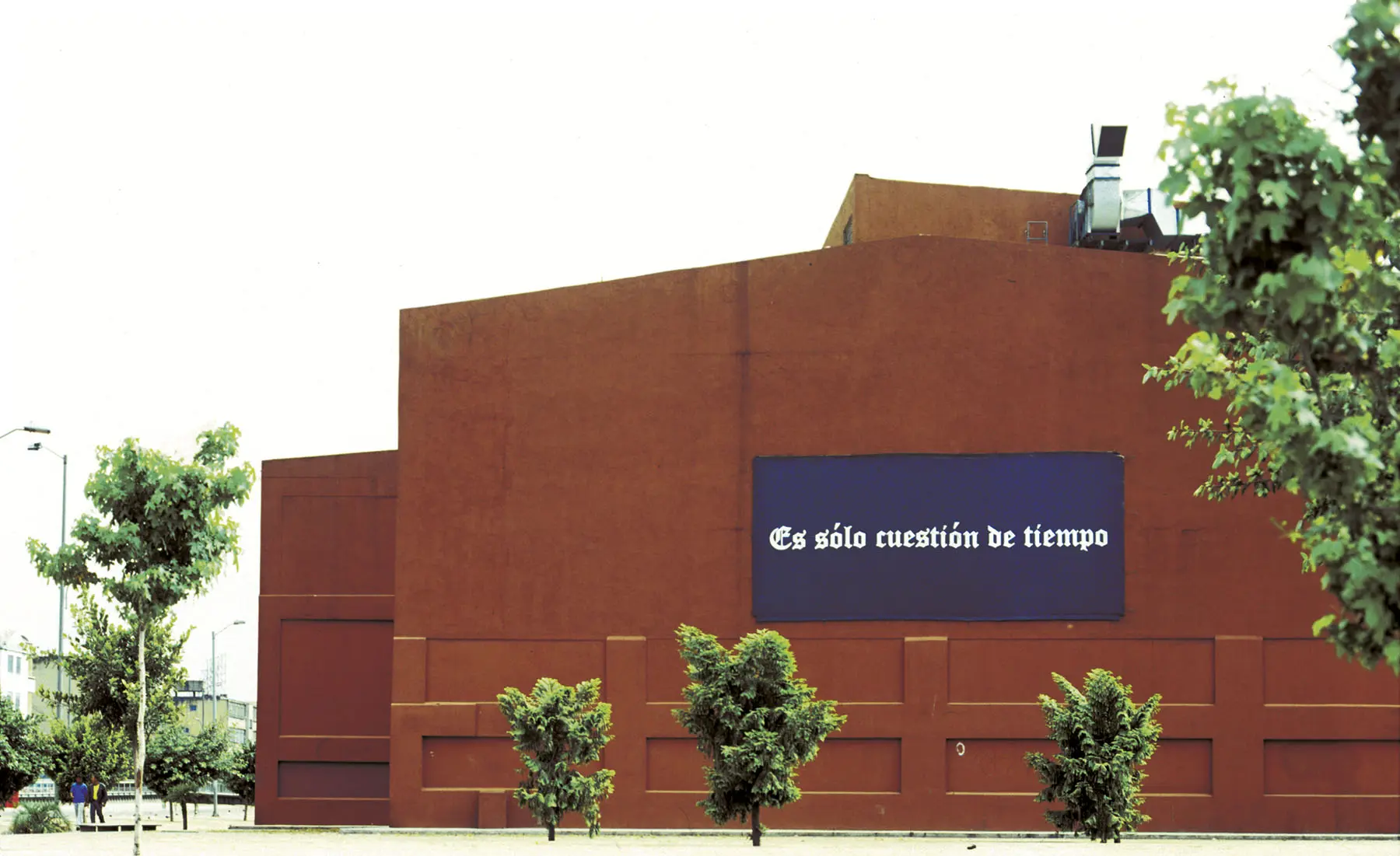
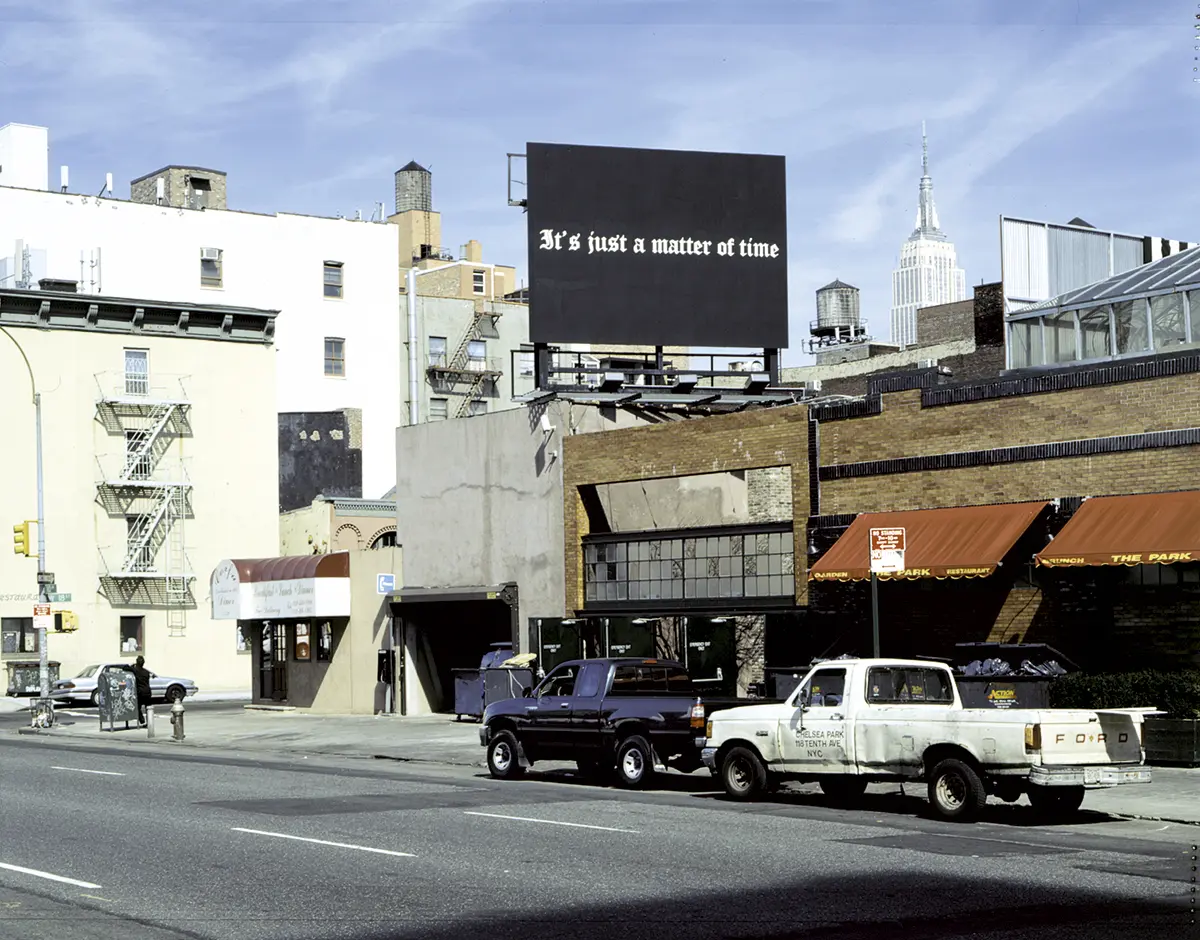
One of these billboards is Sin título (Es sólo cuestión de tiempo), which has been on display at the Instituto de Medicina Legal in Bogotá, Colombia, under the sponsorship of Leo Katz. The work in Bogotá merits a brief history. This board, with white gothic-style lettering on a black background, was shown for the first time in Hamburg in 1992, as part of a González-Torres show at the Kunstverein entitled Gegendarstellung—Ethics/Aesthetics in the time of AIDS. It was shown again last year on the occasion of González-Torres’s double exhibition in London and New York and, above all, as a reflection on the impact of the events of September 11 and its aftermath throughout the world. Obviously, the meanings differ from those of its original appearance in Germany, and we may infer that possible interpretations change according to the site of presentation. The parameters established for González-Torres’s billboards require them to be installed in a minimum of six open-air locations in any given city. Now, thanks to the collaboration of many people and institutions throughout the world, the concept has been expanded from “city sites” to “country sites.” Sin título (Es sólo cuestión de tiempo), number 190 in Félix González-Torres’s Catalogue Raisonné, has been displayed over the past months in fifteen different cities in various countries: Athens, Berlin, Bogotá, Cambridge, Dublin, Kirkwall, London, Milan, New Delhi, New York, Rio de Janeiro, São Paulo, Tokyo, Warsaw, and Zurich (in each location, obviously, using the local language.)
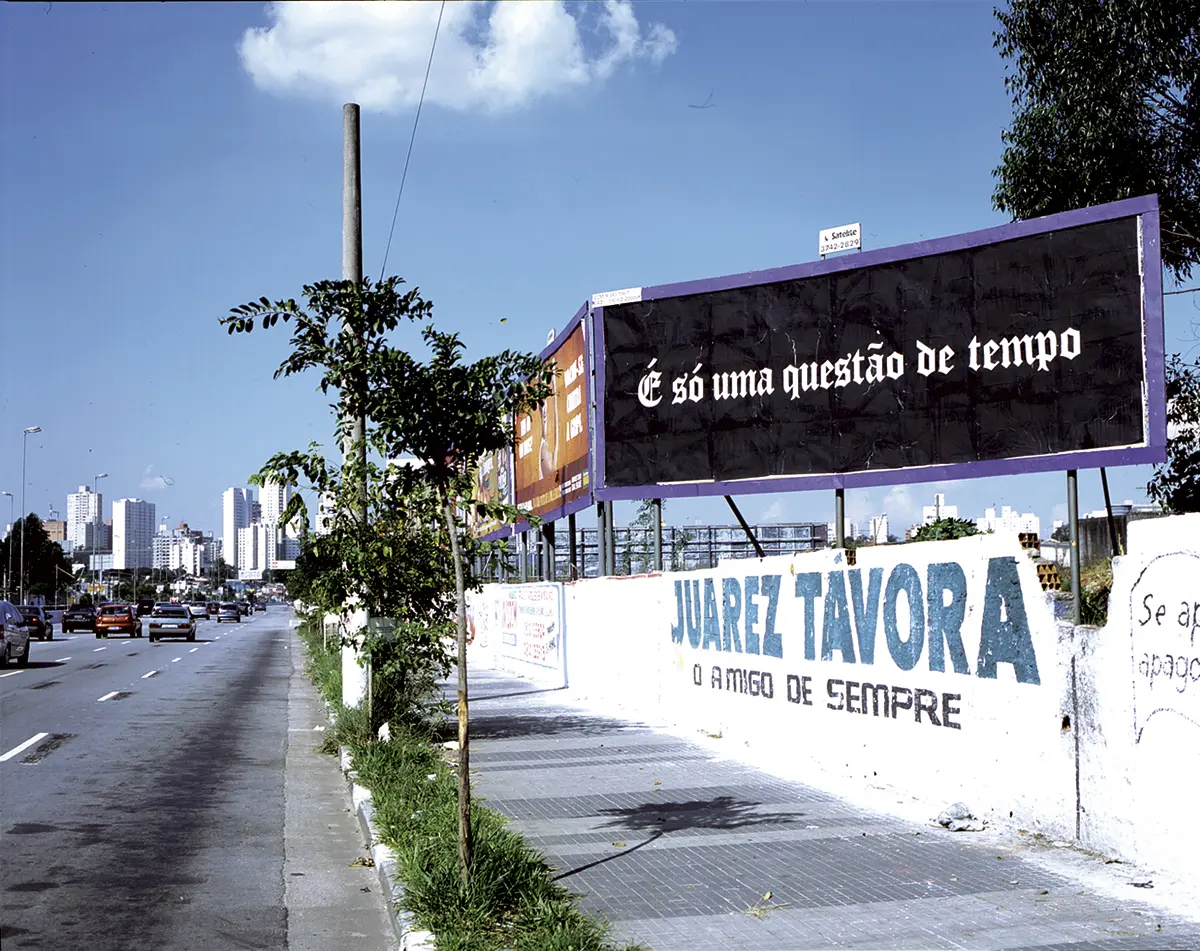
The meaning of the text in this billboard (as in others by González-Torres) shifts not only because of the resonance it acquires in each of the sites where it is displayed; it changes also according to each viewer’s personal interpretation, and it changes with the passage of time. Read in Bogotá in early 2003 (and in one of the city’s poorest and most unsightly locations, one that is in transformation as well), the phrase “It is only a matter of time” is disconcerting—particularly so when we think about the city’s history and when we imagine the consciousness of its citizens, let alone their subjectivity. Yet, upon reading and re-reading, the text acquires or could acquire (we should not forget González-Torres’s emphasis on the heterogeneity of perspectives) a hopeful meaning, implying the possibility of transformation.
It’s Just a Matter of Time is the title of the book to be published by Sadie Coles HQ, Andrea Rosen Gallery, and Buchhandlug Walter Konig. The book is exclusively dedicated to the billboard works by Félix González-Torres and will be published during the fall of 2003. Jan Hoet contributed to the publication with his texts.
GERMÁN RUBIANO CABALLERO
Historian and art critic.