
Fernando Casas is part of a constellation of Latin American artists who have established themselves in the Houston art world since the 1970s. He teaches philosophy at Rice University and is represented by one of Houston’s most prestigious and architecturally impressive galleries of contemporary art. Casas’ recent work revisits the possibilities of collage as a means to incorporate reality into the painted image. Almost a century after Picasso and Braque first introduced it into painting and at a time when digital technology has made the manipulation of the image ubiquitous, Casas blends his own imagery, media images, and art historical icons by painting a trompe l’oeil of imposture whereby pasted collages and painted collages are rendered indistinguishable. The idea behind this legerdemain is to reconstruct reality not only from within the perceiving artist but also from the social generators of imagery. The following review explores a work in Casas’ current exhibit at Gremillion Gallery that best exemplifies his most recent thematic interests: Spine (2002).
Spine is a diptych consisting of two panels held together by twine as if they were contiguous pages of a book. The title of the work alludes primarily to the binding that gives a book its familiar form. Indeed, two images of books are telling details of Spine: an art book and the Christian Bible. These details make reference to the culture of both pagan and religious books which has shaped history. However, the other meaning of “spine” is “spinal column” for it is obvious from the posture of the main human figures that the verticality largely responsible for human intelligence is implicated in the subject matter of this work.
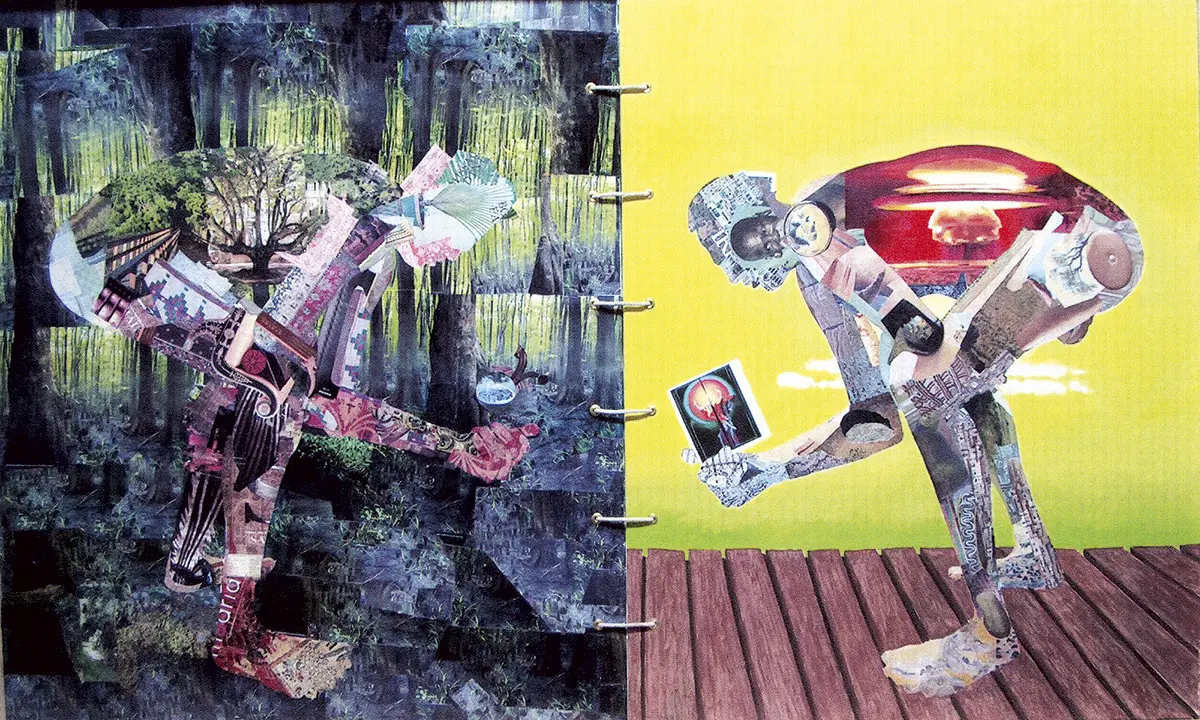
Each of the panels of Spine bears the silhouette of a man leaning over as if to pick something up from the ground. It is a posture more akin to anthropology or homoerotic iconography than to the history of art. As homoerotic imagery, it suggests sexual enticement and/or submission, whereas in anthropology it is the natural posture of hominids immediately preceding Lucy. Both leaning figures in Spine are inspecting the objects they hold in their hands—the very act that spurred the evolution of human intelligence.
Yet it is not only physical but also cultural anthropology that holds Casas’ interest. Part of the figure on the right panel is an image of a man whose lips have been pierced, stretched, and fitted with a wooden disc. It is an image that alludes to a subversion of canonical beauty and the modern Weltanschauung implicit in the deformation/mutilation/decoration of the body so widespread in contemporary urban cultures. On the feet of the left figure, there are ancient Maya hieroglyphs—part ideograms, part phonemes: a link between literate and iconic cultures. Ways of life that were once regarded as useless anachronisms have become important not only for body artists but also for the iconic culture of the cybernetic world.
The spine of Spine is also the surface of a virtual mirror. The silhouetted men are distorted reflections of one another and the way they are reflected by this mirror is guided by the critical malice of a philosophical demon: images subsumed under a clear concept have obscure reflections, whereas enigmatic ideas gain clarity contextually. Casas the philosopher reflects Casas the painter. The rather ominous reflection of a growing tree on the torso of the left figure has become a mushrooming nuclear explosion on the right figure. Casas showed a similar concern for nuclear annihilation in the work Approaching Storm (1983) produced during the Reagan presidency.
Thus, Spine is a work in which rational calculus mutates into mere insinuations and, conversely, impressions are transformed according to the logic of art. The man on the left panel is picking up the globe painted on the closed panels of Hieronymus Bosch’s The Garden of Earthly Delights. That work—The Creation of the World—is seldom seen by the visitor to the Museo del Prado. It would be necessary to close the panels in order to see The Creation of the World, but by so doing The Garden of Earthly Delights would be concealed. Spine brings the focus back to the forgotten diptych. The man on the right panel, in turn, is holding Casas’ own version of Grünewald’s Resurrection, where the head of Christ is hidden by the spine of the book from which he painted it. As artists, we distance ourselves from the religious content of the art of Michelangelo, Leonardo, Grünewald, etc. The Bible (the Book) gives us the body of Christ, while the art book hides its head. The first page of Spine gives us the forest, while on the second page, the trees are gone and only the clearing remains.
Living by the Book (any Book) is different than living with books. All authors are fallible. In spite of contemporary actualizations of harmless and harmful anachronisms—self-mutilations, religious fanaticism, shamanism—there is an evolution towards that minimum of understanding. Spine is a reflection of someone who lives with books. Its opened pages show that it is not a life away from the world but very much a part of it. The other works in this exhibition eloquently confirm this fact and my initial thesis that Spine is the backbone of Fernando Casas’ current artistic/philosophical concerns.
FERNANDO CASTRO R.