
Fragmento y universo (Fragments and Universe) presents recent works by important Venezuelan artists, within the framework of a reflection of the universe of contemporary art. Works with shared characteristics, whether of form or content, comprise individual semantic worlds within the exhibition. The various parts and segments, or artists’ various areas of interest, as much as the works of art themselves, can be seen as fragments of a discourse. The curators decided to run the risk of working with an aesthetic of fragments, attempting to build an all-encompassing discourse about a segmented universe, and their choice allows for the gathering of diverse artistic expressions. Viewers will thus find new associations and threads that are shared by different explorations. The artists themselves reflected, in their works, in their performances, and in writing, on the manifestations of the universe and its fragments.
Old totalizing discourses about art, the belief in a single path for artistic exploration —even if over a brief period of time—, and the unidirectional definition of what an artist is have all lost their way, and in their stead, we find a more complex scenario, one where many visions coexist. The urge to belong to an Academy, to official art, or to the latest avant-garde, which defined the paths to follow and the aesthetic ideas to adhere to, has been replaced by a preeminence of individual options. One common thread is the artists’ awareness of their work as belonging to just one section of the world of art, of their focus on just one part of a wider whole. Artists’ investigations emphasize one or several areas of the many that are open in an expanded universe.
The city of Caracas has been overtaken by political passions, the same passions that today grip every Venezuelan’s private and public life. The Corp Banca gallery is located a few blocks from Plaza Altamira, which at the time of the show’s opening had been occupied, in an act of civil disobedience, by high-ranking military officers. Artists are not indifferent to the political situation, and it is intriguing to find a direct relationship between the themes of a given piece and the piece’s context. The show’s first thematic area refers to the fragmentation of society and the issues of war, mass consumerism, migration, and sociopolitical divisions. Javier Téllez and Sandra Vivas take political passion and turn it into reflection.
Along with his investigation of the manifestations of madness, Javier Téllez has introduced symbols related to Venezuela’s current situation. His video installation identifies an organization that has been the target of political aggression, Caracas’ Metropolitan Police, which has moved from being an observer to being observed, from investigator to investigate, from the guarantor of the city’s collective security to a force in dire need of defenders. In a monitor that is hooked, in real-time, to a security camera, we watch a police van. The van has no tires, so it won’t move, but its sole presence makes it a possible target for vandalism. Identities and relationships have been altered, and the symptoms of a political fracture resemble those of fractures in the psyche.
In a split screen, Sandra Vivas’ video describes two tours of the city, one to the east and one to the west. The split screen technique was famously used by local TV stations to show simultaneously the President’s speech and the street protests of April 11 (now known as the “April 11 massacre.”) The urban landscape seen from the expressways in each direction is the same; the sharp territorial/ideological divisions of contemporary Caracas are revealed unnecessary and useless, even if they are a political reality.
The devastating consequences of human conflict in amply evidenced in Lihie Talmor’s desolated gray landscapes. Talmor’s photo prints record a different geography, that of the border between Lebanon and Israel (with a well-known set of issues and conflicts of its own), and its symbolism goes beyond the mere notion of divisiveness: it refers to war and its corollary, situating us one step ahead in the process of fragmentation.
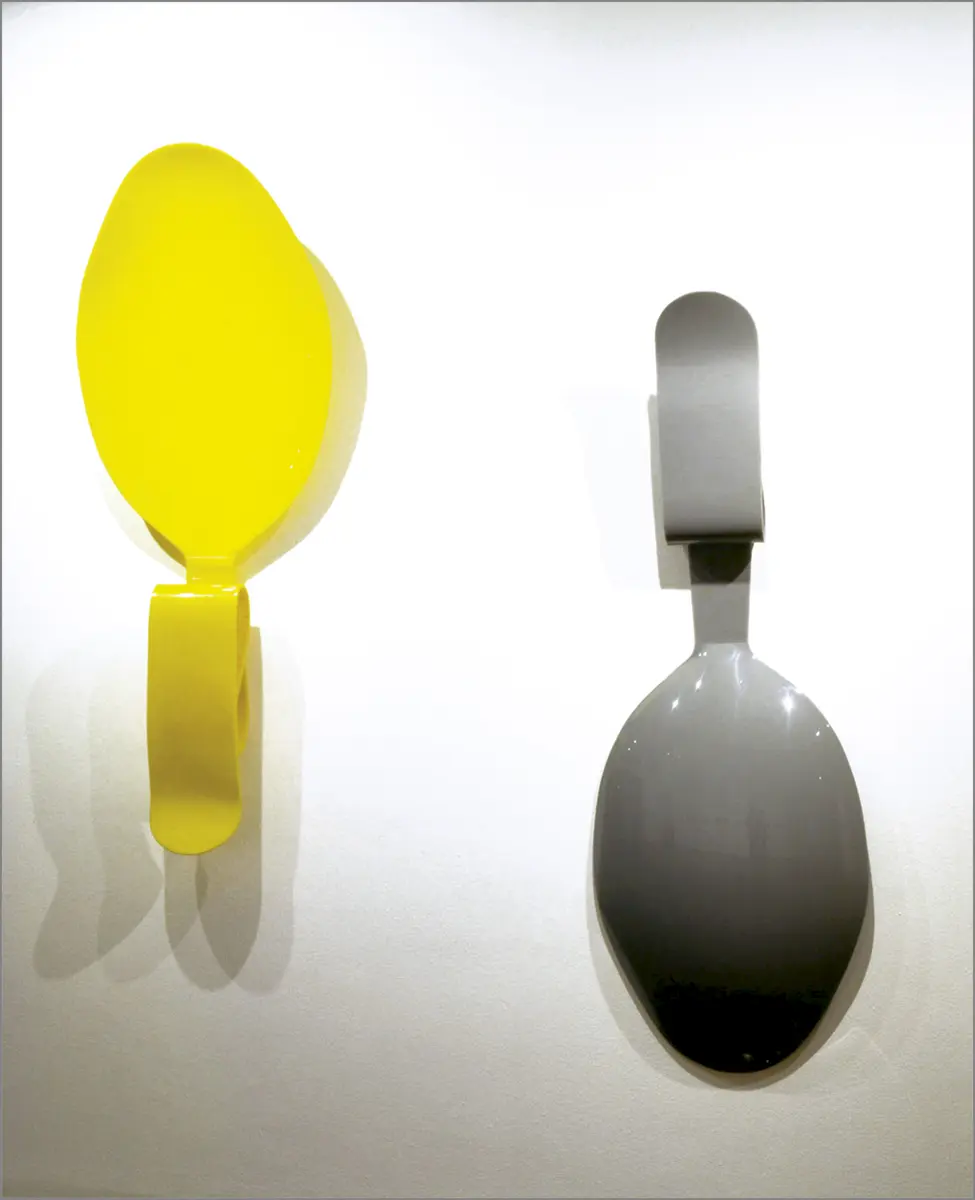
Within this set of situations and circumstances, we are able to distinguish a simple, everyday object, oversized and bent: a spoon. José Antonio Hernández-Díez reformats this popular object to emphasize its function in consumption, be it of sweets or nutritive foods, as well as in the preparation of crack for smoking and in scavenging through garbage. In this way, Hernández-Díez is reflecting on the consequences, both positive and negative, of the massification of consumerism.
A Framework of dreams is our introduction to the second group of works. Inside a large white frame, Ramsés Larzábal pastes phrases and words taken from his private journal; as dreams do, these phrases and words take on strange and sudden meanings.
In the second group of works, the focus is on the psyche and the body, and political intentions are replaced by a very human element —humor.
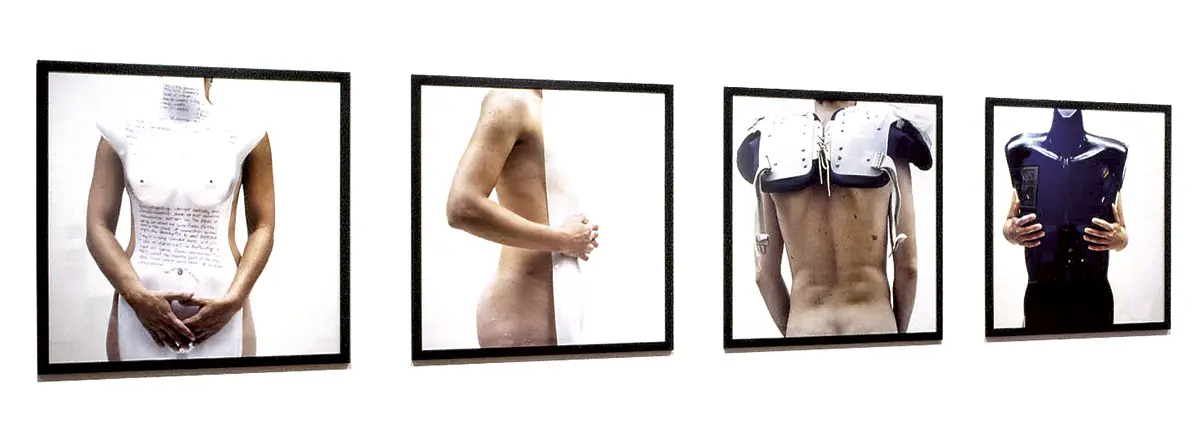
In Amalia Caputo’s large cibachromes, the body appears as the container for the range of all that is human. Prosthetics-addled torsos, being and appearance, in shapes of a sculptural character. Ambiguous figures whose artifices indistinctly signal characteristics of both sexes, such as a female torso with shoulder pads like those used by football players.
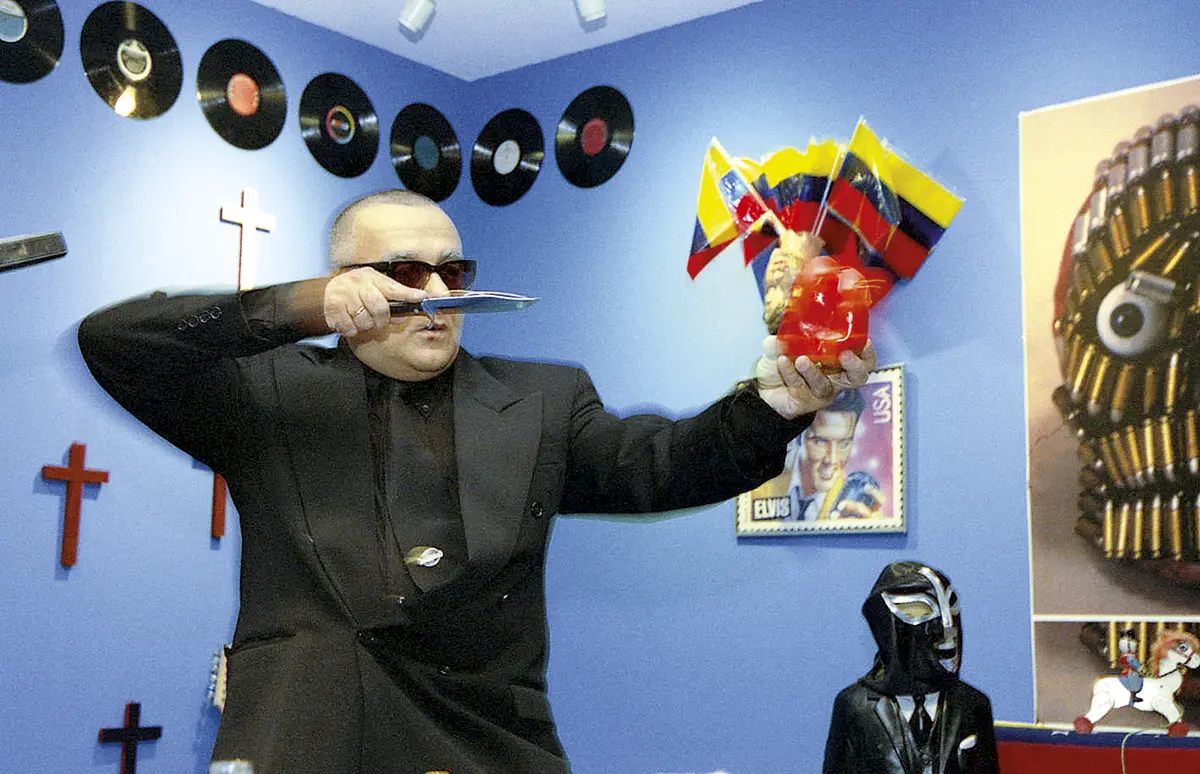
Carlos Zerpa’s work is the background for a performance in which he plays a 1950’s disc-jockey —a game he played as a child—and at the same time an altar to nostalgic feelings for a past that is nonetheless recent, one whose music and imagery we still recognize.
A variety of techniques are present in this show. The artists present make no thematic leap or transition in order to adapt to the curator’s intention; there is, instead, a fluid relationship between the curatorial concept and each individual exploration. Artists in the show experiment with new techniques, from painting to pixilated images, as media for the transmission of new content or to emphasize the value of the medium in itself.
Roberto Echeto and Enrique Enríquez experiment with drawing. Echeto’s work is a large-format projection of small drawings, the artist’s daily musings turned into a narrative. Enríquez, in turn, tells us about nonexistent drawings, drawings that will only exist in the imagination of the listener.
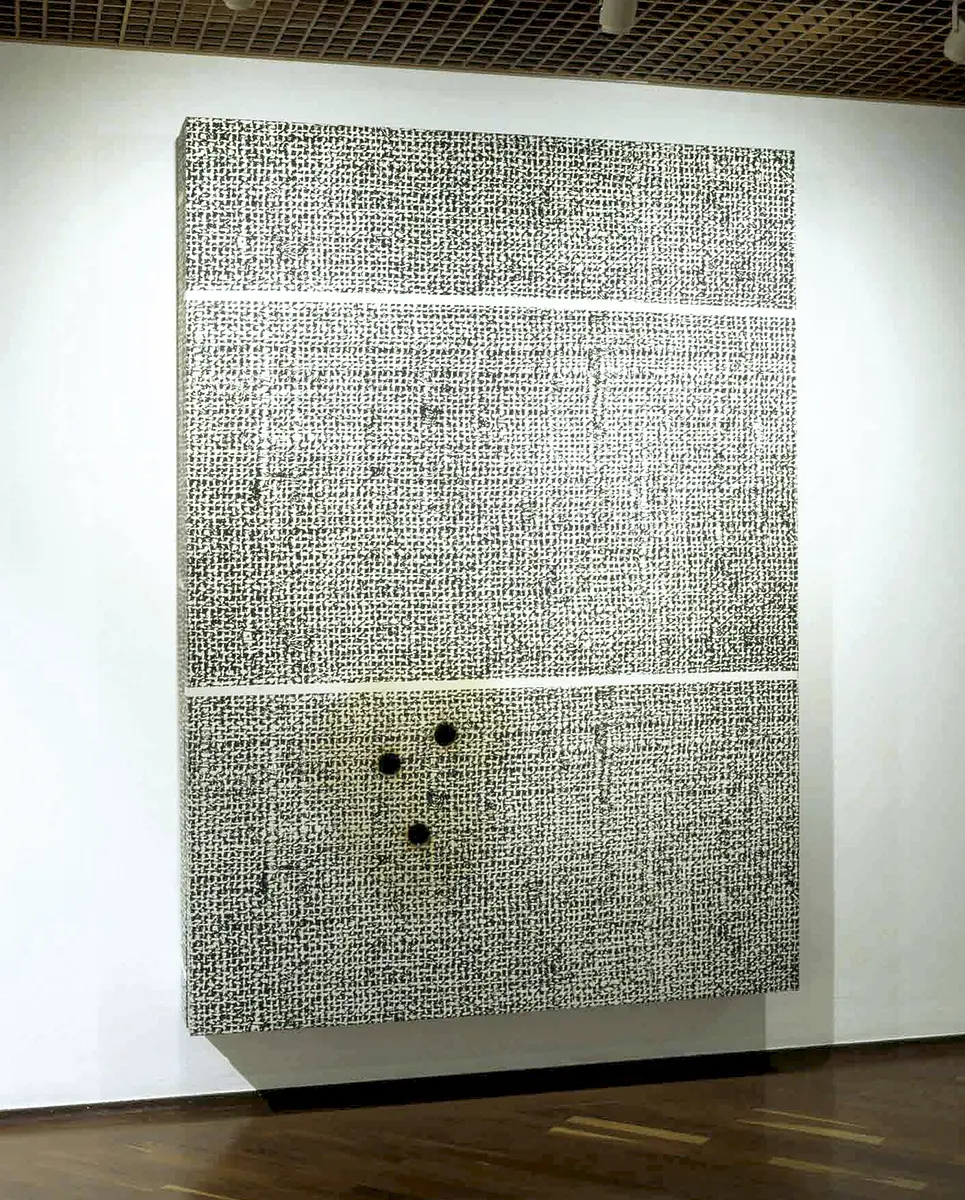
The medium of painting is also subjected to experimentation. Meyer Vaisman attempts to deconstruct pictorial illusion through the creation of, paradoxically, a painting. Vaisman magnifies the support, turning its very fiber into the work’s subject; he creates shadows and textures by puncturing the canvas and staining it with oil.
In Rafael Romero’s video installation, our senses are confounded by pixilated images of a Caribbean seashore and the sound of waves breaking. It is an abstraction of Nature, its technological reproduction through color and elemental sounds.
The work of Juan Araújo makes explicit reference to an important Venezuelan artist of the past; Araújo paints and draws on a monographic volume devoted to the work of Alejandro Otero. The younger artist’s action highlights the futuristic, visionary character of Otero’s work, as well as its relation to artistic tradition; at the same time, Araújo gives value to the publication itself. It is a kind of homage that works as a pretext for the creation of a new piece, this time of a pictorial character.
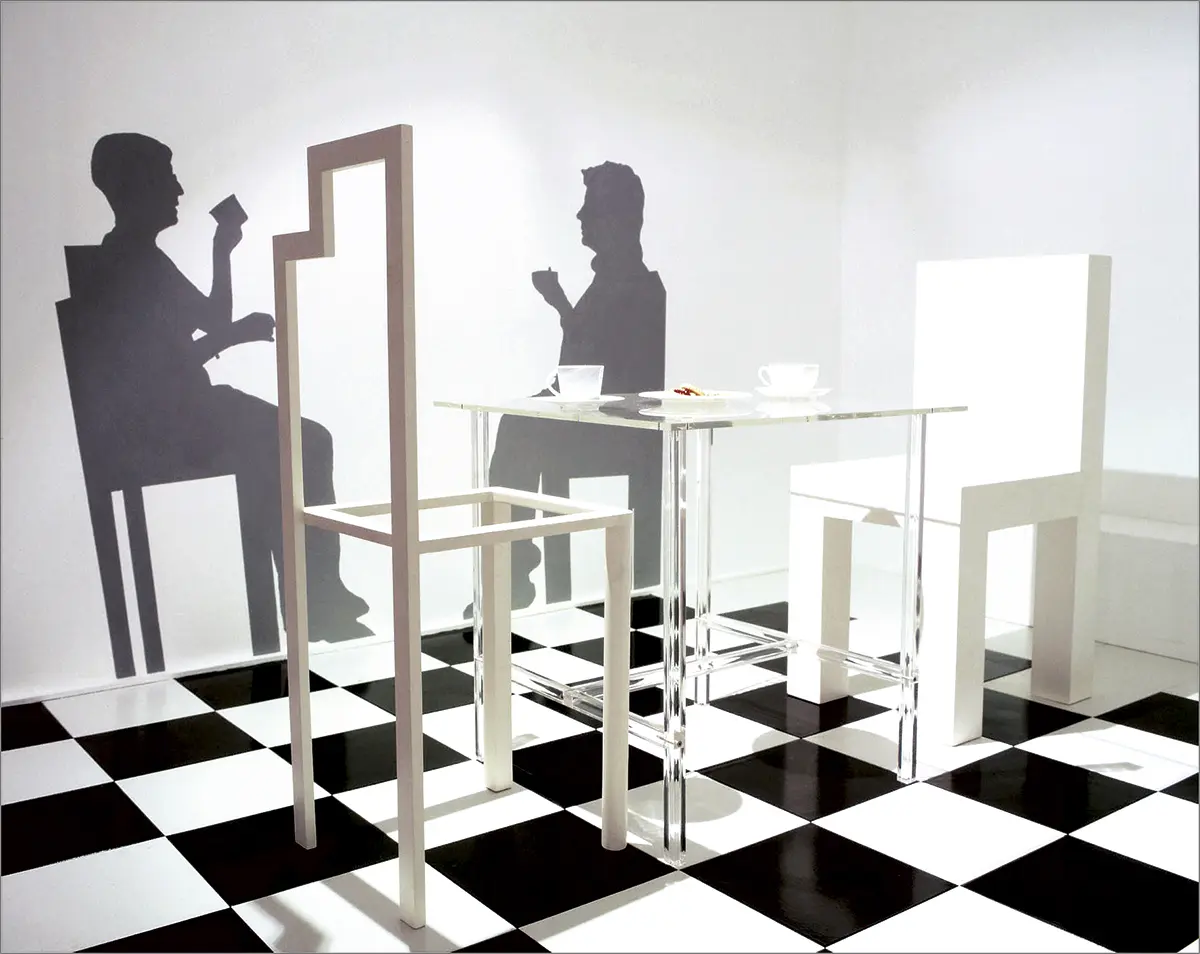
Antonieta Sosa’s audio installation is a companion to a conversation between the artist and the show’s curator, and it focuses our attention alternatively on Sosa’s sculptural objects, especially her chairs, and the conversation itself. Sosa also presented a performance piece in which she patiently weaves a three-color flag, in reference to this symbol’s prominent presence in today’s Venezuela, and to the metaphor of “weaving the country together.”
Spatial illusionism becomes virtual in Pedro Morales’ work. Morales has long used computer technology in his artistic creations. Using a computer mouse and a regular screen, the viewer moves around a computer-generated room, while the route chosen and the discoveries made along the way are reproduced for all to see on a much larger screen. Like a videogame, the process captures our attention with the strange paths it follows on landscapes that have elements of a clearly Venezuelan idiosyncrasy.
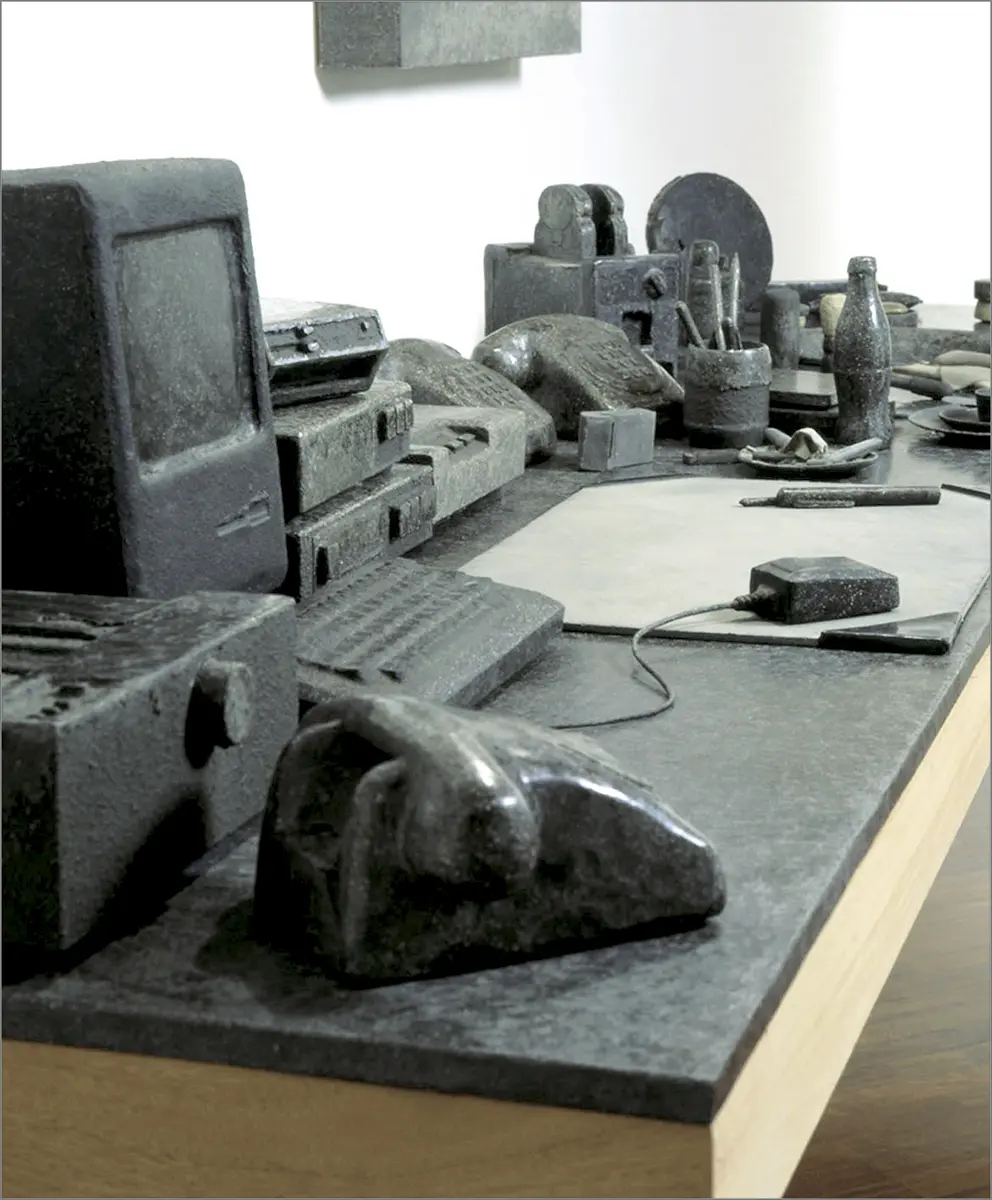
Some of the artists use new communication and image-creation technologies as tools and also as the subject of their work. Jorge Stever creates dark and intriguing sculptural objects that reproduce common technological items —latest-generation machines that will soon become fossils, machines that define the interpersonal relationships through which we discover new communicative modes and new states of isolation.
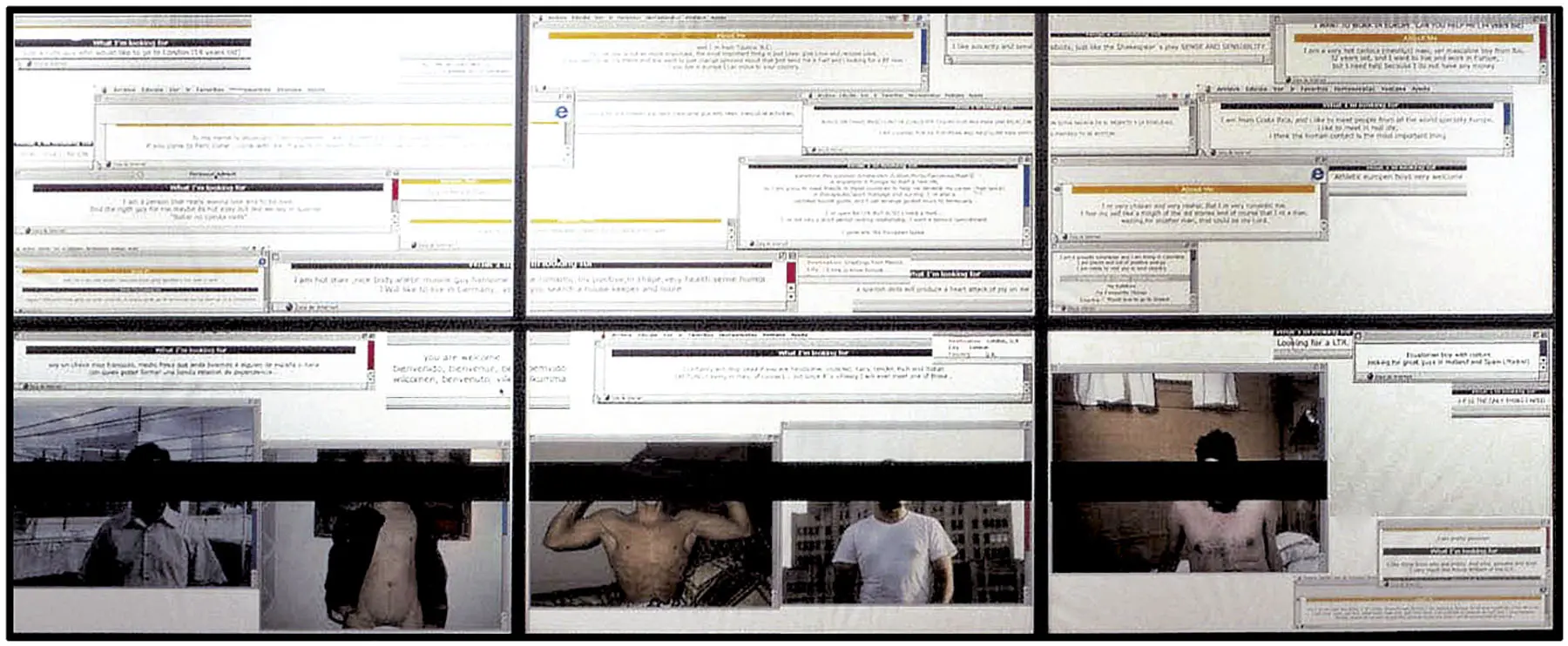
The messages, more than the objects themselves, are the raw creative materials in the work of Alexander Apóstol. He creates a vast photographic oeuvre exploring the acts of communication between people who are physically separated, through the Internet, with its component of deception and aspiration.
We know about technology and we know about some scientific processes, as well as their possible consequences and their impact on Humanity as a whole. We have ways to acquire knowledge, but, as curator María Elena Ramos points out, knowledge does not equal wisdom. The marriage of art and science is a recurring theme in the show; indeed, it is one of the show’s thematic groupings.
Alfredo Ramírez presents a sinuous, light shape created on the basis of scientific themes and instruments. Its movement resembles a sound wave. This suggestive sculpture wants to represent in three dimensions sound’s the volume of sound, generating in the process a beautiful plastic object.
In a smoke-filled room, we find ourselves surrounded by an installation of liquids and sounds, with projections on bubbles and transparent spheres. It is Mariana Rondón’s space of fantasy and of multiple sensations, which refers to experiments in genetics and ultimately to a most current issue: the issue of cloning.
This show is eminently contemporary not only because of the artists present but also because of the issues explored and the techniques employed —techniques that are in permanent evolution. These artists are working on emphatically current topics, so current indeed that, for instance, the same police department explored by Téllez was divided by Venezuela’s political turmoil while the show was still open, revealing that the members of the art-viewing public were not the only ones watching it. Similarly, the possible birth of the first human clone was announced before the show ended, adding an extra layer of meaning to Rondón’s work. The massification of consumerism, the problems of violence, our rapidly evolving technology, the human body’s ideals and adaptations, and the staying power of popular music —these are some of the issues that define our age, and they move us to rethink our surroundings and our own humanity.
SONIA CASANOVA