
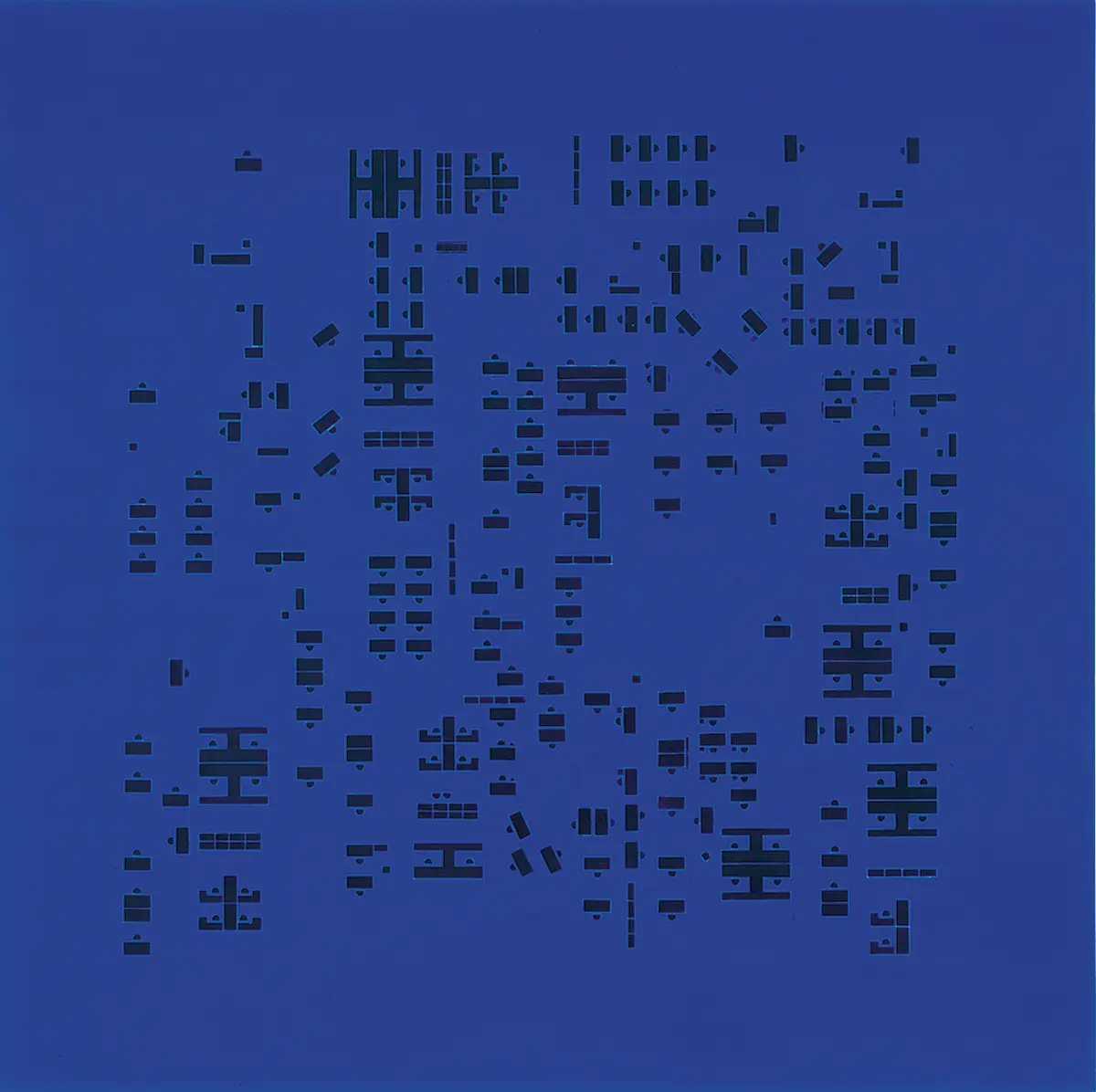
When minimalism and other reductionist gestures of the 1960s manifested themselves, few if any people could have predicted that they would turn out to be a point of departure for much contemporary art rather than the logical culmination of modern art practice. One artist who has managed to build an engaging body of thematic work through the adoption and subversion of minimalist form and conceptual practice is the Argentine Guillermo Kuitca. In recent years Kuitca has used the template of architectural floor plans, rendered in diagrammatic drawings or large monotone paintings, to create works that can be read as geometric abstractions just as easily as they can be recognized for their original purposes. These works often derive interest and effectiveness through a sort of fluid optical punning on the visual similarity between an art that was supposed to negate all references to the outside world and one that was meant to be purely functional. What makes these works even more evocative are Kuitca’s particular choices; the floor plans and architectural renderings that he appropriates are usually some type of public space, which adds a human dimension to such apparently abstract austerity.
It is this cold austerity and architectural purity that has occasionally elicited negative responses to Kuitca’s work. The general perception of precision and overtly intellectual sensibility in Kuitca’s art is challenged by his most recent exhibition at Sperone Westwater. The Ring is a multi-part exhibition that centers on a large, five-panel painting that refers to Richard Wagner’s operatic Ring cycle. Using historic recordings of the Ring operas as his inspiration, Kuitca presents five album covers. Each cover represents a different opera in the cycle, and just as the operas are presented in sequence, so too are the styles chosen for each recording, from a quasi-cubist design to a pseudo-digital rendering. The recordings are sequenced chronologically from the 1940s to the 1990s, like the visual movements, as well as geographically since each recording was made in a different country.
This painting is large, colorful, and impressive, full of clever conceptual puns and associations. The true surprise of the exhibition, however, lies in the series of smaller works on paper that accompany the main canvas. Many of these are plans and seating charts of famous theatres and opera houses. Kuitca has executed theatre charts before, but these have lost much of their clinical precision through various manipulations, both manual and computer-aided. These plans are transformed into undulating abstractions, elaborate Baroque forms, and occasionally even suggest musical staffs. They are also further embellished by a luscious use of color, the various rich hues dripping and flowing into each other. These drawings bear an unavoidable resemblance to esoteric sketches by spiritualist artists such as Rudolf Steiner. The visual reference to Steiner makes perfect sense since his drawings were intended to be visual representations of the effects of music, particularly the music of Wagner, whose theory of gesamtkunstwerk was an attempt to unify and draw parallels between the various arts and senses.
In addition to the Ring works there are a series of large paintings that Kuitca has entitled his Nocturnes (another musical reference). These are floor plans and schematics of places such as the baggage-claim areas of airports. These paintings are generously scaled and imbued with rich saturated colors, particularly blue and red. It is interesting to note that the works most immediately and easily recognizable are the airport paintings. Whether or not this is due to the current media attention to airport security, and whether that is Kuitca’s intent, is undetermined. Nevertheless, the added reference resonates with the strong colors and interesting formal arrangements.
Despite the shared musical titles and artistic strategies, there is little that specifically connects the Nocturnes to the Ring works. Nevertheless, with these recent works, Kuitca has remained true to his longstanding artistic preoccupations but has allowed himself a level of visual play and pleasure that adds new dimensions to his project.
JOHN ANGELINE