For many years, the paintings of Jorge Tacla have pictured a world in ruins. Recognizable spaces and institutions are assaulted by his brush, falling victim to an apocalyptic vision. The demolished structures that populate his numerous canvases haunt us, all the more so since these nightmarish depictions have become reality. Long before the shocking events of September 11th, 2001, Tacla painted a series of aerial views of the Pentagon, in which the building appeared covered in ash. In 1999, John Yau wrote prophetic words about these paintings: “Seen from the air, the viewer becomes a character in an unspecified, open-ended narrative. Are we terrorists? Passengers in a plane flying above Washington D.C.? Is this a dream or something glimpsed? Is terror finally a daily occurrence, something that has infiltrated every aspect of our lives and dreams?"1
The September 11th tragedies brought to life Tacla’s visions, and his art in turn began to explore this lived experience. He worked through the all-too-familiar iconography of the World Trade Center remains in a disturbing and painful series that has never been exhibited publicly. Tacla’s need to come to terms with the barrage of media images that resonate with the themes of his own paintings drove him to explore the topography of New York City.2 The resolution of this search comprises the exhibition Mass of Cement at Galeria Ramis Barquet.
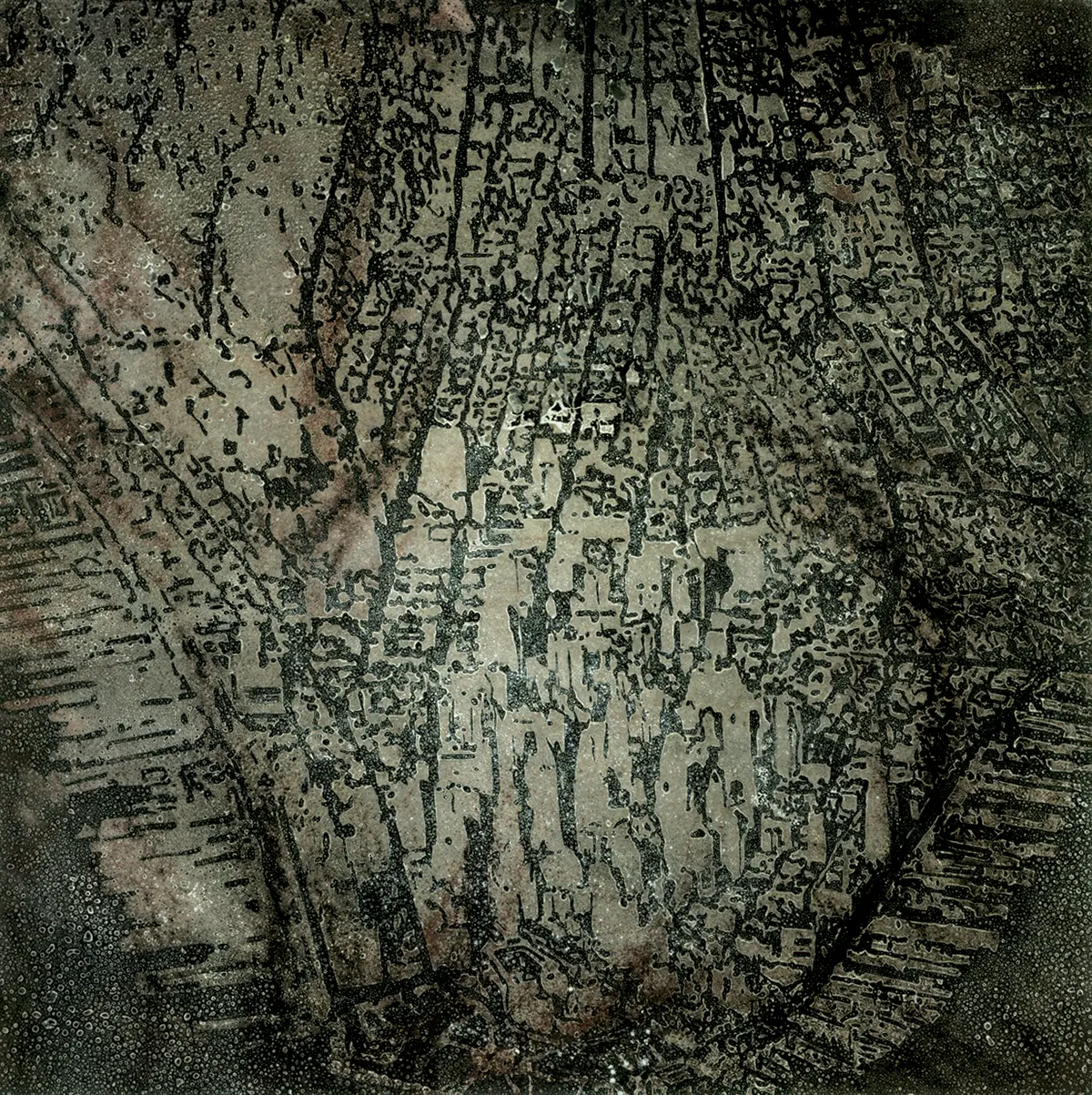
Seven of the ten paintings on view are based on a 1933 aerial photograph of Manhattan. Taken during the Great Depression, the referent adds a significant dimension. It recalls a similar moment in history – of economic crises and oppressive regimes that threatened worldwide stability. Furthermore, in the early thirties, New York began developing its character as the city of skyscrapers, an identity that would be epitomized decades later by the Twin Towers. Because Tacla’s Mass of Cement series describes a time before the World Trade Center, the sense of loss and shock associated with the void in the skyline becomes mediated.
While most of the paintings in the exhibition share the same subject, they present variations on the theme. In Mass of Cement #6, the canvas is marred by droplets and the entire scene appears engulfed by a storm. The grid-like plan of Manhattan here threatens to tear it apart at the seams. Mass of Cement #8 describes a diseased surface, marked by palpable scabs. Darkness and shadows overtake the panorama, calling attention to the forces of nature that cause the cityscape to shift away from straight verticals and horizontals towards an irregular structure. In the indigo-blue Mass of Cement #4, a tidal wave seems to overtake Manhattan, simultaneously overwhelming and suffocating the viewer. A similar effect of vanishing topography occurs in Mass of Cement #1. The entire painting looks aged and decayed, as though a layer of fungus has invaded it and is spreading uncontrolled. In Mass of Cement #3, New York becomes a ghost town. Buildings on the west side have disappeared, and the rest are depicted by blank spaces and outlined by shadows.
Despite basing his paintings on an aerial view, the works in the Mass of Cement series are oriented along a vertical axis, drawing the eye either upwards or downwards. A similar effect is achieved in Mass of Vapor, a series in which Tacla renders clouds that recall the billows of dust and ash created by the collapse of the World Trade Center. A far cry from the cumulus clouds of Constable’s numerous studies or the abstract, disorienting cloud patterns captured by Stieglitz’s camera, Tacla’s clouds are ominous formations of toxic air. They appear as indexical markers of a horrific event.
Throughout the exhibition, the paintings of Jorge Tacla transmit a sense of urgency, a need to describe the past and ponder what the future may bring. His scarred surfaces and underlying content assert the relevance of painting as an artistic medium in the twenty-first century.
NOTES
1. John Yau, “Ten Things I Want To Say About Jorge Tacla’s Paint,” 1999. Reprinted in http://www.artnexus.com/servlet/ECatalogReview?ecatalogid=3&order=1
2. Conversation with the artist.
TATIANA FLORES