In their now classic Born Under the Sign of Saturn, Rudolf, and Margot Wittkower argued that the attitudes and personality traits attributed to artists have a historical nature and that these attitudes and traits change with the times. The same is true, of course, of the social role of artists. From the Medieval craftsman affiliated with a Guild to the intellectual artists of the Renaissance, inspired by a subtle melancholy; from the methodically ethical religious visionary of the Baroque and Mannerist periods to the worldly artist represented by Rubens; from Neoclassical rationalism to Romantic maudit attitudes… in each and every case, a mixture of individual truths and social conventions contributed to the emergence of diverse and even contradictory human types, including the most variegated characters in the orbit of what none of them would hesitate to call “a most singular profession.”
Any attempt to define José García Cordero’s personality as both a sociological type and as an individual would demand a dual context, common to all emigrant artists (be it in Europe or the United States) who nonetheless retain strong attachments to their country of origin, not only through at least one individual show every year but also, in many cases, with their presence in group exhibitions or even with more or less extended periods of work among us, here in their native land.
At any rate, Europe is a point of reference, a context where artists tend to see themselves more and more as “art professionals,” and where their trade is understood as one among many. The second context is Latin America, where the stereotype of Romantic bohemia subsists to a greater degree. Between these two points of reference, we can assuredly identify José García Cordero’s typology as one that relates to the archetype of provocation, a spirit who seeks, above all, to keep the flame of the avant-garde alive and active.
García Cordero won a Drawing Award back in 1979 at the Visual Arts Biennial held that year in Santo Domingo, and had his first solo show already in 1983. Yet he is to our mind an artist of the Nineties, one who, moreover, holds the banner of painting up high in a scene ever more dominated by photography and installation. An artist of resistance, but also one of the avant-garde, clearly committed to that unbridled creativity sought by the group with which he is affiliated, along with Martín López and other artists: the extramodernos, whose vehicle of expression in the 1990s was, mainly, the publication El Frío Cálido.
García Cordero’s work shows that the move beyond Modernity hinges not on the media that are used, but on the use that is made of them, and of the cultural context, in a clear-sighted critique of Modernity’s formal and ideological limitations (mainly, a critique of the Nineteenth Century’s naive faith in progress, which also informed the artistic avant-garde project) while nevertheless retaining the freedoms achieved by the Modern era.
It is in this sense that García Cordero’s work “A Transgression of Limits, a Questioning of Taboos, an Illumination of What is Hidden and Repressed” is among the most provocative in today’s scene; it enters the territory of the sinister, background and limit of conventional aesthetics and at the same time its negation. And also that space of the oceanic, where the damned and the sacred, as illustrated by the Latin word sacer, are one single, unified abyss.
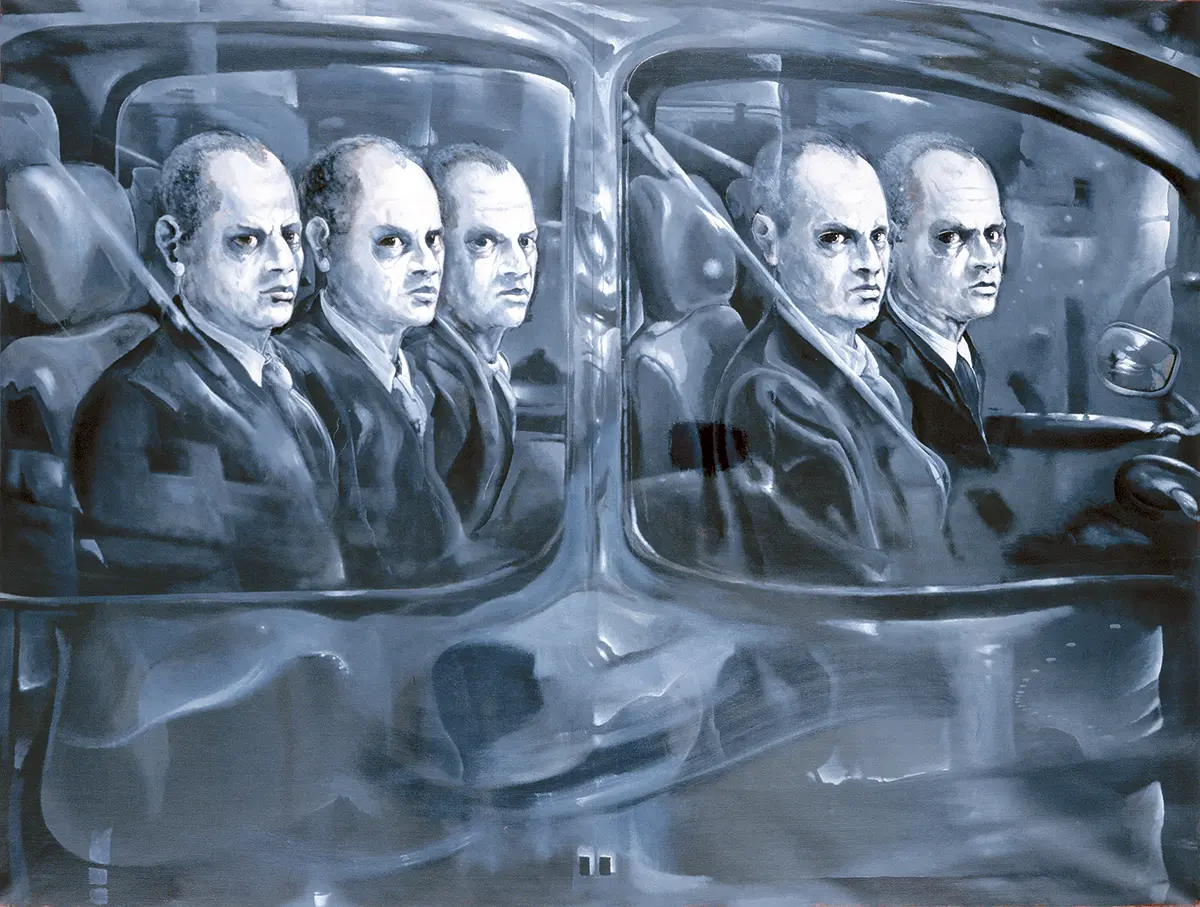
García Cordero’s current show at Lyle O’Reitzel Arte Contemporáneo, titled El retorno del mataperros (The Return Of The Dog Killer), is a full-fledged exercise in introspection. Here the artist explores his own consciousness, turning self-portraiture into a tool for self-analysis, and presenting a perception of reality that is the same for the psyche as it is for the object, thus obliterating the subjective/objective divide. His animation of Nature, on the other hand, differs from that of Romanticism in that it does not imply an expression of Man’s reconciliation with the world, nor of Man’s subsumption into the Numinous-Sublime, but of mutual aggression, as well as of the pendant of the reification of live beings.
Irony is also an important resource, particularly with respect to symbols of social power and status, such as the characters’ jeepeta or sinister air, emblematic of a society that is harmonious on the surface but hides within itself unimaginable evils and a muted undertow of violence. The artist transforms himself into a boxer, a mobster, or a thorny cactus; finally, he rests in a hammock with his supposed victim, the dog he was to kill. The dramatic style of composition and the baroque use of chiaroscuro, the bloody drama of the color red, and the composition predicated on an aesthetics of accumulation whose obsessive rhythms bring to mind Hitchcock’s cinematic techniques, and García Cordero’s incisive draftsmanship, all help create some of the most haunting and expressively effective images in contemporary Dominican art.
LAURA GIL FIALLO