
The Church of San Agustín is a peculiar building in the heart of Mexico City’s historical area. I call it peculiar because it is a conventionally structured religious building that has nonetheless served a variety of functions since the Reform Laws of the late Nineteenth Century. The most evident alteration, which in fact needs to be mentioned in order to describe Matus’s and Rocha’s intervention, is that after the transformation of the Church in the National Library site, a series of monumental sculptures (approximately 3 m high, with a 2-meter pedestal) of philosophers and thinkers of historical importance, such as Aristotle, Dante, and Goethe, was placed in its central nave. The Church’s central nave is 60 meters long, with a maximum height of 35 meters, and there are six lateral chapels. The Church is practically abandoned, although it is under the jurisdiction of the UNAM’s Department of Visual Arts and has been used in recent years as an exhibition space for rather spectacular shows, such as massive installations by Janis Kounelis, in 2000, and Thomas Glassford, in 2001. Now, two artists from very different fields have occupied the space and created a complex, moving work of art.
Mauricio Rocha, a well-known musicologist and sound artist, recorded the sound of his own hands clapping in each of the four chapels at both ends of the nave. These sounds were later manipulated into a variety of tones, which were then amplified in two independent tracks and blasted through speakers located in each of the four chapels, shaking the whole building.
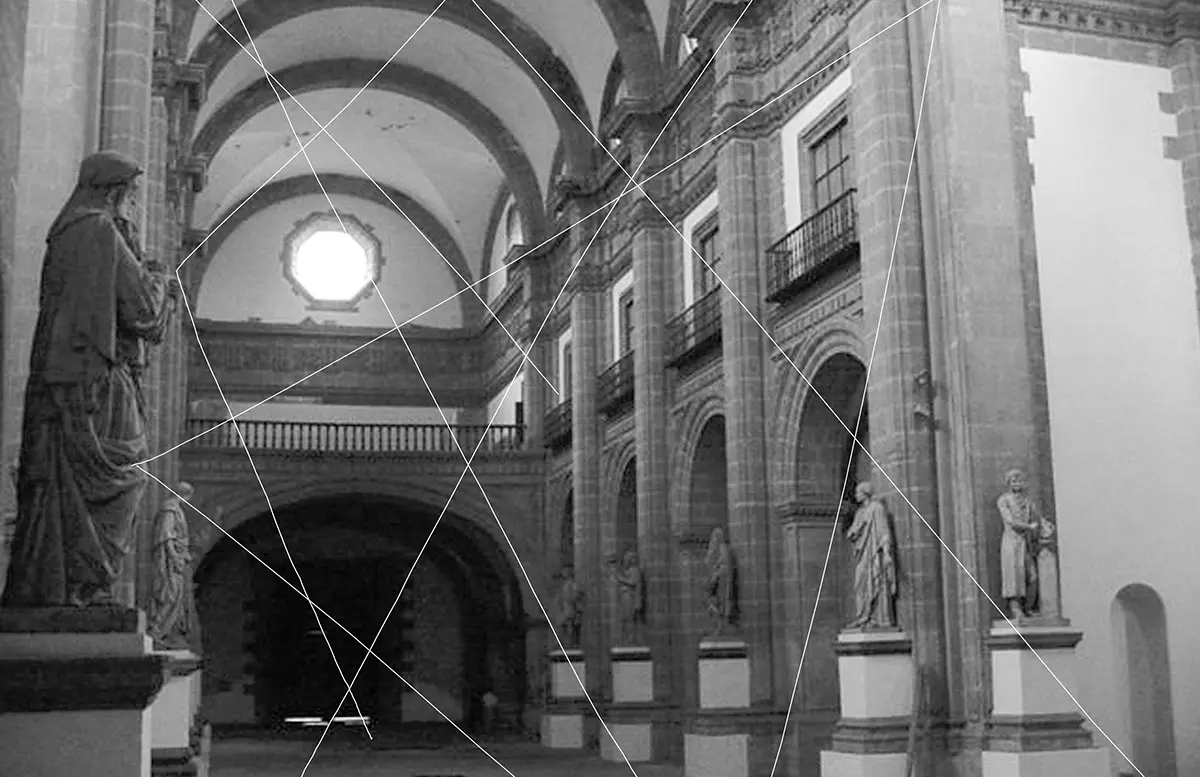
Meanwhile, Luciano Matus continued with his series of interventions in specific spaces using slim metallic tensors with magnets at each extreme, which reveal the space through the distance separating them. Matus’s intervention in San Agustín was the most ambitious of his career, and the solution it found was splendid. Matus was able to intervene on the very feeling of the space’s scale, through a weaving made of tensors supported only on pre-existing features of the Church’s architecture. The building is a National Treasure, which means that it cannot be modified; artists are not allowed to even push a nail through the wall. Matus studied the building’s interior features and structures in order to hang from them his metallic tensors. He used on this occasion flat nickel wires, 3mm wide, which reflected light intermittently. Throughout the nave, at a height of approximately 1.60 meters—the artist’s eye level—Matus placed 26 pairs of magnets. These guided a course through the space in the direction of the altar, where we discovered the two-track sound installation that played with our perception and encouraged us to continue exploring the piece in order to understand it. Arriving at the nave’s crossing, where the tensors ended their journey, we found yet another magnet; this one was close to the floor and moved constantly, yet subtly. This detail, at the beginning or end of the space weaving, revealed that the tensors had been installed as a circuit.
The experience of the nave filled with sculptures of philosophers instead of saints (as one would expect), intervened by hundreds of meters of metallic tensors capped with what seemed a trick of gravity-defying magic created with magnets, and with the booming sound installation, went well beyond anybody’s preconceptions. The building’s massive scale was truncated by the silvery threads that broke down its space into human-scale triangles. When reflecting light, either natural or artificial, these threads became visible and filled in a previously empty space, revealing for the viewer its immensity—and at the same time comforting the viewer with a sense of protection derived from the human scale that those triangles created. Seen from the altar, which is one meter above the rest of the space, the shining tensors seemed to make visible light itself and created a mystical, magical sensation. The piece’s sound, thanks to its abstract and ubiquitous quality (its point of origin in the space nonetheless impossible to identify) contributed greatly to the unity of the various elements.
Without a doubt, Matus and Rocha conquered a complex, peculiar space. Their work is difficult to paraphrase with words, and extremely rich in sensations.
FRANCISCA RIVERO LAKE