
María Elena González’s recent show evinced the eclectic use of a wide scope of media, and this ample, formal heterogeneity advanced a dominant image in the exhibition: an electrical tower. Like the diversity of materials in the exhibition, this image was configured in myriad ways such as a glass sculpture of about ten inches in height placed on a sculptural pedestal; a piece residing somewhere between drawing and sculpture consisting of the artist’s fingernails placed horizontally and shaped into an electrical tower; and a series of altered photographic negatives of electrical towers set against a black background. Because of their blurred quality, the photographs extend into the realm of painting, albeit somewhere between figuration and abstraction. With pictures that are situated in the interstice of photography and painting, between mimesis and abstraction, González seems to be attending to formal concerns. Yet these aesthetic dichotomies, many more of which can be extrapolated, are points of departure for numerous narrative investigations rooted in the focal point of the exhibition’s dominant image.
The exhibition’s general thematic focus is anxiety. This was exemplified by the use of fingernails as well as what may be construed as a paradoxical response towards technology: the menacing electrical towers are both vehicles of light (through electricity) as well as life-threatening (a possible cause of cancer). Evincing this ambiguity in the photo-based works is the tension between a stark, almost Gothic composition via the pictures’ overall darkened quality punctuated by what appears to be electrical currents, and the angle of vision between the viewer and the towers, where the former is in subordination to the latter. The disparity between the viewer and artwork also highlights the picture’s sublime subtext. The sublime can be traced back to Edmund Burke and Immanuel Kant who proposed that nature is a force of greater magnitude than humanity; technology was the genie let out of the bottle with cataclysmic force after the dropping of the atomic bomb and subsequently offered a new reading of Burke and Kant that can be called the “anxious sublime.” González’s electrical towers ride the wake of this tradition; the anxiety that is personal—evidenced in the idiosyncratic medium of fingernails, as well as the optical differential between viewer and image—now takes on more general proportions. The tropes that help convey this in the pictures are reminiscent of the photographic work of the Russian constructivist Alexandr Rodchenko, and the exploration of the aesthetic qualities of the towers themselves have affinities with the work of German photographers Bernd and Hilla Becher.
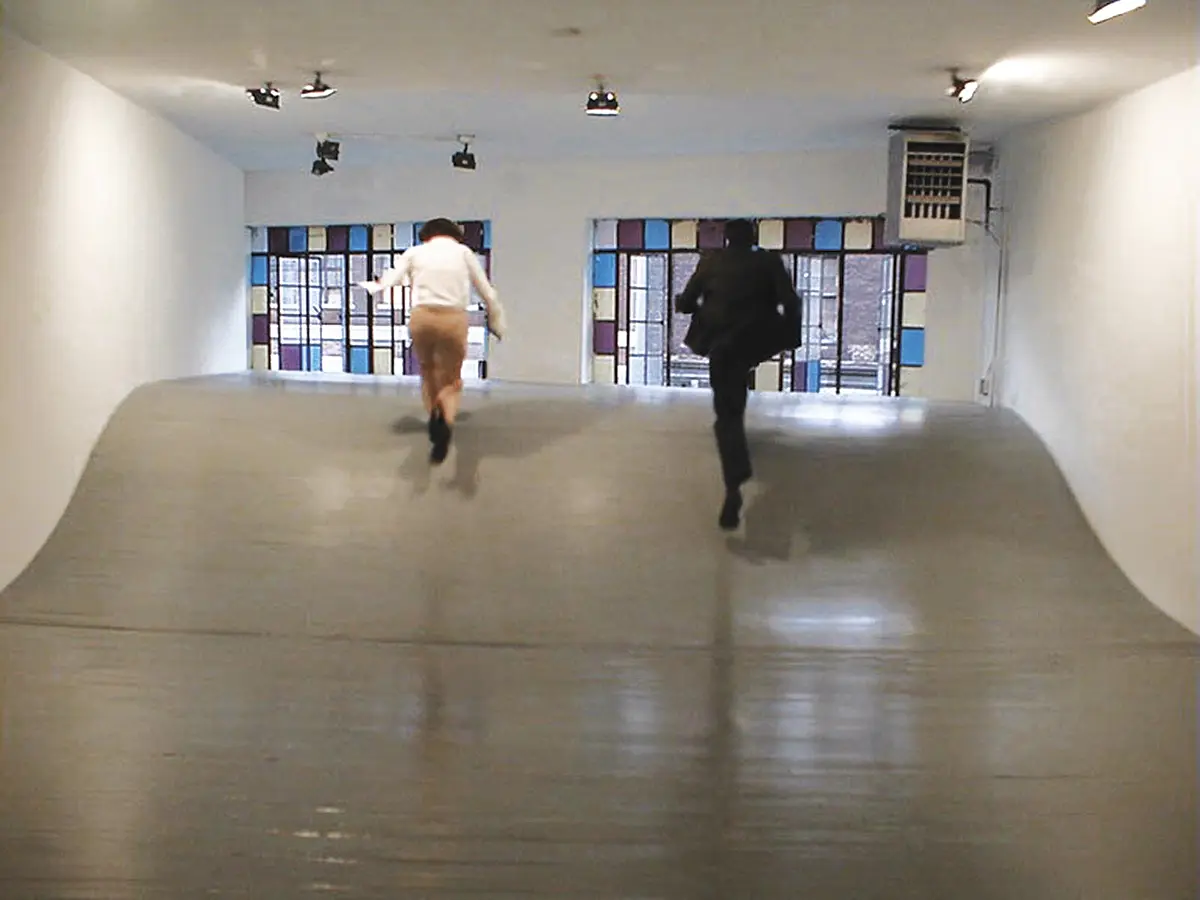
Apart from the works on the first-floor gallery, the most ambitious piece in the exhibition was located on the second floor. The work, entitled Window Wave, consisted of an intervention into physical space where the middle part of the gallery floor swelled up to the window creating a sort of architectonic wave. One could not help being reminded of other artists who have used this strategy, most notably Vito Acconci and his work, Seedbed. In Seedbed, the gallery floor was wedged up at an angle, providing a place for the artist underneath it; hidden inside its recess, Acconci masturbated while the public listened to the audio element of his act. Acconci’s gesture was construed as an attack on Minimalism; González’s piece advances this and also provides a rereading of Acconci’s piece in an altogether different register. The feminist connotation of González’s work is evident, though it is articulated with conceptual intelligence and elegance and is not at all ideological. This has been a trademark of González’s art. The subject matter of her previous work has attended to a panoply of issues that can be interpreted as political in nature. Yet González has managed to escape the trappings of identity-based work that can succumb to didacticism through sophisticated visual poetics ciphered in this exhibition via an array of artistic practices: sculpture, photography, painting, site-specific installation, and architecture.
RAÚL ZAMUDIO