
The title Tropicales fantásticos is appropriately fitting for the most recent exhibition of oils and collages on canvas by the well-known Panamanian artist Teresa Icaza. The show surprises us with the spontaneity of its shapes and colors, and with the absence of those trees and woods that have been so central to Icaza’s work in the last ten years. This series of canvases, with their exuberant, almost explosive compositions and colors, represents a liberating step forward in Icaza’s creative development, after the creation of an abundant body of work over three decades.
The development of Teresa Icaza’s paintings has had clearly defined stages, connected to each other through their particular focus on the representation of light, something that was already evident in Icaza’s initial abstract works and has remained constant ever since. Icaza’s current works suggest a closing of the circle she started with her earliest pure abstractions, with a new movement in the direction of abstract art, albeit in a visual language that is radically different from that of her first years.
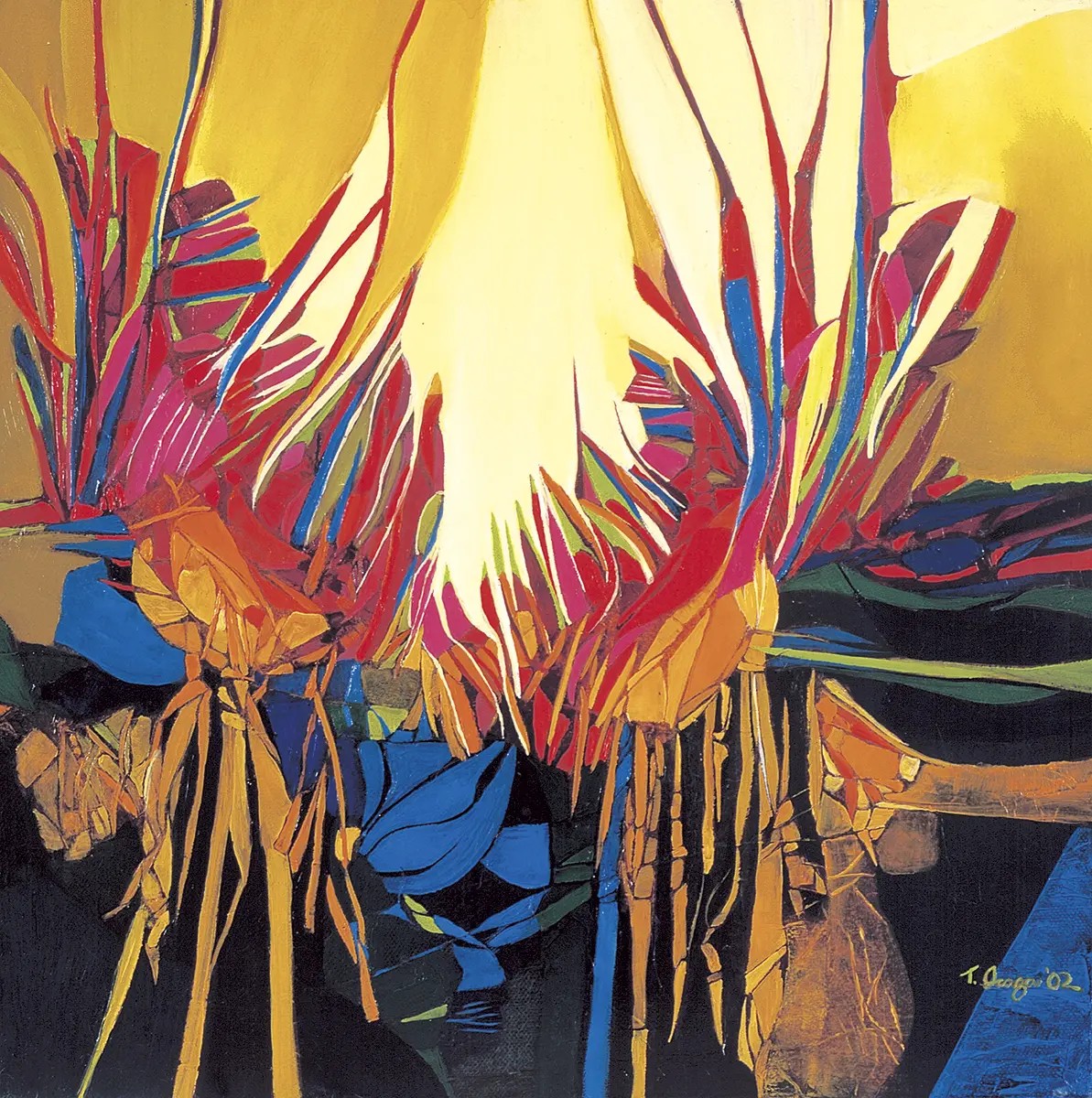
Back then, Icaza’s compositions were almost monochrome (or very limited in their range of colors) and had a meditative character; now, her works are characterized by an intense expressiveness, by the strength and variety of their colors, and by a laborious technique that results in an amazing appearance of spontaneity. The strokes of paint and the hundreds of pieces of paper applied as collage burst forth, meet, intertwine, and unfold as if on fire. Like a modern dance performance, Icaza’s images create a sensation of fluidity and easy rhythms, but they are the product of years of trials and dedication.
It is precisely that rhythm that turns these compositions into such an important moment in Icaza’s career. Icaza is a self-taught artist who carved a path for herself on the basis of discipline, reading, and an inner need to self-express. Her earliest works, from the 1960s, are related to the lyrical form of abstraction that characterized most Panamanian art at the time. Later, Icaza’s fascination with science fiction pushed her art towards the pictorial description of imagined realities, of shapes floating in outer space—a space that was almost colorless but always defined by a mysterious light. These works resembled solitary extra-terrestrial landscapes in grays and browns, with shapes and textures that ranged from rocky surfaces in a dense impasto to completely flat areas of iridescent colors. In the end, the ideas expressed in these works had to do as much with science fiction and the exploration of space, as with emotion, with human beings and their lived experiences, combining the theme of Nature with an expression of the most private worlds.
Icaza’s landscapes came to be occupied by moons and planets against dark, deep skies. These were silent, atemporal images reflecting an interest in the representation of abstract ideas such as the idea of time. In the 1980s Icaza’s work went through a period of great emotional freedom: the planets in her canvases seemed to explode, shooting asteroids that irradiated their own light. It was during this period that the artist began using paper collage as a technique. Larger and larger shapes floating in spaces that are bathed by light were to Interest Icaza into the turn of the century, when her work went through a fundamental transformation and turned towards color. Icaza experimented then with the magnification of a small area taken from an older piece, which started a period of intense creativity more intense colors, and an open embrace of abstraction.
This moment of renovated creativity slowly gave way to a new figuration, characterized by the presence of woods, trees, and swamps, often represented at dusk. The change came joined with an interest in ecology and the typically tropical Panamanian natural landscape. Icaza’s luminous yet somber landscapes were created using a special technique developed by the artist, applying colorful layers of paper on a base of oil paint. Once again Icaza was moving from abstraction to figuration, since those images, described once as “mental landscapes,” represented descriptive forms from the natural word.
This overview of Icaza’s development reveals an interesting pattern: time after time, after devoting intense attention to a given theme and a given technique, with its variations, the works start resembling each other and the artist starts to seem tired of them, which gives way to one of those periods of greater creativity. It happened with her mythical circles and it happened with the asteroids and moons. And it has happened again with the latest works: Icaza has courageously crossed, once again, into new artistic territory.
Tropicales fantásticos shows Icaza breaking with the representation of Nature and moving towards a new abstract expressionism that retains the horizontal referent but situates itself squarely in the field of the non-objectual. Forms in these intensely colorful paintings are like reflections of the subconscious shooting in different directions, at times disappearing under layers of color (as in Ramas entrelazadas) or surging towards a higher, infinite space (as in Hasta el cielo).
Deserving of notice are the bold strokes and the wide variety of tones employed in each canvas, a kind of “faith leap” from her calm woods into fantasy landscapes filled with fire, wind, and light. Icaza breaks as well with the featureless surface of her previous works; now, with healthy abandon, she lets us see her brushstroke and the crumpled paper she uses in her collages. In contrast to her older works, we are faced now with compositions in loud colors and loud rhythms, like dramatic explosions of music, with conscious and subconscious overtones, with profound ideas and shades in the background alongside the expressive and revealing features of the surface. In distancing herself from the preciosism of her work, the artist introduces a more carnal, more real form of self-expression. It is as if we have finally seen Icaza’s inner fire.
MÓNICA E. KUPFER