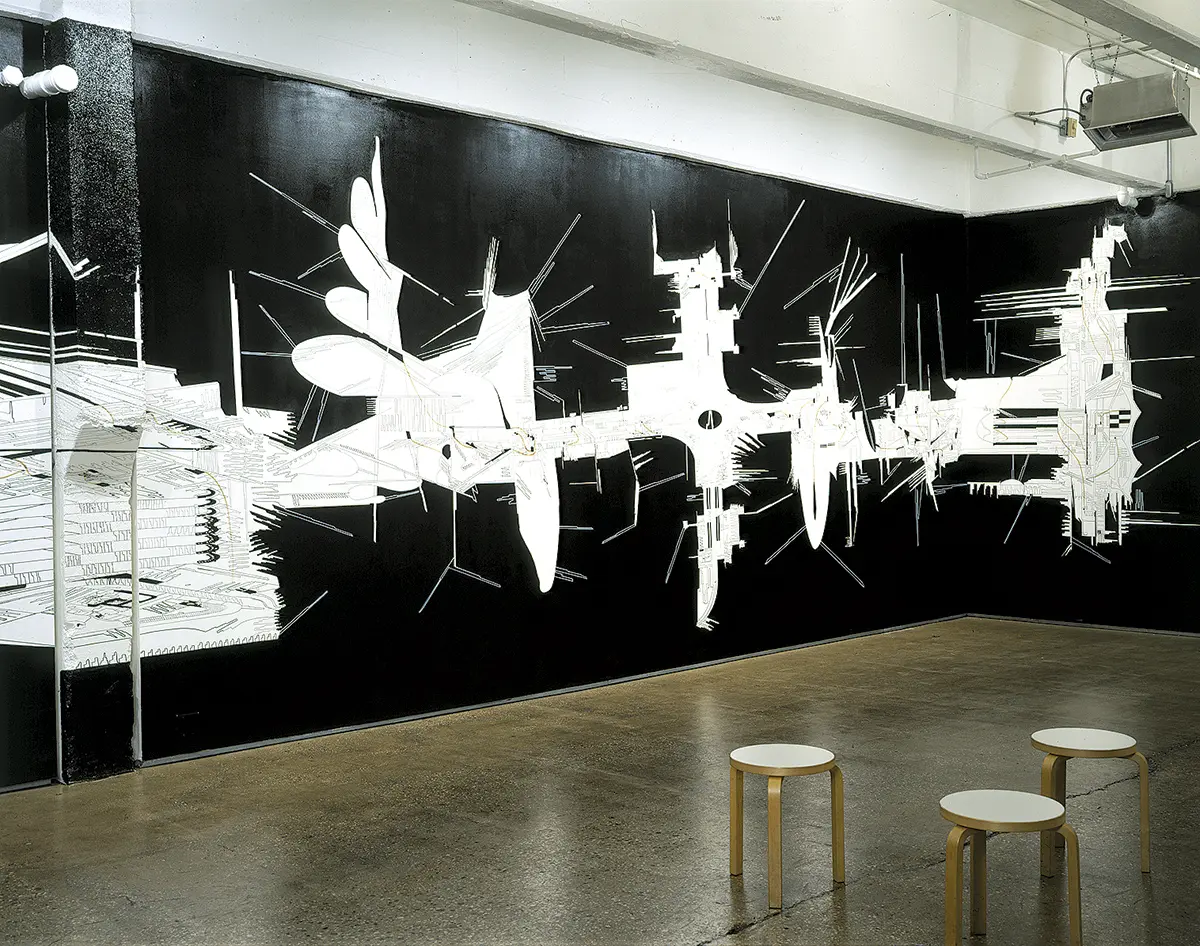
The medium used by Vargas Suárez-Universal (Mexico City, 1972) is space, in both senses of the word. His exhibition at Chelsea’s Thomas Erben Gallery consisted of the presentation of large wall paintings, basically in black and white, reconstructing large sections of airports, banks, museums, and other places that on the whole appear as hybrids of complex spaceships from a Star Wars movie, the black-and-white expressionism of Guernica, and satellite photographs of landscapes seen from outer space, represented in forms that remind us of the space-age iconography that dominated popular culture in the 1950s and 60s.
Vargas Suárez-Universal attributes his obsessive representation of forms to having grown up near the NASA station in Houston, Texas, an element of his biography that, along with the addition of the word “Universal” to his name, has already become a part of the work itself and contributes to the space mythology the artist has specialized in representing.
To this it should be added that Vargas Suárez-Universal has included in his paintings quantities of his own blood diluted in alcohol, investing the material with a particularly personal connotation.
Extending from the gallery’s north wall to its east wall, Vargas Suárez-Universal’s murals showed the floor plans of the Tate Modern, London’s Fleet Bank, and the Kuala Lumpur airport, connected to each other through various horizontal and vertical lines. These three elements, illustrative of the way in which the art world functions today—the Museum, the economy, and globalism—can be interpreted as a meditation on the complex structures that underlie international culture.
However, Vargas Suárez-Universal’s works adopt hybrid forms without necessarily articulating a metaphor or specific intellectual pronouncements, nor do they seek to replicate the complex mechanisms of a spaceship or an architectural plan as ends in themselves. The works, with their large size and with their complexity, in a way oscillate between scientific illustration, sci-fi comics, and abstract composition. Vargas Suárez-Universal’s forms, which could be reminiscent of utopian architecture or a science fiction fantasy, are designed in such a way that they evoke more than one interpretation in the viewer.
In the end, reflecting on the space fantasy portrayed in these works—and I insist on the space reference even though the models for these drawings are earthly buildings—means realizing that beyond their fictional character, they result in convincing representations of our general understanding of outer space. After all, what do we really know about this subject? The recent tragedy of the Columbia shuttle has reminded us of how little we know about the mysteries of space, and how little we can control. A common person’s comprehension of the universe is not based in real images, but on more or less complex diagrams and schematic representations. These are not intended to show something that ultimately cannot be shown—infinity—but they give us images for that which is, in the end, unknowable. The possibility of constructing a “spatial aesthetics” derives from this. Vargas Suárez-Universal plays with those very perceptions in order to articulate works of art that are simultaneously aware of their own inventiveness and obsessed with their own artistic activity.
PABLO HELGUERA