
2080, an exhibition held at the São Paulo Museum of Modern Art from January 23 through April 6, offered a panoramic view of Brazilian art in the 1980s, a decade that affirmed essential issues for the country’s artistic production and pointed it in new directions.1 The 1980s also brought to the fore the role of curators in the critical identification of new artistic trends.
The emergence of a new generation of artists in the 1980s coincided with Brazil’s transition to democratic rule, and with the consolidation of the local art circuit as the art market expanded and stimulated the establishment of new galleries. The figure of the curator appeared in the Brazilian art scene as a fundamental agent in the production of art shows, almost an author, securing a new space for critical discourse.
The 2080 show brought together 50 works by 37 artists, including Alex Vallauri, Beatriz Milhazes, Leonilson, Ester Grinspum, Leda Catunda, Sérgio Niculitcheff and Rodrigo Andrade.2 The show was originally conceived by Rejane Cintrão, and it was curated by Felipe Chaimovitch, of the São Paulo Museum of Modern Art’s Consulting Council for the Visual Arts. The Museum’s Education Department also played a role.
Chaimovitch’s strategy was to go back to theoretical contributions made by other curators in the 1980s; these became the basic axis for the exhibition, which referred back to representative events for the interpretation of the period’s artistic production and emphasized essential issues in the analysis of contemporary art in general. Four specific shows from the 1980s were of particular importance for Chaimovitch’s concept, functioning as anchors for 2080’s nuclei (signaled in the show’s museography by the colors green, pink, yellow, and orange.)
The first nucleus was titled, "Support of Painting," and it appropriated a 1983 show held at the University of São Paulo’s Museum of Contemporary Art. The show identified a new trend by a young generation of artists who broke with the expectation of technical quality and durability in the art of painting, engaging instead in experimentation of both form and content. The exhibition also emphasized a redefinition of the support itself. The 1983 show, titled, Painting as Medium, was conceived and produced by Aracy Amaral, who was the Director of the University’s MCA at the time.
In the catalog for Painting as Medium, Amaral wrote: "With the freshness of a new epoch in the face of the country’s tired artistic events, a young painting is beginning to take shape in São Paulo (…). It is not a group or a movement, because every artist possesses his or her own distinct personality as a producer of art, sharing only the fact of being of the same age (between 23 and 26 years old). These paintings emphasize here their 'cloth' support… Thus offering art that is naked in its naturalism, independently of its being figurative or not, or, as an instance of visual communication that is legitimate in its own terms, devoid of aspirations to ‘Great Painting,’ albeit it remains essentially painting."
The second nucleus, "Anarchy and Pleasure," referred back to the exhibition, How Are You, Generation 80?, a 1984 show at the Parque Lage School of Visual Arts in Rio de Janeiro, curated by Paulo Leal, Sandra Mager y Marcus Lontra. This show highlighted the artistic production coming out of the famed carioca3 school, an institution that at the time attracted many young artists from different parts of the country, all of them interested in contemporary forms of expression. In the work of these youngsters, the curators identified an absence of commitment to the World History of Abstraction; they pointed out that the objects demanded to be recognized as art because they were the result of an artistic practice primarily interested in the celebration of actual pleasure, regardless of styles or concepts.
This is how the curators characterized the show in the catalog as follows: "How are you, Generation 80s? Artists from everywhere in Brazil respond, and they will take over walls, doors, windows, pools, bathrooms, built spaces, and empty spaces in the School of Visual Arts imposing building, as well as the boulevards, trees, caves, and little malocado corners4… We are less interested in what they do than in the freedom with which they do it … And although none of them express a pedantic desire to 'make History,' to become a household name, all of them aspire to make something. They seek, ultimately, to appropriate art; to approach art as a knight approaches a damsel in a castle, only to paint her lips of the most vivid red and roll with her wildly in the hay —or in the parallelepiped— in the precise moment in which work and pleasure walk together."
The third nucleus was titled "Neo-Expressionism," and it related to the 1985 São Palo Biennial, curated by Sheila Leirner and titled The Big Canvas. This show identified the similitudes between gestual painting in Brazil and international trends: such as aggressive brushstrokes, large formats, and free-ranging references to the history of modern art. Neo-expressionism was presented as a contemporary language platform from which artists were able to operate a link between art and life. The neo-expressionist character of the artwork was emphasized clearly by the curator who designed the space as a large hallway that accommodated the production of both local and international artists. "The vision of this collection is founded in utopianism," Sheila Leirner said at the time. "These works are anti-didactic, anti-historicist, anarchic, and as theatrical as those works that represent their own historical referent and autobiographical repertoire… No movement has a stronger link to current artistic directions than expressionism … expressionism refers directly to Man and to Life."
Finally, the fourth nucleus, "Quotationism," was based on a 1987 show titled Images of the Second Generation, curated by Tadeu Chiarelli and also presented at the University of São Paulo’s Museum of Contemporary Art. This show identified common references between works of art and visual mass media. It posited the role played by a dynamic flow of information in the speeding-up of Brazilian culture and global pop culture. As Tadeu Chiarelli said, "One of the most noticeable characteristics in the artistic production of the last ten years is ‘quotationism.’ An important number of contemporary artists, besides their recuperation of painting and sculpture, are engaged in exploring the universe of images produced by humanity throughout history, available for all thanks to the mass media… This new generation, born after World War II, experienced the mass media in a more absolute way (from the cradle), particularly television but also magazines movies, etc.; it received, without any kind of pre-conceived resistance, a fragmented universe of references, full of images from the most diverse historical periods and geographical origins, all of them made homogeneous by the same media."
Chaimovitch refers back to these events but hastens to explain that his show is not a recreation of any of them. "I take some of the era’s curatorial ideas, without being anachronistic," he says and points out that the works originally exhibited originally are not the same as those presented in the new show, since the latter is based on the collections in the Museums of Modern Art in São Paulo and Rio.
The curator also proposed a strategic interplay designed to engage the public. With the support of the Museum’s Education Department, he gave the show an experimental character, rearranging the way the different nuclei were distributed according to visitors’ recommendations. Thus, different works migrated from one section to another according to what members of the public thought. A kind of amphitheater was built inside the Museum’s large exhibition space, and from this vantage point, the visitor could see the whole of the show and suggest changes. In this way, the show ended up offering four different montages, in what the curator deemed "a democratic exercise on how to deal with art."
The curatorial strategy emphasized that its view of the way the works relate to one another cannot, and should not attempt to block the visitor’s freedom to express their aesthetic receptivity. The exhibition can, however, provoke thoughts at the level of various orders and about specific themes suggested by the works (or the themes they don’t suggest) in the field of artistic creation.
In a general sense, the work of these 37 artists made evident the enormous diversification of contemporary art in the 1980s in Brazil. The show proved that this decade inaugurated, in the context of a globalizing world, a space for the plural, for the subjective, and for new experimental languages.
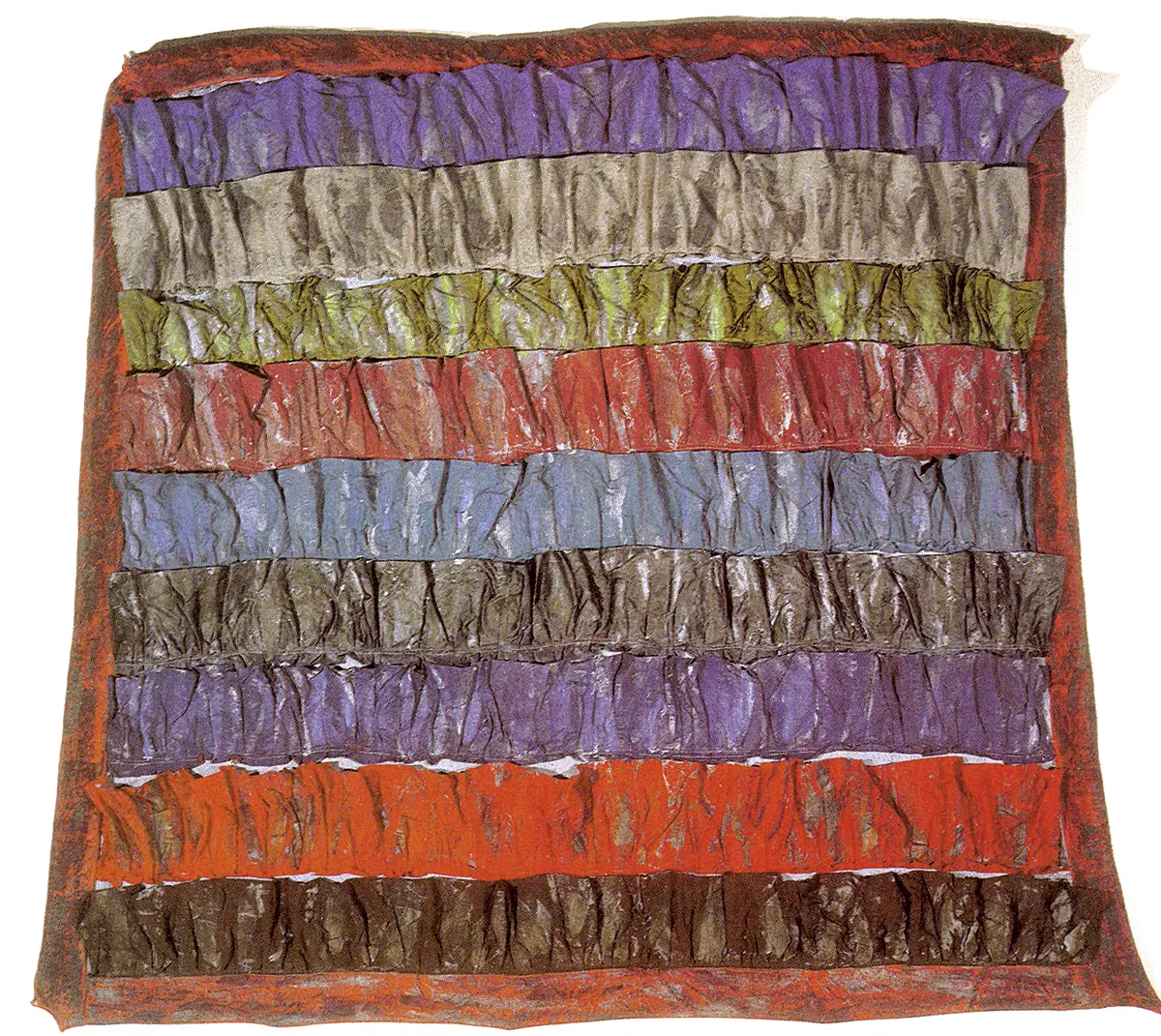
Artwork by four of the artists included in the exhibition, Leda Catunda, Beatriz Milhazes, Sergio Niculitcheff, and Leonilson underscore some of the characteristics that defined the new art of the 1980s, as highlighted by 2080. Leda Catunda was one of the female artists who emerged with particular force in the early 1980s. Her work is made with strips of sewn weavings, representing a period in which she moved away from figurativism and toward an investigation of constructivist abstract artwork. Sewing appears as the element that gives structure to the support, with a strong matteric character. The strips of woven material in different colors both display texture and create a plastic and visual rhythm. The reference to the craft of sewing is also a reference to traditional femininity, and the idea of sewing together these weavings carries a reference to the fuxico, a traditional handcraft of great popularity in Brazil. The fuxico consists of stitching together patches of leftover weaving, which are thus recycled. Leda Catunda was included in both Painting as Medium and How Are You, Generation 80?
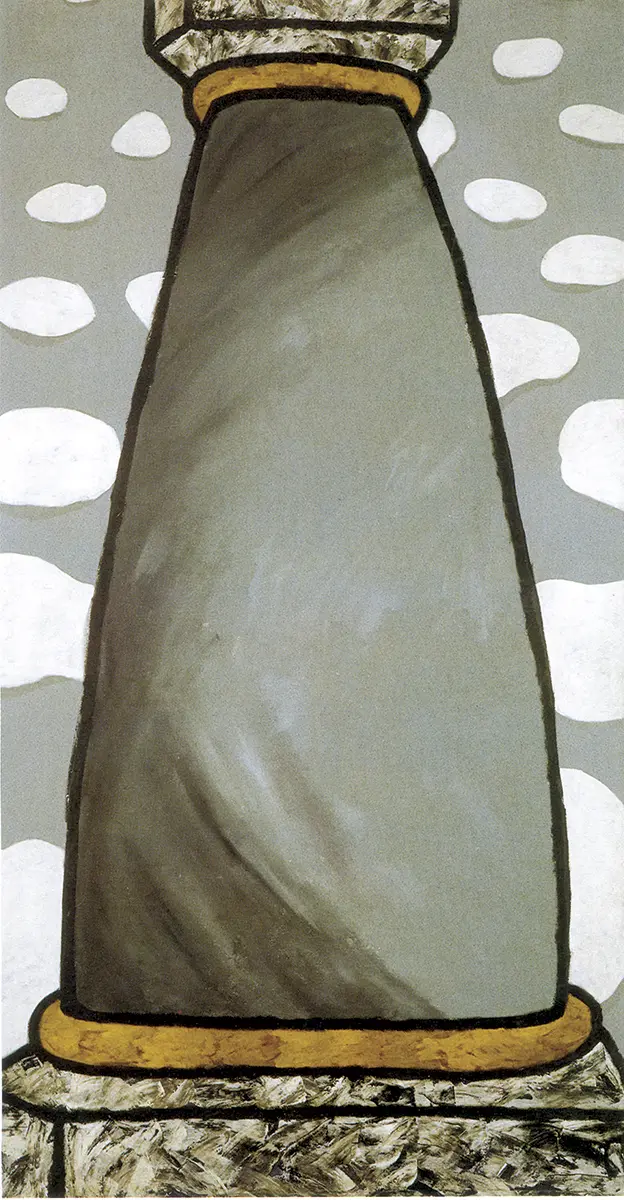
In turn, Beatriz Milhazes’ canvas dates from 1984. Milhazes is one of the artists selected to represent Brazil at the 2003 Venice Biennial, but her older work is very different than what will be displayed in Venice. In one early painting, she presents fragments of flowers, fruits, and cut-out arabesques taken from colonial architecture’s decorative practices, in a kind of allegory of Brazilianness. In Milhazes’ work, Untitled, 1989, we can see one of the most salient characteristics of 'quotationism': the representation of icons from the history of art, so common in what is often called postmodernity. The classical world is remembered as a cultural reference to the reality of the present, through the image of a column that extends vertically through the canvas. Such dialog on basic issues in Art History was an important element in Milhazes’ work until around 1992. Milhazes was also included in How Are You, Generation 80?
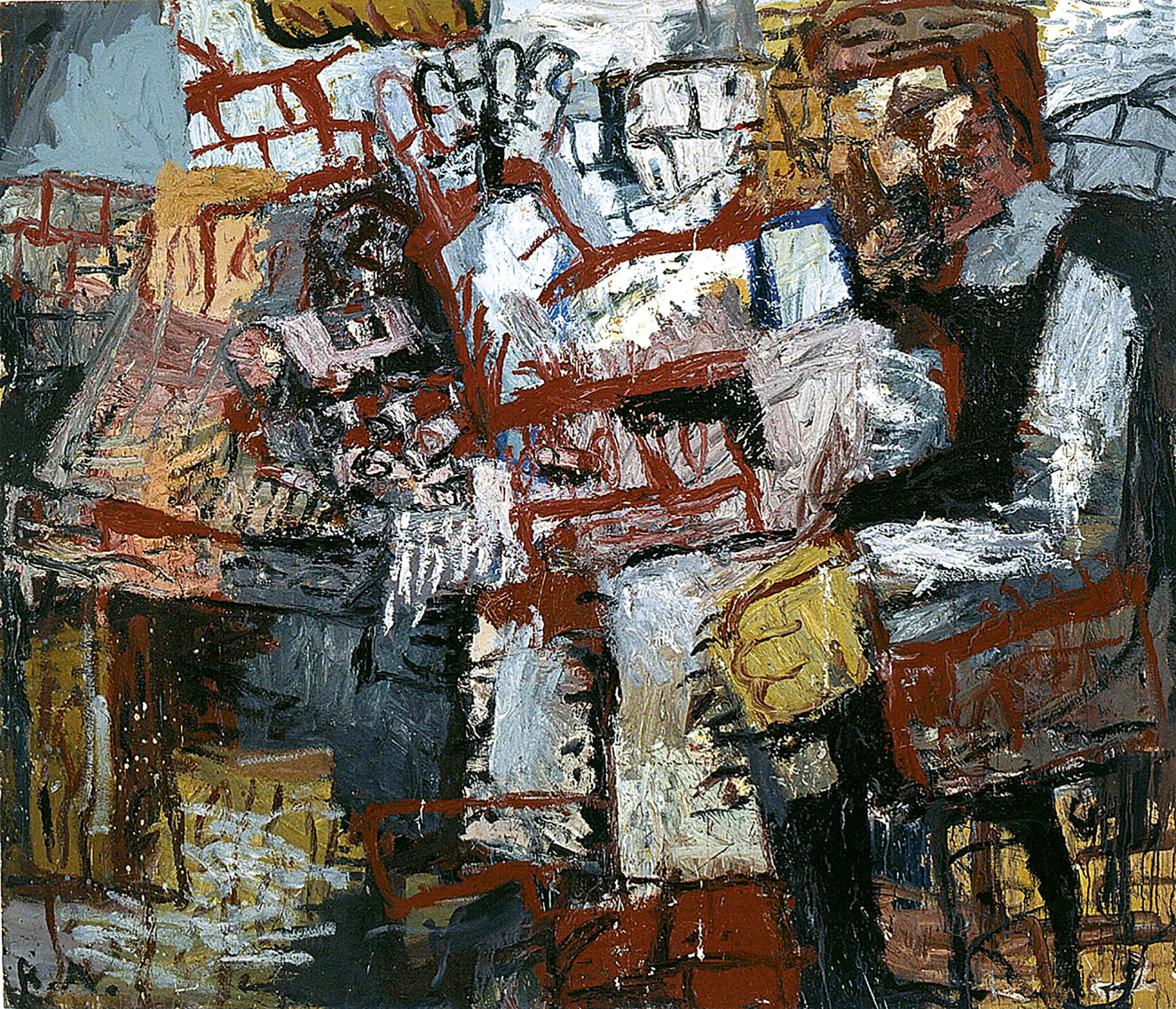
Sérgio Niculitcheff’s painting has a somewhat archaic meaning. His images carry a heavy symbolic weight, establishing links of memory with distant time. References such as fire, towers, jars, wheels, and snails are frequent symbols in his work. These images float loosely in a monochrome, somber space. Sometimes they are joined by more modern symbols, such as the gear systems of modern industrial machines. Niculitcheff’s works include a critique of painting as a representation of the symbolic world. The artist was present in Painting as Medium and in Images of the Second Generation.
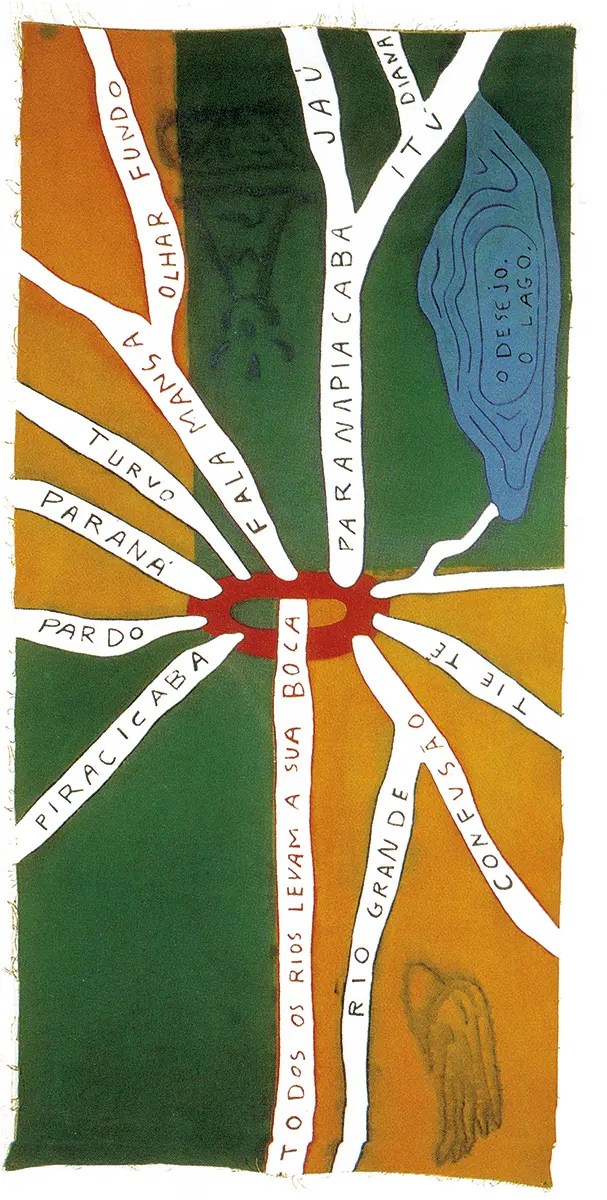
The works of Leonilson (1957-1993) are like pages from a diary in which the artist reasserts himself as an individual and reaffirms the language of art. His painting is charged with lyricism. In Todos os rios levam à sua boca, we see a background of green and yellow rectangular shapes on which the names of the rivers in São Paulo have been inscribed, acquiring an emblematic nature. This is a map, the outline of a landscape where the arteries through which life flows have been foregrounded. The title of this work signals a message of love, the mark of a romanticism that was a constant in Leonilson’s work until he was overtaken by illness.
NOTES
1. Art of the Twentieth Century, decade of 1980.
2. The complete roster of participants reads as follows: Adir Sodré, Alex Flemming, Alex Vallauri, Ana Horta, Ana Maria Tavares, Beatriz Milhazes, Caetano de Almeida, Carlito Carvalhosa, Ciro Cozzolino, Cláudio Fonseca, Daniel Senise, Edgard de Souza, Eduardo Kac, Ester Grinspum, Fábio Miguez, Felipe Andery, Fernando Barata, Florian Raiss, Hilton Berredo, Iran do Espírito Santo, Jeanette Mussatti, Jorge Barrão, Jorge Duarte, Jorge Guinle, Leda Catunda, Leonilson, Luiz Pizarro, Luiz Zerbini, Monica Nador, Nelson Felix, Nuno Ramos, Paulo Monteiro, Paulo Pasta, Roberto Micoli, Rodrigo Andrade, Sérgio Niculitcheff, Sérgio Romagnolo.
3. Carioca is a term used in Portuguese to indicate that someone or something is from Rio.
4. Maloca is a Portuguese term used to designate a home in a shanty town, or favela.
LISBETH REBOLLO GONÇALVES