
The exhibition Comer o no comer, o las relaciones del arte con las cuestiones de comida (To Eat or Not Eat, or the Relationship of Art with the Matter of Food), tackles the ways in which artists have faced the phenomenon, the problem, and even the depiction of eating. The project presented at the Centro de Arte de Salamanca, Spain was organized by Darío Corbeira, in association with a curatorial team that individually assumed responsibility for the various sections: “Artificios Vivos” (Live Artifices), curated by Carlos Reyero, covers the period from the end of the seventeenth century to the end of Impressionist painting and examines the collection of still lifes; “Estados Alterados” (Altered States), was curated by Carlos Jiménez and studies the period from the early twentieth-century avant-garde to the end of the 1960s; “Comer, Crear, Pensar, Disfrutar” (To Eat, to Create, to Think, to Enjoy), organized by Darío Corbeira himself, covers the last three decades of contemporary art; and finally Eugeni Bonet curated a series of film and video.
The exhibit, thus organized, occupies the entire space of this recently created museum and presents a more conceptual than exhaustive review of the subject. Perhaps more importantly, it opens a suggestive exploration of the subject of the representation of the culinary, alimentary, and gastronomical spheres that frequently and erroneously have been considered collateral.
Comer o no comer (To Eat or Not to Eat), as the title of the exhibition suggests, is a political and social commentary that summarizes, more than any other, a crucial dilemma of our time. It signals the basic difference and inequity emphasizes the injustice on which the present global order is based, and undermines any emancipation project that does not take this minimum common denominator of survival into account. In terms of food, the quandary between eating and not eating, of Hamlet’s “to be or not to be,” can only be a postscript of the basic and undeniable affirmation of the human condition. Obviously, problems such as terrorism, security, and economic and philosophic independence, take a (temporary) back seat. From the rational statement of wisdom and priorities to resolving the predicament between being able to eat, and how to eat or not to eat, the first step in solving these quandaries may be to understand that even though they are positioned successively, they are not more or less important but are categories of “to eat or not to eat.”
In the face of social inequalities, political or criminal violence, insecurities, catastrophes, the absence of political freedom, and even poverty and misery, art is a weapon and a tool that “feeds” and dignifies; however, in the face of hunger, art, like anything else except food, is nothing, or very little.
The exhibition, however, does not focus on this, and the device of food and the formulation of hunger is only covered in a subordinate way, but when it is dealt with in the graphic portfolio titled Hambre (Hunger), realized by five German artists (Käte Kollwitz, George Grosz, Otto Dix, Otto Nagel, Völker and Johansson) in the impoverished Germany of 1924, it is probably one of the most shocking moments of the exhibition. Curiously, hunger and its effects have not been the subject or the preoccupation of artists. On the contrary, ways of eating, the contradictory aspects, investments, and perversions, as well as the broad metaphorical charge, from a critical point of view, are the focal points that introduce the exploration of the mundane and its symbolic meanings.
The documentation work in the exhibition is extensive, as much in the explanatory aspect as in the selection of texts for the catalog, and is frequently supported by the presence of a specific work regarding food or by the actual act of eating. The critique that could be made of the exhibition is the inclusion of works that merely touch on the main subject, like Kosuth’s chair that appears for its own celebrity as an accessory, as well as the absence of works by lesser-known artists that may deal with the subject more incisively, for example, Arturo Barrio’s Livro de carne (The Book of Meat), or some of Tania Bruguera’s performances. Nevertheless, as it is impossible for an exhibition to pretend to be complete, and even if the present strategy is too broad, the exhibition proposes a course of action that exceeds the art dedicated to food and connects very different sensibilities. There are related threads, less narrative than conceptual, of tension or dialogue among the various pieces.
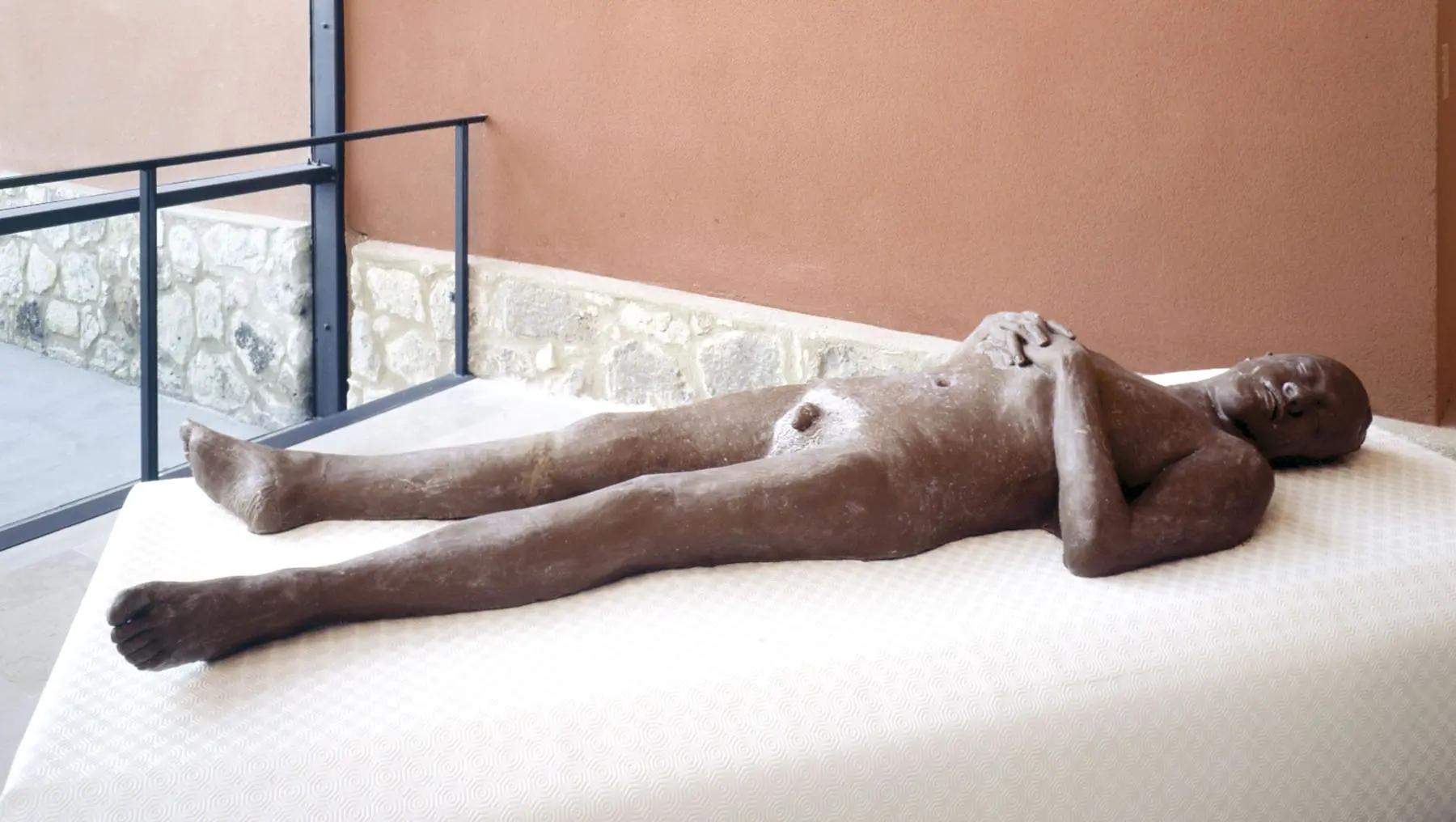
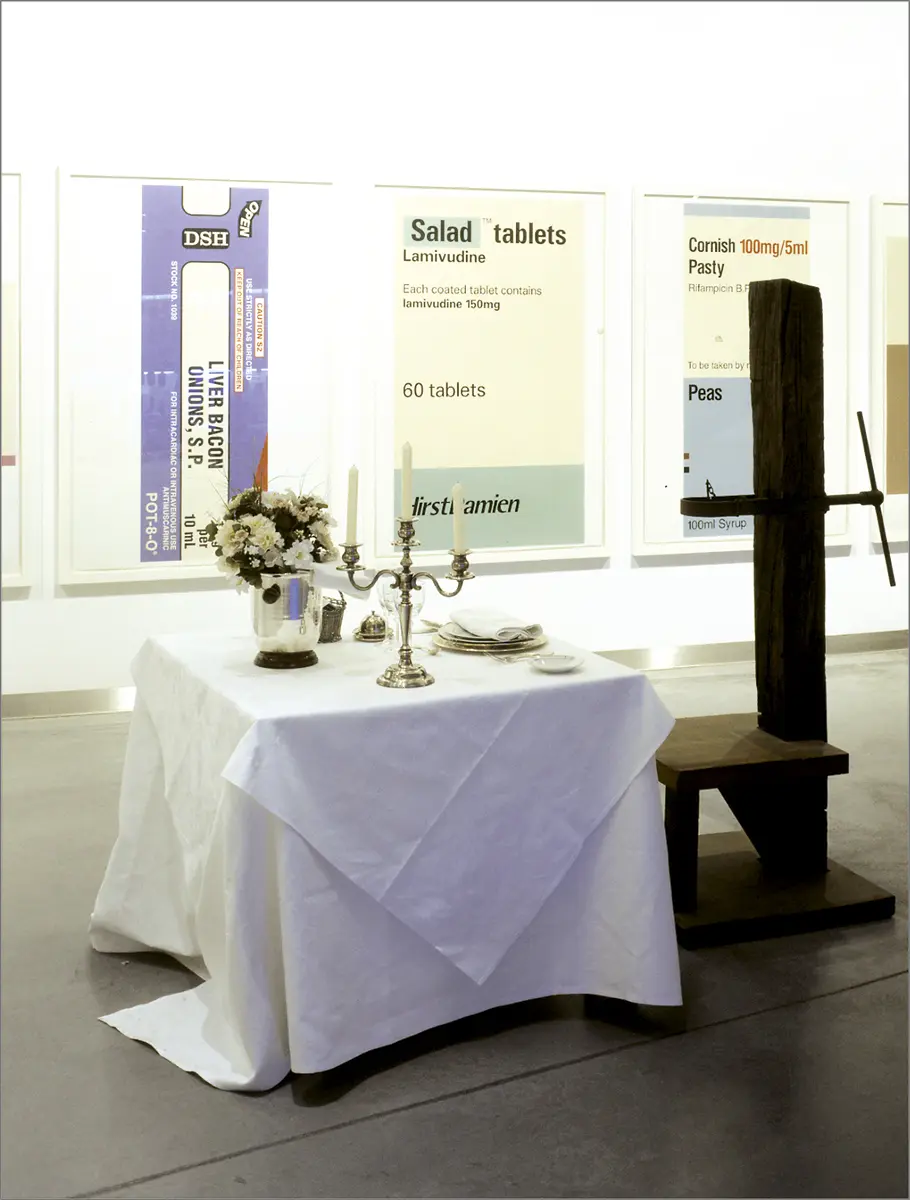
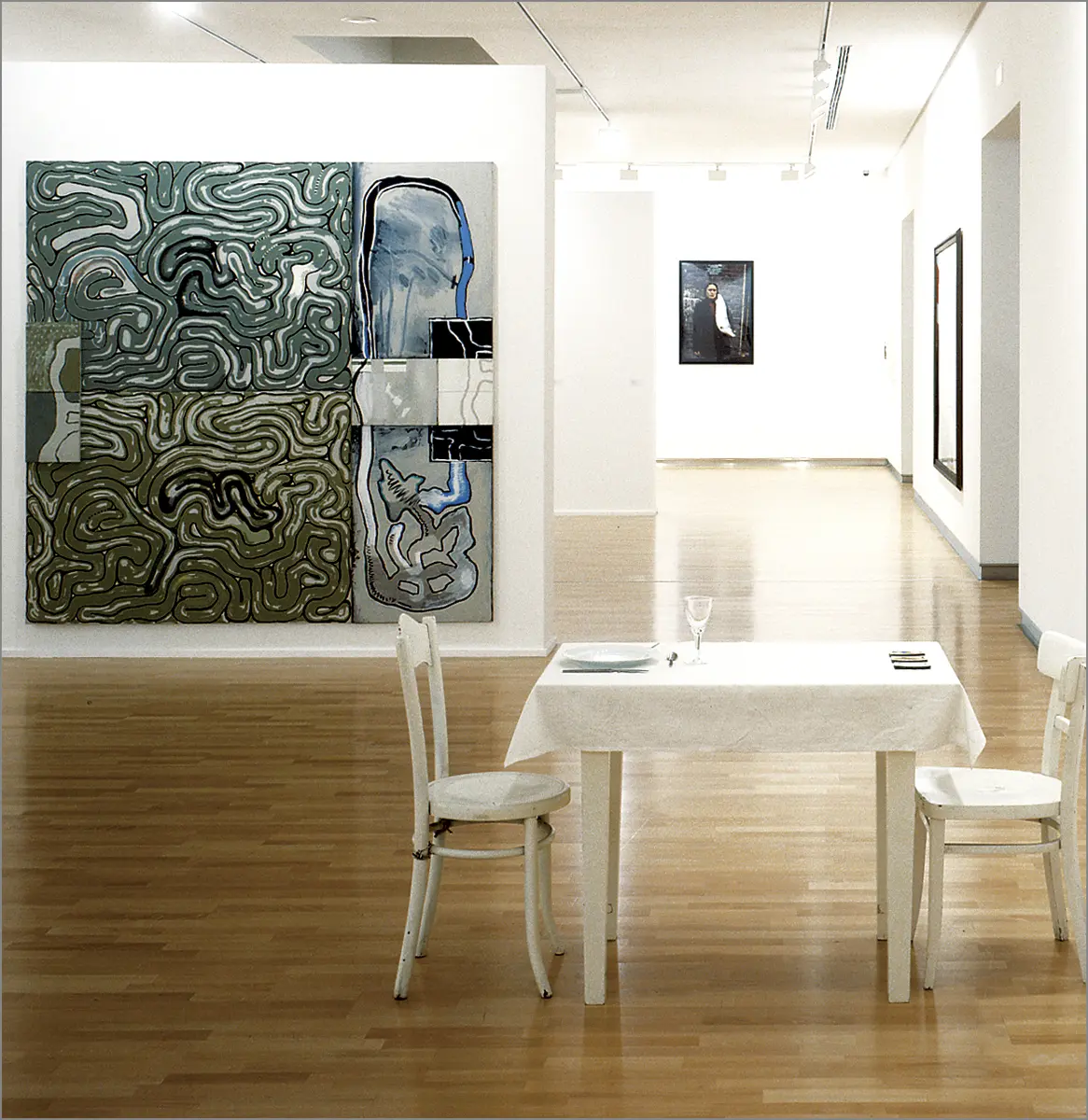
For example, using as a point of departure the idea of the table as a place for food, many works of great relevance have been gathered: Joan Brossa’s El invitado (The Guest), 1986–1990, in which —as a system of execution that was still valid in Spain until the end of the Franco era in the 1970s— a despicable club presides over a table with the precise elements of a refined dining hall, set for one guest; Victor Grippo’s Analogía IV (Analogy IV), 1972, in which a plate of glass potatoes confronts a plate of real potatoes; in George Brecht’s Table and Chairs, 1962–63 a set of playing cards faces a plate, a goblet, and cutlery; Luciano Fabro’s Bacinelle (Trays), 1975 presents various glass trays; Martha Rossler’s Gourmet Experience, 1974; in Mona Hatoum’s Deep Throat, 1996 a video from a plate in front of a chair carries us to the interior of a throat and stomach; or, finally, the piece that opens the exhibition in the museum’s entrance hall, César Martínez’s El hombre de ébano y sol (The Man of Ebony and Sun), 2001 is an edible sculpture that reproduces the figure of a man in chocolate.
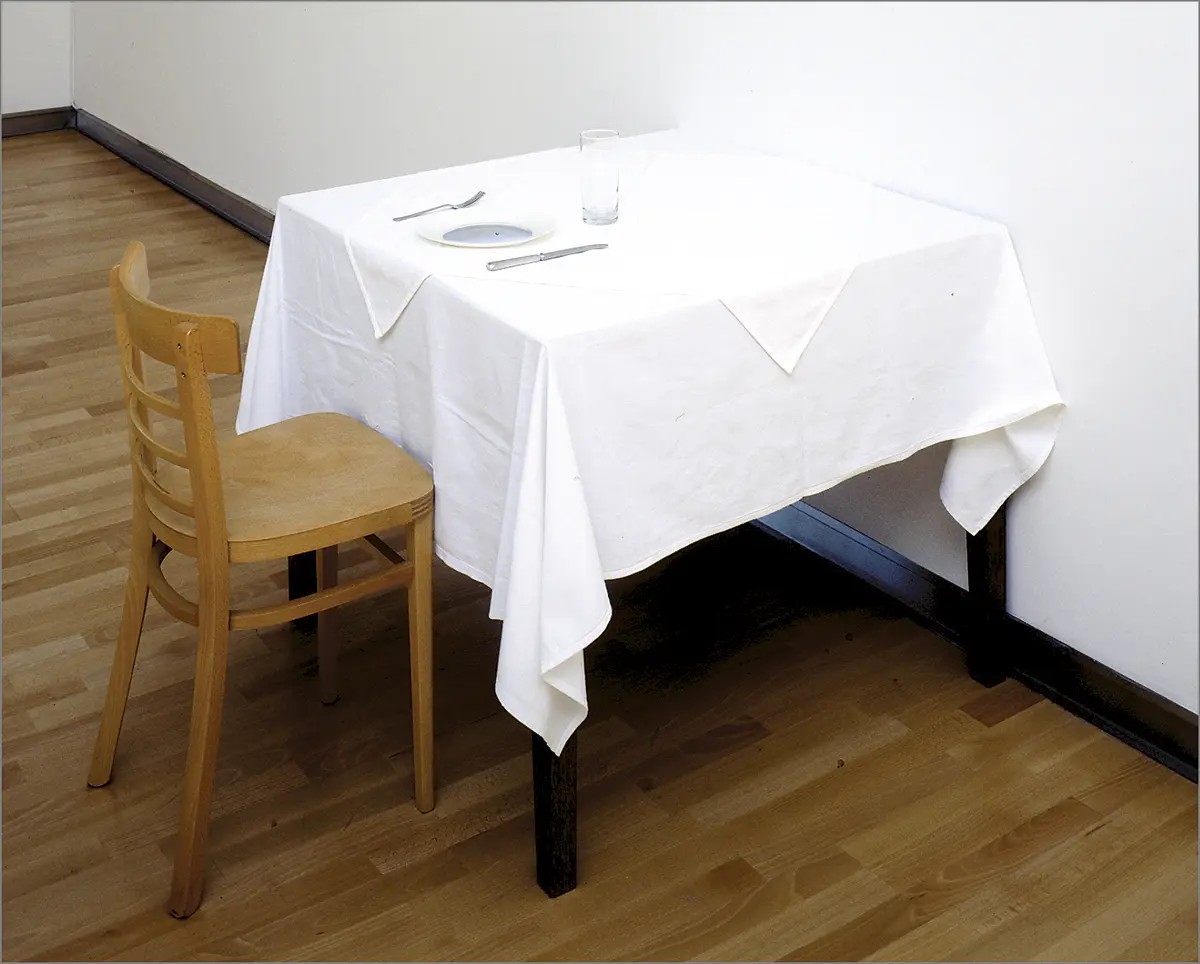
Despite its apparent literal nature, one of the works along this theme that is more incisive, from my point of view, is Isidoro Valcárcel Medina’s installation, No necesita título (It Doesn’t Need a Title), 1990. Medina represents a welfare dining hall in all its details, including the menu of the day. In the exhibition, tables, tablecloths, and cutlery belong to one of the social welfare dining halls of Salamanca, and the plates that would naturally contain real food are replaced every day, the smells providing credibility for the piece.
In other works, such as Rosemberg Sandoval’s Extensión—segunda version— (Extension —second version—), 1980-1981, in which a piece of fabric preserves coffee and urine stains, the concept of food is drawn from the body and its physiological functions. The same approach appears in Teresa Margolles’s work Secreciones, 2002, where human fat stains one of the walls along the hallway that leads to the museum’s restaurant.
The exhibition is a labyrinth that itself refers to the matrix of the body in the face of art and the conflict of representation: the body and its food reproduce the basic structure of the artistic process in a dysfunctional, metaphoric, and finally, deconstructive way —an incessant feeding and feedback of ideas. Food and its multiple forms overlap with art, as survival— in the same way that sex overlaps with art, although in a more complex and, at the same time, more basic model. Art as an incessant devouring and digestion, reflects the model while it devours and digests it. It is precisely the most basic aspects that are the most complex, not so much because of the contradictions that they propose but because of the way they synthesize and summarize the variety of spheres of existence and the demands of the human condition. The synthesis is resolved as digestion and at the same time as an ever-tragic joy.
The exhibition conveys the importance that something as banal as food can acquire in the creative process: the process itself is food, and the ultimate question is whether to eat or not to eat.
SANTIAGO B. OLMO