
As a whole, Fernando García Correa’s (Mexico City, 1958) drawings and paintings at the young Mexico City gallery Myto (Temístocles #23-2) display a homogeneity on which we can once again discern a constant: the obsessive care invested in each piece, the cautious formal order, and the recurring motif of lined-up, pattern-forming cracks, gaps and track marks. Either in large or small formats, the patterns are repeated intermittently across the canvas, suggesting weavings that criss-cross to produce images that, sooner or later, refer to Nature. In other words, García Correa’s enigmatic paintings are like a detail of what could be a bloody fingerprint, or the lines on a diagonally-cut tree trunk, or our central nervous system unfolded and on display. Exploring each work feels like trying to emerge from a convoluted labyrinth, like trying to smooth out a ball of twain, like poking a complex spider web.
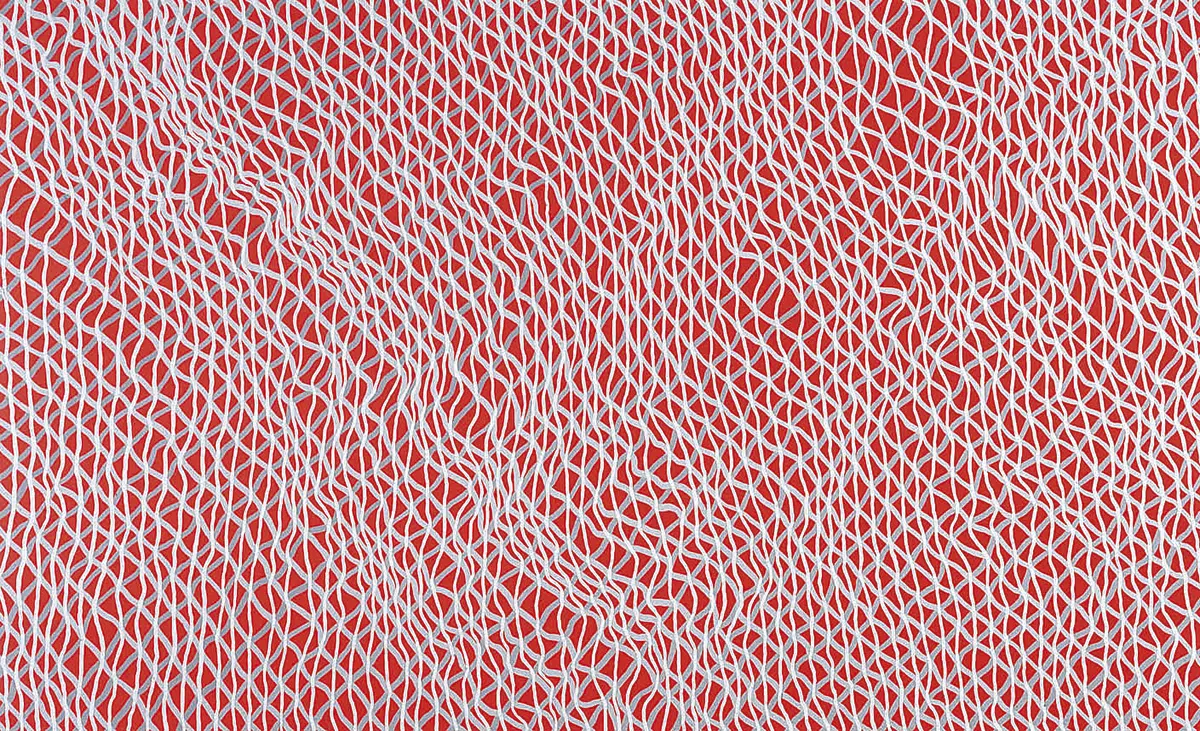
Free strokes move across the paper, delineating a mountainous pass; lines of paint fade away against a background of intense pigments; intentionally or not, García Correa’s works emanate a strong sexual charge: many of the patterns resemble a female pubis, the pubic hairs untangling in front of the vagina; or, the open gaps refer to the inevitable wrinkles that appear with age on any human face. If a motorboat crosses the waters at 120 kph leaving behind a foamy trail, as it dissolves, it leaves a trace; if a family of crabs runs around all through the night, its track marks will be there in the morning; if water falls freely from a high rock to a low-lying lagoon, the drops and splashes will remain as evidence of its path. These are the kinds of clues that emerge as traces in García Correa’s art, forming very complex patterns that interweave and suggest that all vision breaks up into loose threads, apparently impossible to sort out and order. Yet the word “disorder” has no place in García Correa’s vocabulary; what we tend to perceive as a chaos is in truth an as-of-yet-undeciphered pattern.
If something has distinguished García Correa throughout his career, it is the excellent finish and presentation of each one of his pieces. Individually or as part of a group, the calculated, reasoned, logistically placed drops are yet one more demonstration of the artist’s technical mastery, after his minimalist foray of recent years. García Correa emerges from minimalism to surprise us with this laborious, ingenious tangle, distributed as a series of intricate patterns without easily discerned beginning or end.
Some of the works could at some point bring to mind those Op-Art exercises that were common in the 1970s. For instance, a graphite-on-paper of fine lines that intercut each other on the white space, refers back to Bridget Riley works on what was known as the “waterfall effect,” due to the fact that the contrast of black on white is experienced visually as an apparent movement of the retina, as of water in a waterfall. In other works we see fine orange lines in zigzag formation against a red background, or the same pattern in different acrylic colors; these also remind us of 1970s Op-Art, although García Correa’s painting possesses a greater depth of both intention and technique. Yet other works on display here could relate to the decorative paintings of the 1980s movement Pattern & Decoration, although this is perhaps too simplistic an interpretation: there is, yes, a formal similitude in the preference for ornamental borders, curvilinear motifs and seemingly superficial elements, but the work of Pattern & Decoration had a merely visual intention while García Correa’s is, in its own peculiar way, highly symbolic, real, and intentional. Pesqueira Gallery will exhibit the artist’s work in December.
LUZ MARÍA SEPÚLVEDA