
This year has not been the best within the cultural field. To the evident ignorance and provincialism of government officials and the lack of official budgets, we can add —thinking directly of art exhibitions— the disproportionate growth of the artworks’ insurance and the regrettable cancellation of exhibitions sponsored by other countries, which, do not justify the exhibitions of objects of monstrous banality, excusing themselves perhaps by the Armani exhibition held at the Guggenheim Museum a few years ago, as if worthy of comparison. If the institutions that organize exhibitions haven’t been able to do much, neither have commercial galleries had any special activities and their programming hasn’t been the most appealing.
Thus, it is worthy to point out Jaime Franco’s exhibition of oils on canvas and works on paper, which took place at Galería El Museo from the end of February through March. Pity indeed, that no catalogue remained, even if it were to be small. It is my understanding that some galleries in Colombia do not finance the catalogs and artists take on the expense. The best way to make known the work of an artist is through a publication that can reach many places and many interested people through the mail.
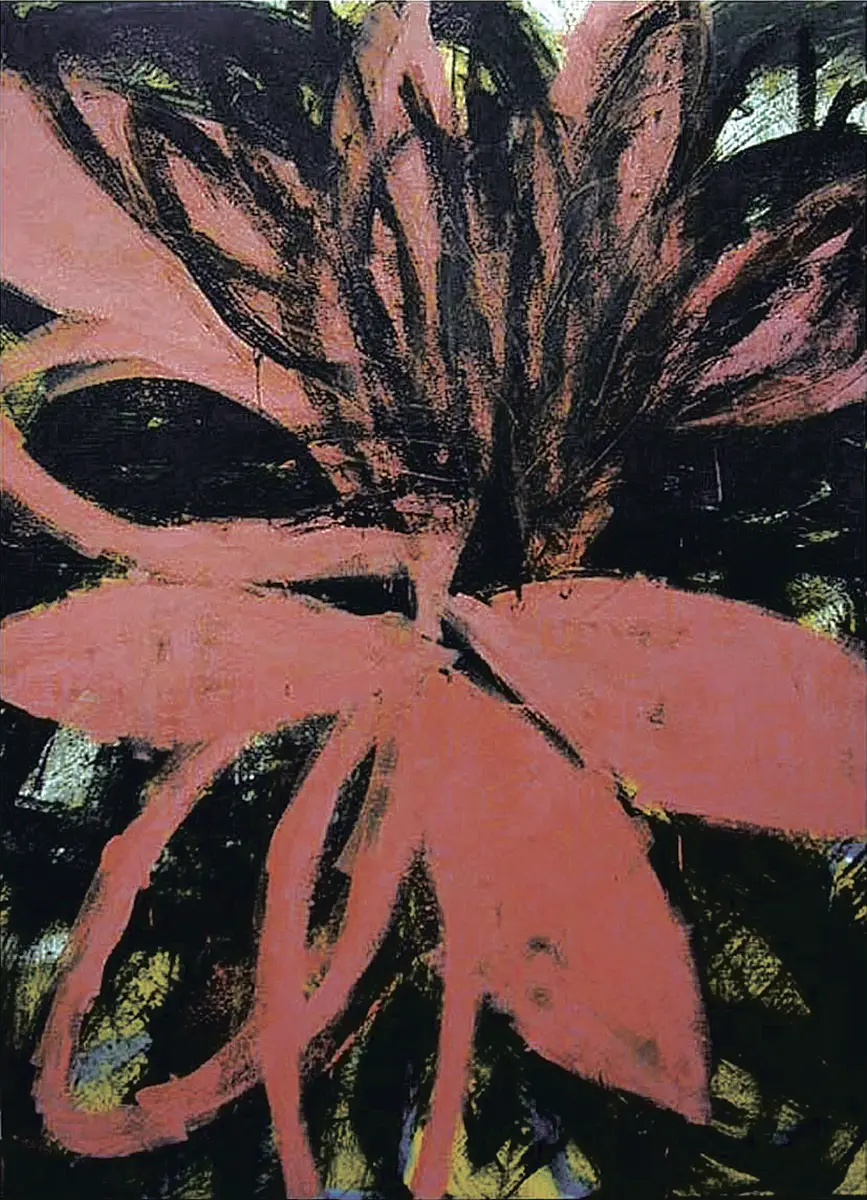
In the invitation card to the exhibition, Franco wrote: “During the fifties, facing the abstract expressionists’ first paintings, the critics that described the canvases as blank as a battlefield, weren’t a few. The final results were the marks of a battle in which the painter had to face himself. Even in the paintings that were quieter and lacking color, which I have done for some time, I have faced the canvas with that conviction. Perhaps in this exhibition, this fact will be made more evident.” True. Throughout his career of more than 15 years, the artist has kept the constant of painting as a vigorous action, with the purpose of making a bidimensional pictorial work of art —with stains, textures, colors— in which more than a representation, a symbol or a concept, the process of painting can be seen, the mark of an arduous work as physical as it is intellectual. This year’s exhibition gathered a good number of oils in various formats and a number of mixed media drawings on paper, in which, according to the artist, the struggle of the painter with himself results more evident as are the remains of the scuffle.
The exhibition as a whole creates an impact: it was extremely varied, much more colored than in previous years and with very different compositions that went from very strong and apparently rude —Manzanas levemente heridas (Slightly Wounded Apples), for example— to others that were gentle and almost monochromatic —Cintura de arena (Waist of Sand)— and even others of semi-figurative appearance —for example, Fiesta de los taladros (Party of the Drills) that brings to mind some leafs falling. One of the most accomplished oils is No he venido a ver el cielo (I Haven’t Come to Look at the Sky), in a horizontal format, in which many strokes of light and hydrangea blue, are arranged vertically and imposed on other more horizontal black ones. And the dim of the war leaves no doubt on Feria de ceniza (Fair of Ashes), a dark canvas of black and passionate brush strokes and marks of great dynamism. The works on paper deserve special mention. They are all untitled small format works, in which very visible brush strokes create a variety of plots, some very colorful, or form different designs in the way of tangled arabesques, graphic structures, or curvilinear twists.
From afar, Franco’s work, the best abstract painting in the country among the artists of his generation, is tied to the abstract expressionism of the United States. Behind his extremely good current paintings, one can think of works like those of de Kooning, Kline, Clyfford Still, and even Robert Ryman. However, this Colombian doesn’t only study them, but has completely assimilated them until they achieve their actual production with unique results.
There is one factor that contributes to this particular expression of Franco. It’s his admiration, his taste for music. I might not be wrong to attribute to him these words of Mathias Goeritz: “…What interests me, actually, what seduces me about art is the emotion that it produces. Deep down, I would like to make music like the one Bach, Händel and Mozart made. The work of each one of them moves me more than any visual arts work.” Besides these composers, who are also important to him, Franco is very interested in jazz —its compositions and improvisations. Among the many composers and interpreters that the artist admires, I remember now, specifically, the name of John Coltrane. I don’t believe it is too imaginative to state that the beautiful paintings of Jaime Franco could be timidly lyrical or rough, intense and full of emotion just as ballads or like parts of a particularly praised piece such as Coltrane’s A Love Supreme.
GERMÁN RUBIANO CABALLERO