
It is greatly important that Legacy Fine Art presented, for the first time in Panama, an exhibition of Jiménez Deredia’s sculptures. As a renowned artist of the neighboring country of Costa Rica, established now in Italy, his work is virtually unknown to the Panamanian people. It is the key to the analysis of Deredia’s work —despite his long years in Europe— that ties him to the sculptural tradition of his country of origin, at the same time that he reflects upon a relationship with Italian art and the marble of his adopted city, Carrara.
In this exhibition, Deredia’s sculptures showed the conductive thread of his work which is the creation of human shapes inside of, or based upon, geometric structures in bronze or marble. The sphere shows a notable preponderance as leitmotif, to the point that the exhibited works produce an almost excessive homogeneous impression in the repetition of forms, of the scheme that compounds the forms of women and orbs, and the preponderant shine he finishes them with. For example, in the piece entitled Mujer sobre esfera (Woman on the sphere), we see a woman seated on a large sphere, leaning over, making an ample curve out of her vertebral column, an impossible pose from where she raises her head in an almost frontal position and holds in her hands another sphere. The dark and polished bronze shows golden lights on the surface of the toes, the outline of the hands, and the features of the face. There is also light on the outline of the smooth and spherical shawl that usually covers the heads of Deredia’s sculptures, akin to the sculptures of Inuit art, contributing to the avoidance of detail that could provide any individuality to these prototypical figures.
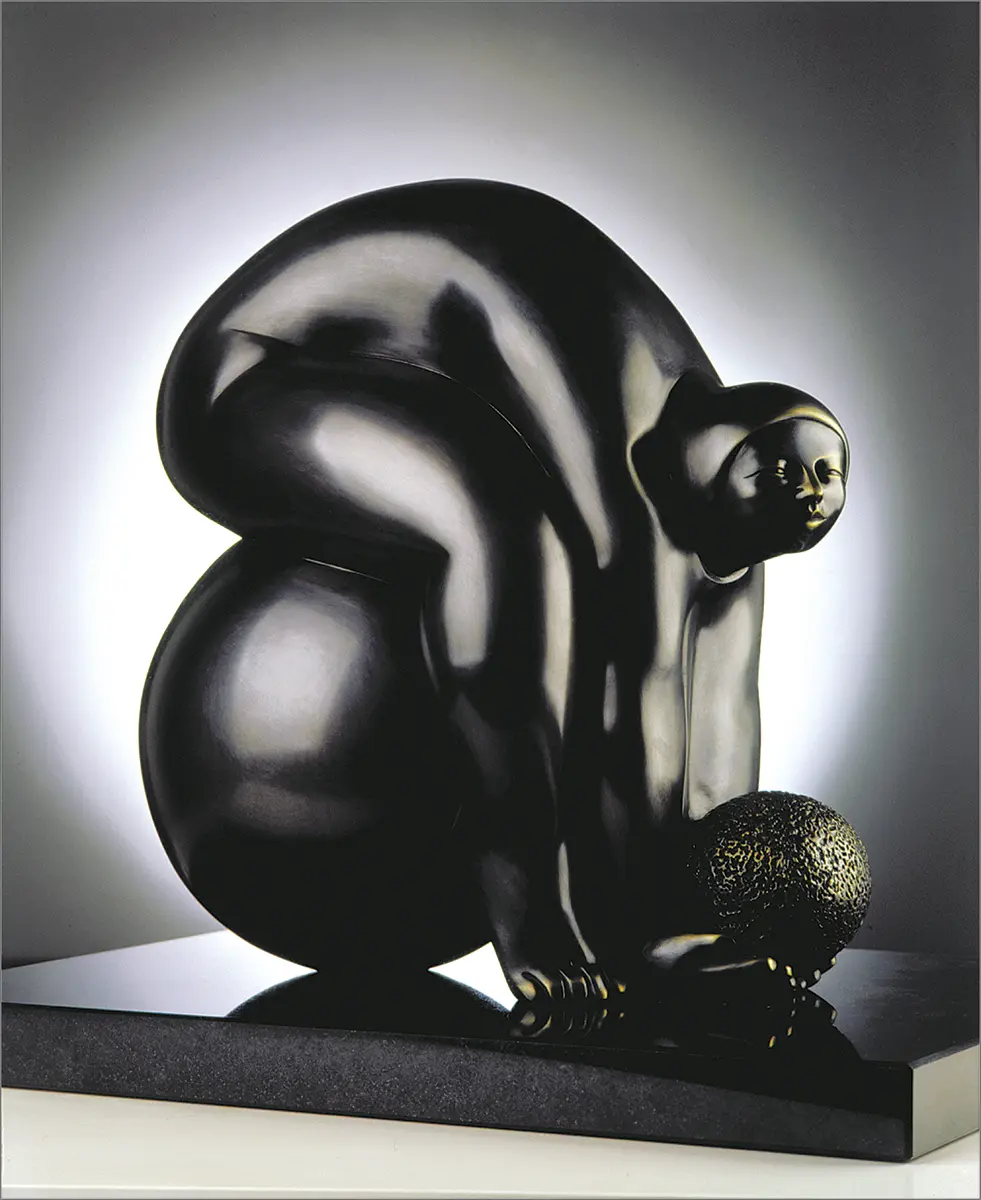
Mujer sobre esfera shows a flawless finish, achieving the smoothness of onyx in all its shapes with the exception of the rough surface of the ball that the woman is holding, whose surface is rough. This contrast between smoothness and roughness, between brilliance and opacity, characterizes many of the bronze and white marble sculptures. They also share the way in which women’s faces —small in relation to their massive bodies— show an impassive attitude with semi-open eyes separated by a narrow but strong flat surface of the nose, full cheeks, and polished lips. They are slightly reminiscent of the heads of Constantino Brancusi, transformed by the characteristic spherical shapes of Deredia.
We observe a similar stillness in figures like Meditación (Meditation), made from white marble, where a figure with straight legs, bends over from the hips while holding a cylinder with arms extended. The marble is opaque but full of small lights throughout the piece with the exception of the face and the feet that sparkle. The piece is almost abstract because of the inverted “U” shape that Deredia achieves with the human body and because of the way the back of the piece resembles more the slate tablets of the Ten Commandments than a living being. A similar playful tendency is observed in pieces like Germinación (Germination) where a woman lies face-down on a large ball, or in Juego (Game) where a feminine figure kneels on top of a sphere while reaching to the ground from her impossible position, producing a tension between the organic and the geometric which lies at the root of all of Deredia’s work.
In other pieces, perhaps the purest ones, like Mujer esférica (Spherical woman) and Centinela (Guard), Deredia carves the entire figure of the woman inside the sphere. In a fetal-like position, the arms support the knees and the crossed legs end in small feet that retract against the thighs. The artist attributes the central role the sphere plays in his artwork to his childhood experience visiting the Museo de San José in Costa Rica, where two-thousand-year-old giant spheres made by Boricuan Indians are exhibited; “the only abstract sculptures before Cristopher Columbus, who arrived in Costa Rica in 1502.” These enormous spheres of great weight were originally aligned in accordance with the position of the stars or the sun, and Deredia is making a great effort to catalog their existence.
The symbolic relation of the sphere and the ovoid with spiritual themes such as birth is magnificently represented in works like Génesis (Genesis) where Deredia presents four bodies that show the artistic process and the way in which he envisions the human silhouette within the geometric shape. The first piece is like an egg, the next one contains small incisions on the surface that insinuate where the knees and the head of the figure will appear. The head of the woman emerges in the third piece, and in the fourth, the full feminine anatomical shape is perceived as collected into herself in such a way that the original ovoid still exists. They lay on a narrow, elongated, rectangular base, with a surface of irregular markings that creates the line of the axis on which the four small sculptures are placed. The work represents the creation of a three-dimensional form.
Deredia initiated this series in four stages beginning in the 1980s, starting with pure geometric forms like the sphere –in Imagen cósmica (Cosmic Image), for example– and in time, with more organic shapes as two works show it in the Legacy exhibition. The second one, entitled Genésis papagayo (Parrot Genesis), also in bronze and of small proportions, starts with a curved and elongated shape and ends up representing a woman that leans on her knees like a leaning ovule from which the arms that hold a small sphere are extended. In the hands of Deredia, the body turns into a malleable shape without any osseous impediments that would prevent its total curvature.
The preponderance of the curve and the inscription of the feminine figure within practically closed shapes, without any dramatic projections to the space that surrounds it, link Deredia with some precursors within the rich development of sculpture in Costa Rica. In this sense, there are ties with the well-known master Francisco Zuñiga (in works like Desnudo Ovoide (Ovoid Nude of 1963, for example) and with the interpretation of women in the work of artists like Max Jiménez Huete and Juan Manuel Sánchez. There are also some common points with other sculptors from the same country, and at the same time with the so-called primitive art: the interpretation of the faces with indigenous features, the curves of the eyebrows which meet to form the nose while sharing the same surface with the forehead, and the almond-shaped and elongated eyes that remain only partially open. In the same way, Deredia joins a long tradition of maternity as a sculptural theme in pieces like “Beso” (Kiss), included in the Panamanian exhibition, in which a crouching mother extends her arms to hold, not a sphere, but the small body, equally curvilinear, of a child. The work of Deredia pleases —without mostly challenging the viewer— for its curves, its solid presence, the smoothness of his surfaces, and the theme related to the human being and creation, at the same time impresses for its mastery of technique as much in the carved works as in the bronzes.
Born in 1954, Deredia graduated with a degree in sculpture from the Conservatorio Castella in Heredia and at the Academy of Fine Arts in Carrara, Italy, and then as an architect from Florence University. He has developed his artistic career in Italy, where he has participated in a great number of exhibitions, including three Venice Biennials, without losing his connection to Costa Rica and also with other Central American countries, where his sculpture is much appreciated by collectors. At some point in his career, he changed his name from Jorge Jiménez Martínez to Jiménez Deredia, as a way to honor his roots in the city of Heredia in Costa Rica.
This is a Central American artist who has harvested many successes in this region and Europe. Among other things, in 1998 he was awarded the Internacional Beato Angelico Award for “the spirituality of his work” in, later he received the commission to carve in marble an enormous sculpture of Saint Marcelino Champagnat for a niche in the external facade of the Saint Peter Basilica in the Vatican, the first non-European artist to obtain this honor.
MÓNICA KUPFER