
Until this exhibition, the work of recently deceased Spanish artist Jorge Oteiza was little known in the United States, except by his vocal admirers who include Richard Serra and Frank Gehry. Oteiza’s influence stemmed from his sculptures as well as his poetry, philosophical writings, and architectural projects. Born in 1908 in Orio within the Basque region of Spain, he moved to Argentina in 1935 with his family where he showed his sculptures and lectured on the visual link between modernist sculpture and pre-Colombian archaeology. In 1948 he returned to Spain and became one of the leaders of the Basque school of artists, articulating a discourse on abstraction in his sculpture, in architectural commissions, and in the poetry and polemical pieces he wrote on aesthetics.
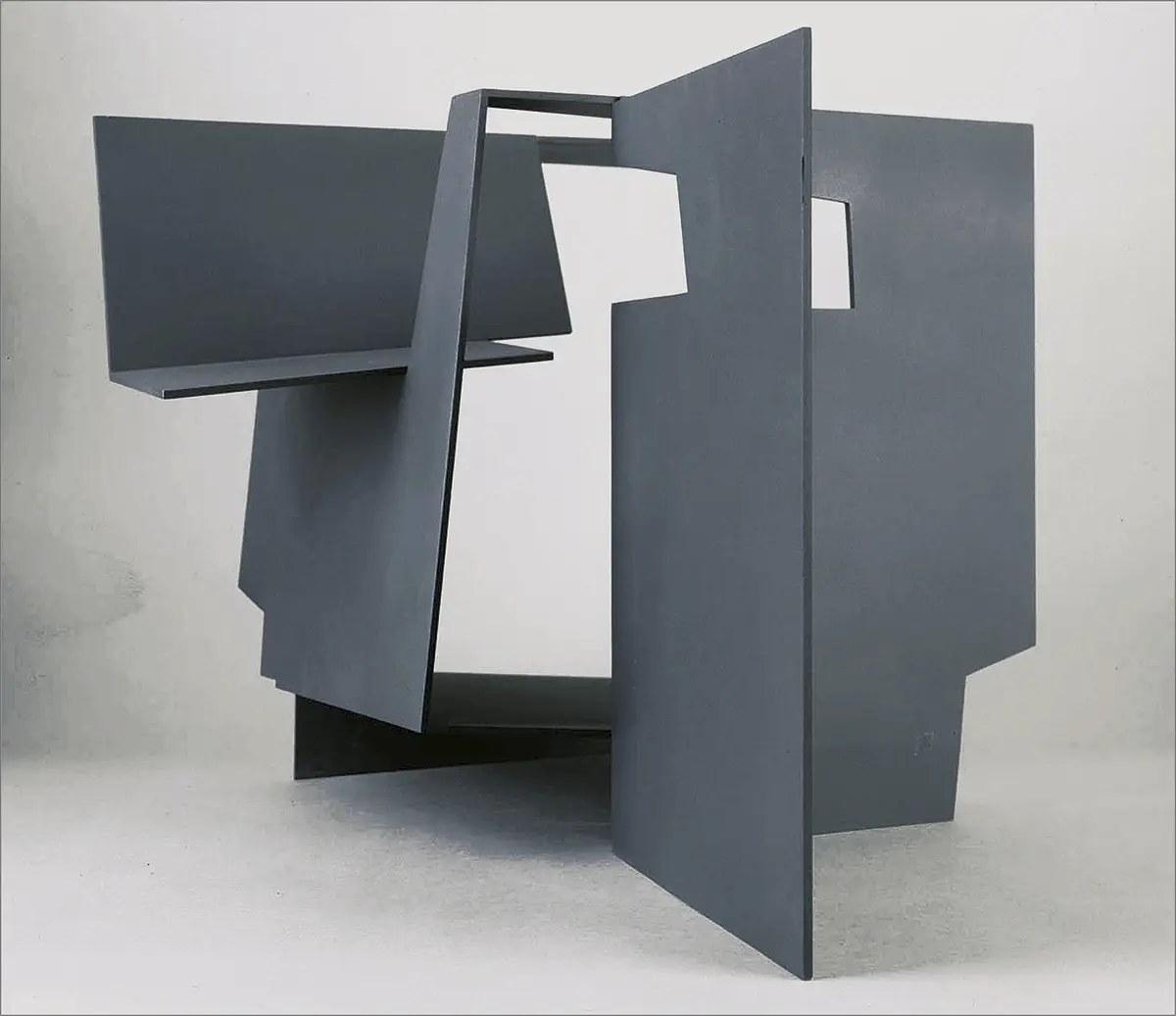
Many of his sculptures date from the 1950s, a period which reveals the development of his visual concerns. By 1959, the Basque artist declared with characteristic defiance that he was done making sculpture, that he had investigated space so extensively that he ended up with his hands filled without sculpture, just space. Amongst the eleven iron and alabaster tabletop pieces presented here, one recognizes Oteiza’s striking ability to carve, shelter, and suggest space with forms wrought of bent metal and hewn stone.
In Previous Stage to the Disoccupation of the Sphere 1957, the Basque artist characterized the dimensions of space with two inter-twining, black iron bars bent into open circles projecting outward at divergent angles from a smaller inner circle floating horizontally. It is as if he opened up the sphere, allowing us to see the void within. Given the visual similarity of this piece, for example, with the constructivism favored then in Brazil, it is no surprise that Oteiza was awarded the prestigious International Sculpture prize at the 1957 São Paulo Bienal.
In Tribute to Galíndez 1957-1958, Oteiza’s half-circle metal bars evolve into curving planes that expand fluidly like arms enfolding the surrounding space. Two vertical planes join, creating a sharp angle that stations the piece, while curved planes of iron unfurl upward and outward from the base. The intimate scale of this sculpture, similar to those throughout the show, beckons the viewer within its embrace.
Oteiza’s collaged works on paper from the 1940’s shown here for the first time, provide a window into the artist’s working process. Visually, they recall the paintings of Russian Suprematist artist Kasmir Malevich, with their starkly simple compositions of clean shapes precisely placed upon a white ground. Further scrutiny reveals that Oteiza explored the layering of shapes and placed pale paper over portions of the dark forms, creating a tone midway between the white ground and the maroon hue of the richly-colored shapes. Hence he created the effect of varying depths within the picture space; the darkest shapes appear to recess deeply into space, the medium tones expand just below the ground and the lightest colored shapes shimmer upon the picture surface.
These works articulate the volume of space Oteiza physically depicted in his metal sculptures such as Open Construction A of 1958. Here the curved metal planes are cut in differing sizes and shapes then set at angles intersecting and jostling each other, creating a panoply of moving planes, bursting with the spiritual energy he strived to articulate sculpturally. The crusty, rust-covered iron surface seems to harbor the force within each piece.
By the end of the 1950’s Oteiza sculpted space through a pure, ascetic expression as in his Tribute to Leonardo from his series Metaphysical Boxes of 1958. This simple, black box allows beautiful ribbons of space to frame three sides of the square. It is an enigmatic form sheltering the vast void within.
A controversial figure to the end, Oteiza, along with his fellow Basque artist Eduardo Chillida —with whom he sparred until months before the latter’s death— led the Basque modernist movement. Oteiza played a prominent role in Spanish cultural life, openly criticizing Franco’s repressive regime, the violent tactics of the Basque separatists group (ETA), Gehry’s Guggenheim design, and his regional government’s plans for a museum of his work. Ultimately, his opinions were widely known but were most articulately stated in the pieces he conceived, their silent spaces and intersecting planes that challenge the sculpture’s very premise.
MARY SCHNEIDER ENRÍQUEZ