
Of great interest was the perspective of time and place offered by the José Clemente Orozco in the United States, 1927-1934 exhibition, contributing as it did to deepen our knowledge of, and enrich our reflection about the work of this preeminent Mexican muralist.
It needs to be noted, for starters, that the spatio-temporal approach was very pertinent to a transitional but highly suggestive period —perhaps one of the least explored— in Orozco’s career.
Exploring generously and systematically the artist’s work during the seven years he spent in the United States, the show gathered some 120 pieces including drawings, lithographs, paintings, and sketches for murals. An important display not only because of the number of items but also because it brought together many works from public and private US collections, not often seen in Mexico.
The remaining works on paper or canvas came mostly from the valuable collection at the Museo de Arte Carrillo Gil (MACG), the same institution that hosted the exhibition between January 23 and April 14. The show was organized by Dartmouth College’s Hood Museum of Art; in fact, one of Orozco’s American works was a mural for Dartmouth’s library, preserved to this day.
Curated by Renato González Mello and Diane Miliotes, the show occupied MACG’s two lower floors. The works were grouped chronologically as well as thematically and by technique. This organization allowed viewers to engage cumulative with Orozco’s trajectory in those years, revealing the distance between the artist who created the murals for the Escuela Nacional preparatoria, finished shortly before leaving for New York, and the author of Catharsis and of the famous Guadalajara murals, started after his return to Mexico.
The show’s starting point was a series of drawings from Los horrores de la revolución, begun in 1926, while still in Mexico, and finished in 1928, the year in which Orozco started to produce graphic works (of which many examples were on display). Among the works, special mention should be made of El ahorcado and Bajo el maguey, works in ink of 1926-1928, and El réquiem, a 1928 lithograph, because of the extraordinary draftsmanship they reveal.
Next is a section titled “The Delphic Circle,” which illustrates the relationship between the Jalisco-born Orozco and the members of that movement (Retrato de Eva Sikelianos, 1928, oil on canvas,) with whom he shared an interest in the occult —which, by the way, had already been announced in his 1925 mural Omnisciencia at the Casa de los Azulejos— and in general cultural issues, as well as the adoption of motifs taken from Classic antiquity, such as marble busts and amphorae (Maniquíes, 1930, oil on canvas).
Appropriately, the museographic discourse emphasized the way in which these and other works from the period became a space for Orozco to confront the lessons of Western art, particularly the formal and content-related ideas advanced by the international Avant-Garde —such as expressionism and Surrealism— which he saw in his frequent visits to New York’s galleries and museums.
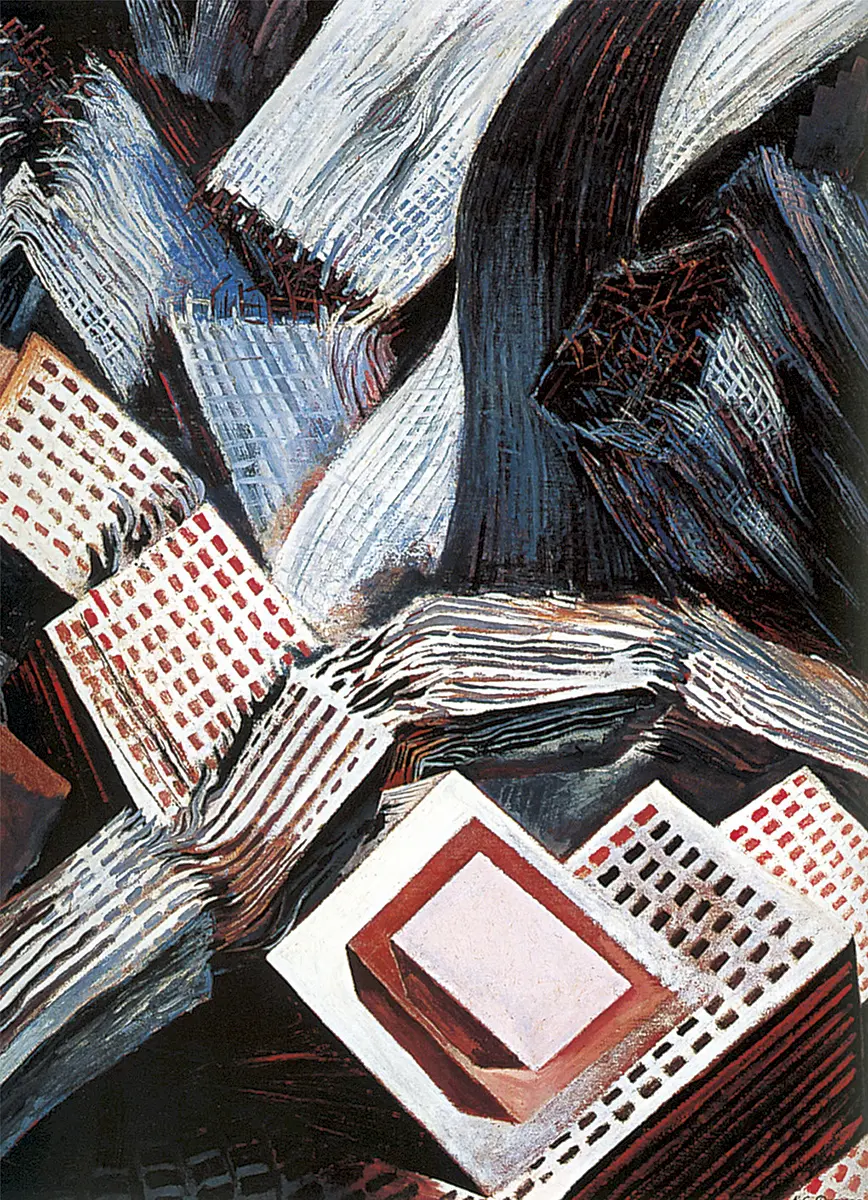
The show also made clear that Orozco sought to incorporate in his work different sides of the Big City: from urban popular culture (Coney Island Side-Show, 1928) to the urban landscape (Puente de Queensborough, 1932), with a special emphasis on the social contradictions created by the crash of 1929 (Gente afortunada, 1931), and carrying to the extreme his pessimistic, critical view of Modernity in the intensely dramatic composition of Los muertos, 1931.
Finally, the show included an abundant collection of sketches developed by Orozco for his American murals: Pomona College (Claremont, California, 1930); the New School for Social Research (New York, 1931); and Dartmouth College’s Baker Library (Hanover, New Hampshire, 1932-1934). This collection of graphite-on-paper sketches gave viewers not only additional guidelines to understand the stylistic and thematic development of Orozco’s oeuvre (the myth of Prometheus, his “civilizing messianism,” his impeachment of power, his representation of universal hopes,) but also signals of yet another transition. To wit, the movement from the artist’s initial concept and intent (the tracing of details, the anatomical study, the spatial construction, the relationship between the parts and the whole, the compositional scheme), through adaptations and modifications, to the finished work —an illuminating journey that sheds light on Orozco’s creative process.
ARGELIA CASTILLO