
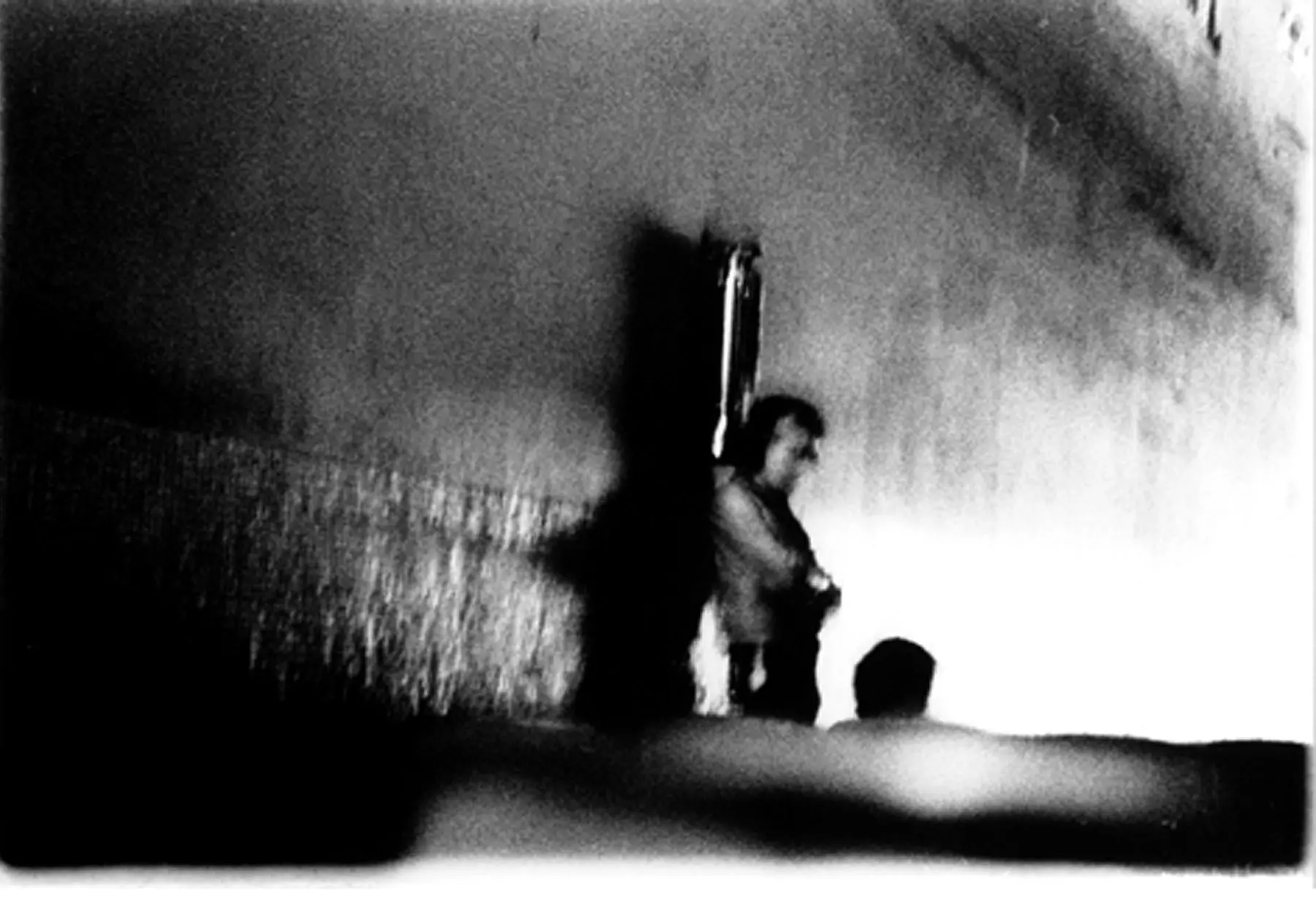
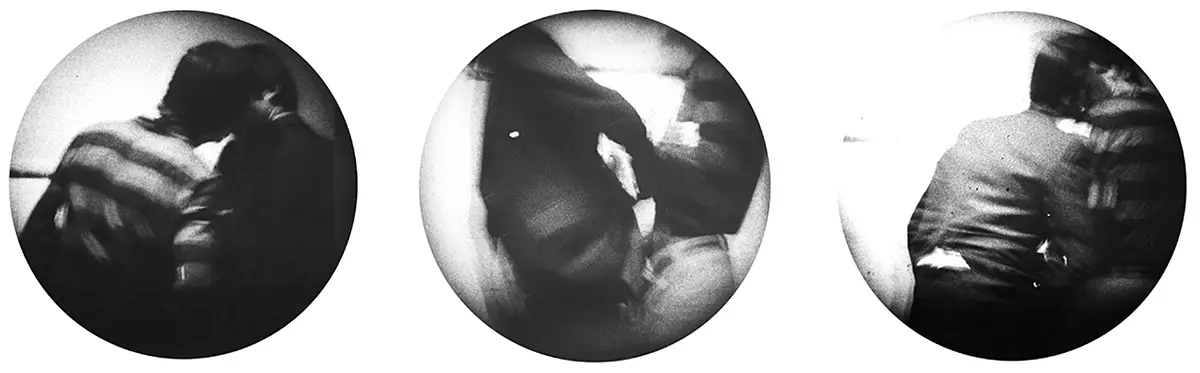
One afternoon in 1979, at around one-thirty in the afternoon, Miguel Ángel Rojas entered the theatre —a somewhat Deco building in downtown Bogotá whose splendor dated back to the 1920s, and that was now pretty much in ruins— and waited in the dark for a sexual encounter. A few moments later, Rojas started taking extended-exposure, black and white photographs, discovering in the process that art involves the entire individual, what it brings into play, as a synthesis, the individual's unconscious, to desires, as well as his ability to distance himself from experience in order to examine it. This was a social moment for the artist. It taught him to see, and the images he saw were indelible.
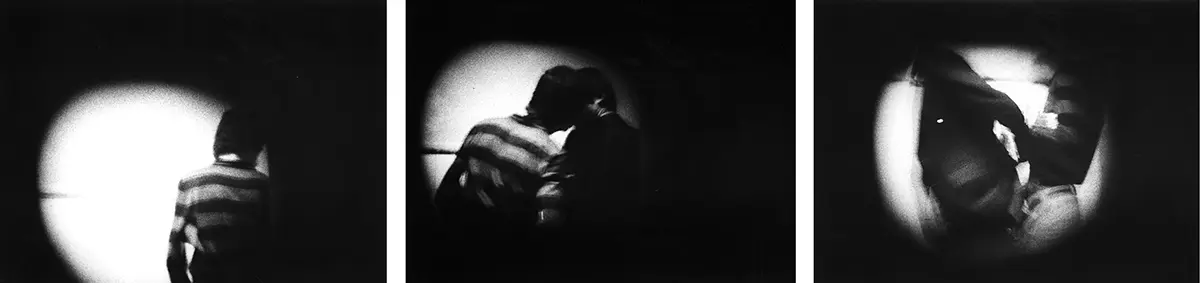
Those moments of waiting, what Rojas calls "suspended afternoons," resulted in more than seventy negatives later organized by the artist into several series: Antropofagia en las ciudades, El fisgón, La vía láctea, Diablo, La visita, Olores, La nave va, Palcos, Take of five, Tres en platea, and Del oriente. These series were built on the basis of a focused, unwavering awareness of what happened inside the theater. Awareness, for instance, of the men coming in; waiting "to get used to the darkness; "1 putting themselves on display for the gazes of those already there; exhibiting imperceptible body signals; mi then approaching each other. He was also aware of the projection screen and he took pictures of the films being shown, generally martial arts movies, thrillers, or westerns. He was aware of the space, and his photographs record the building's interior decorations, its shining balconies, and the few objects strewn around.
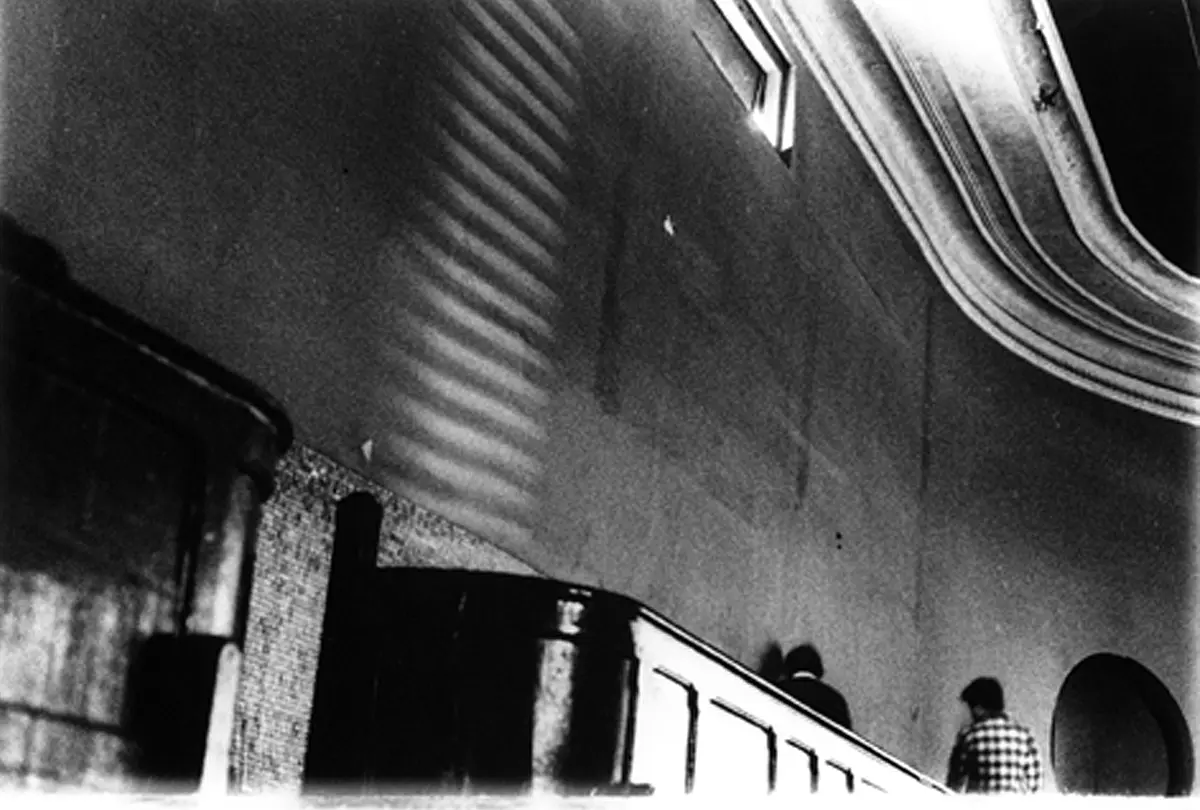
This issue of unwavering attention is of particular interest. In his book Los cinco sentidos, Michel Serres writes that in order for anything to In impressed upon something (or someone) else, a pressing force is necessary; this is to say, unwavering attention is required in order to observe reality and monitor relationships. Serres calls for refining our gaze so that it does not only limit itself to monitoring human relationships but also engages in the pleasure of observing things. These photographs in particular, and Miguel Ángel Rojas's work in general, exemplify both positions: objects are described by the use of long exposure, with attention to the darkness and to the shining presence of fire extinguishers; chairs; the roof transfigured by the flickering reflection that emanates from the screen; and the beam of white light from the projector. Yet, the artist also notices relationships through his observation of the imprecise figures; small but clear gestures, such as the hand that covers the nose to indicate the presence of smell; and the furtive encounter of bodies, an encounter of bodies, an encounter captured "in movement," in a blur, but in a delicious scale of grays. It is true that meaning is achieved by the viewer, whoever he or she might be, thanks to amplified stimuli from the signifier; here, objects are imprinted on us through descriptive richness: those jeans, white shirts, striped tees, shades, belts, but also the relationships between these men, the guardedness of their mutual approach.
The photographs are of gay encounters that in 1979, allowed Miguel Ángel Rojas to find life and accept difference. Today I see them as a sexual courtship that amplifies and enriches our own experience of eroticism: a form of exhibitionism in the outfits on display, the expectant gazes, the caresses, the back-of-the-neck close-ups, the affection, and the sex. They also have the mesmerizing quality of war photographs, where the need to capture reality under difficult conditions results in certain photographic calligraphy of altered focus, significant details, and blurry outlines, which in turn motivate the viewer to appreciate the authenticity of the material, the opportunism of the shot, its high information content.2 This, by the way, is no longer possible: our wars seem preedited before the film is shot.
Three photographs bring to mind those urban "non-places," transient locales such as theaters that in the 1970s allowed many young men to come to terms with their own sexuality in a social context in which the family, the space that anchors one's sense of belonging and identity, does not allow. But that is a different story. There are many paths into Miguel Ángel Rojas's world. In this case, I want to track the indelible character of the gaze and the origin of his current dot drawings.

In 2001 the artist created a video, Corte en el ojo, in which he explored his photographs from the Faenza using a stroboscopic effect and a red light. Corte en el ojo was rooted in a real experience, a beating he took in those years for taking his furtive photographs, as a consequence of which a shard from his own glasses cut his cornea. In the end, the video is an exhaustive record of the theater, going back almost thirty years later at the same time of day to find it empty, with its red leather chairs, wide seating space, and dignified balconies. Rojas went back to the theater out of an impulsive need to walk once more through the spaces he inhabited in the past. Today, the theater has lost its force; I just heard on the radio it has been acquired by a paper consortium. We can predict the experiences future generations will have in this theater. Walter Benjamin was right in thinking that the commodity could not be stopped. Even though it has never been shown in its totality, many people interested in Colombian art have always thought that Rojas's work about the Faenza is an authentic jewel. To revisit it today, years later, helps us understand that an artist is not significant because of his or her "newness." As Serres puts it, knowledge moves back and forth in time, and it percolates,3 turns, and keeps moving without stopping, in the same way that the artist returns to his indelible negatives.
Miguel Ángel Rojas also photographed theaters like the Mogador and the Imperio, capturing through a peephole what happened in the bathrooms. That series is titled Sobre porcelana because the tile floors (porcelana) of Mogador bathrooms were the scene of many sexual encounters. All theories of voyeurism are relevant here, but perhaps the most interesting is one developed by a friend of mine; in truth, he said, voyeurism is part of our sentimental education. Exactly. We are born into families and into a society that compart-mentalize space into public and private, and label certain attitudes as intimate, not to be seen. We are then educated in the desire to see that which we must not see; we know something is happening that we can not see because society has decided that intimacy, the most basic thing, is private. These photographs are then a peek at the most basic thing, the most evident thing, and this is extremely important. For Gregory Bateson, what is evident needs to be covered because it frightens us it pains us because it is difficult to watch; that is why human communication has so many self-correcting systems designed to sidetrack our attention, to close our eyes if necessary, to exclude parts of the process of perception. One thing Miguel Ángel Rojas learned in those "suspended afternoons" was to unveil.

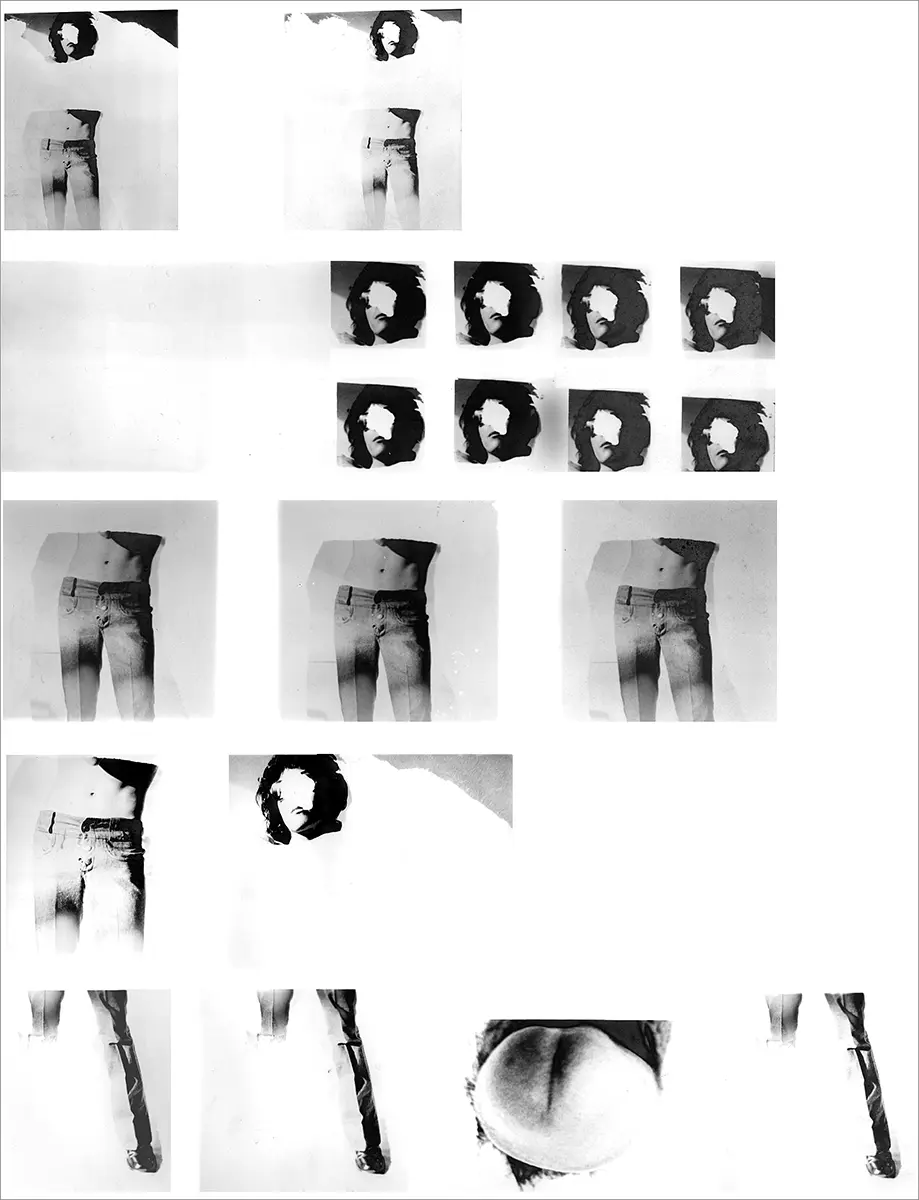
And not only to unveil but also to create a map. According to Bateson, a map is different from a territory. We only incorporate into our maps the things we recognize as different; for instance, if we are traveling through some flatlands and some hills begin to appear, those curved differences of level will be recorded on the map we are drawing. Since his dissertation for a degree in Fine Arts was presented at the National University in 1972, Miguel Ángel Rojas had already begun to work with reduction, to fragment, to select parts of his body that would give him an opportunity to recognize himself and to recruit the enlarger into his service. Later, he presented work based on reductions of his photographs from the theaters: Oblicua in 1972, and Corazones y Paloma in 1973. But the photographs taken at the Mogador, perhaps because they had been captured through a peephole and recorded moments of greater intimacy, remained beyond the eye's reach. In 1988 they became a cornea, in the literal definition of that word: "a hard, translucent surface in the form of a convex disc, which is the outer layer of the eye, located in the eye's anterior section between the iris and the pupil."4 Eight thousand reductions, less than 1 am. and hardened with resin, became seven 77 × 114 cm vignettes affixed to a wall to create a kind of comic strip, titled Paquita compra un helado. Paquita was the result of a beautiful experience, a stain he discovered in his workshop one day, a splash of pink ink resembling a little doll with an absurd hairdo. In reference to this work, it is interesting to recall the notion of the archetype brought to bear by Román Gubern, who says that despite their Platonic origin pointing towards the heaven of ideas, archetypes in truth refer to the sum of our everyday experiences of concepts such as beauty, value, etc. They do not originate in heaven but in our everyday sufferings and joys. Rojas's comic was born from the pain of seeing many of his friends die of AIDS.

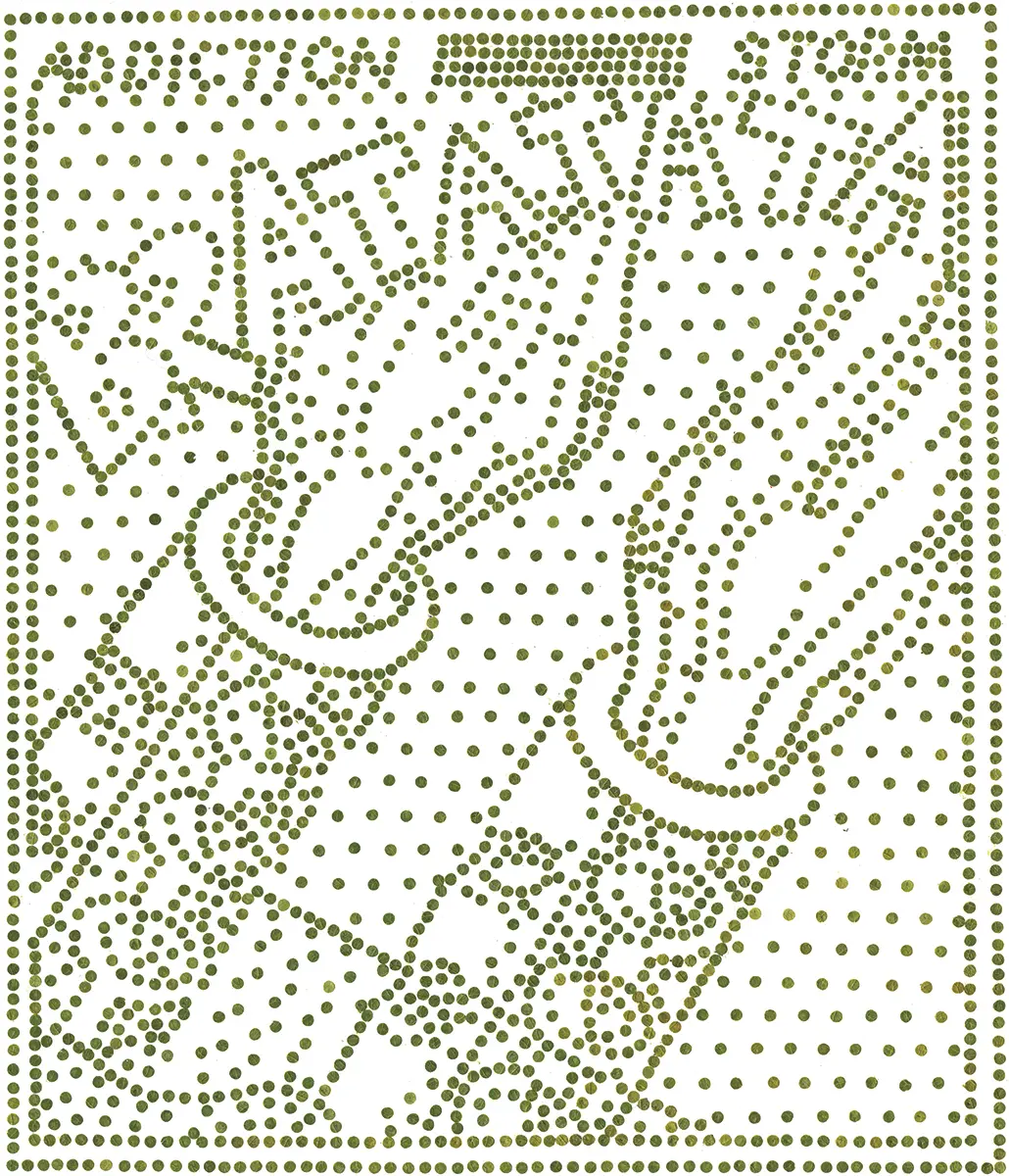
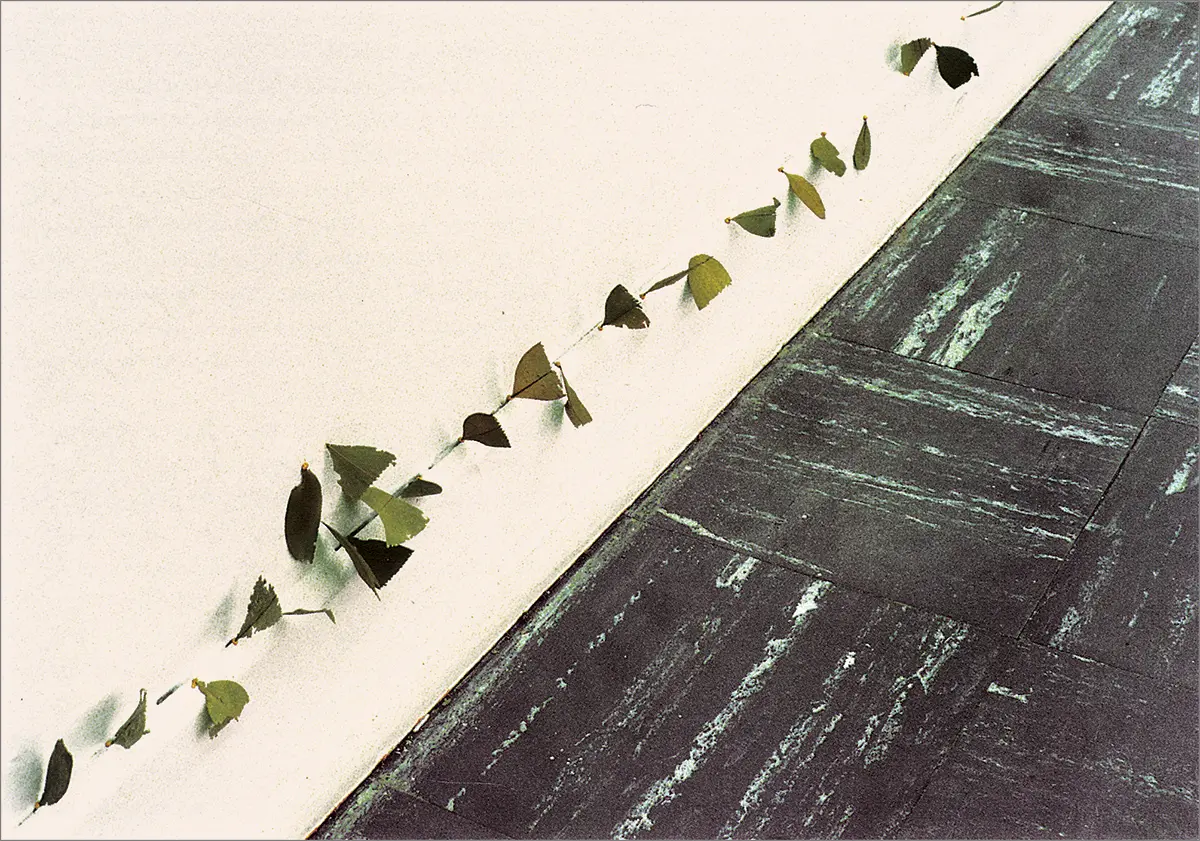
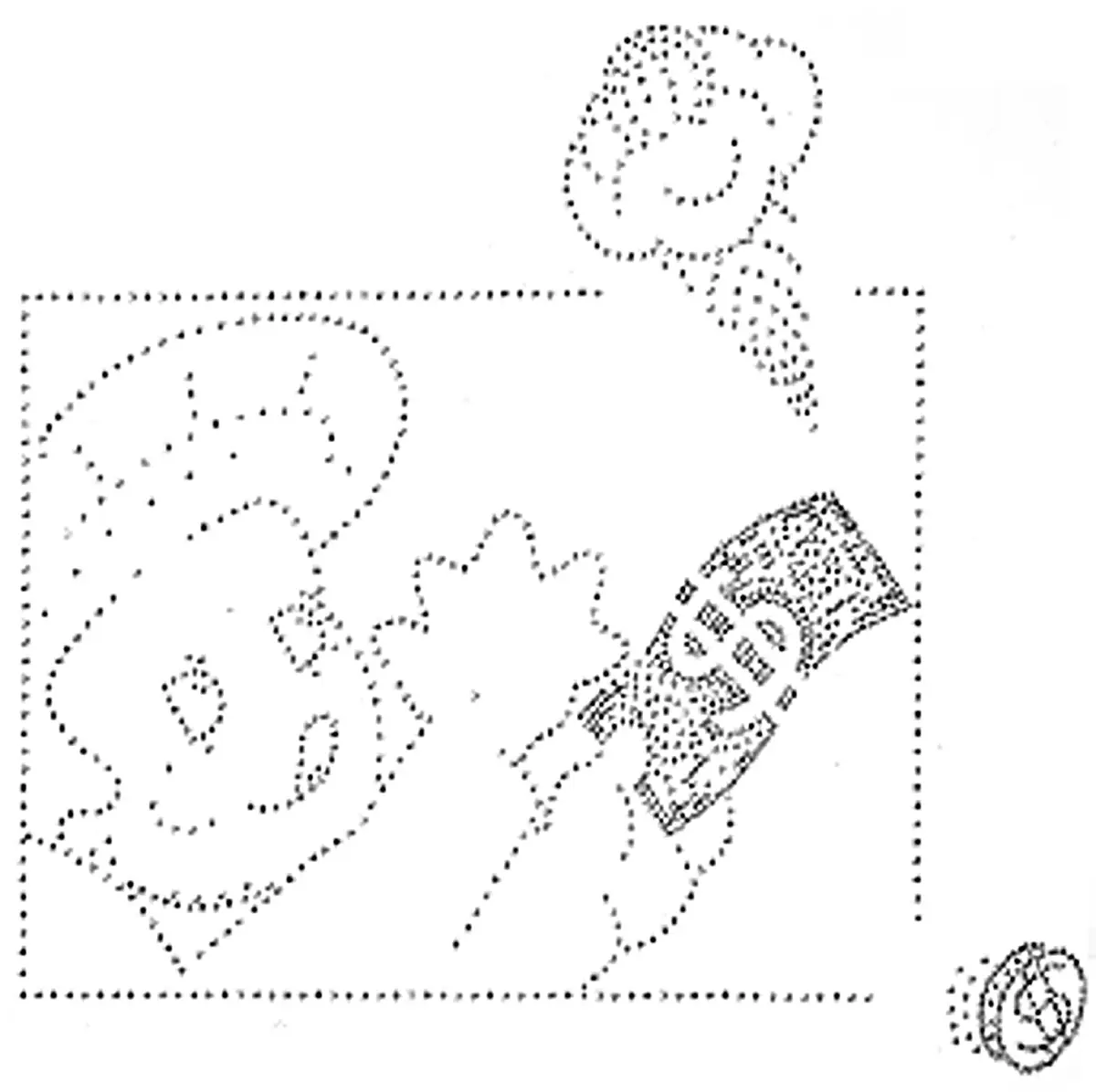
In order to trace the origin of his coca points, we need to understand Miguel Ángel Rojas as a vortex of popular culture and mass culture. He was born in Bogotá in 1946, a rather provincial city at the time, and he lived part of his childhood in Girardot, a port town on the Magdalena River. Both cities marked him deeply, in ways that were amplified by Colombia's embrace of mass culture. "Popular" is a term that has been abused freely, but in this instance, I want to salvage its meaning of having been born in a place where things can be perceived from a closer, more immediate vantage point, whereas for something to have a "mass" character means that it belongs in a social space where mechanisms such as photography make it possible to expand, reduce, and multiply those perceptions, and bring them to bear in relation to the collective sphere. In the year 2000, Rojas focused these conditions of perception on a world as small as the texture of coca leaves cut in the shape of small circles, and as large as that of Colombia-United States relations, as well as drug trafficking as a persistent conduit, visible despite the many efforts not to reveal it in all of its ramifications. It began with an ant trail, Broadway, invading the Museo de Arte de la Universidad Nacional: it was a line of very small coca leaves, cropped and stuck to the floor and the walls' edges, one after the other, as if being transported against all opposition by an invisible army. This was followed by archetypes, such as the cowboy, and landscape of Go On, the jaguars in coca points, and dollar bills facing each other in Es mejor ser rico que pobre, drawn using the same dot. With these drawings, Rojas intervenes in the channels of influence of the images that flow, in anthropological terms, from the colonizer to the colony, and returns them transformed and contaminated; such is the case of Nowadays, a large sign based on the title of a Richard Hamilton piece, Just what is it that makes to day's homes so different so appealing; and ¡Bratata!, based on the work of Roy Lichtenstein. To unveil, to perceive the evidence and to amplify it into the public space is part of what we as spectators owe Miguel Ángel Rojas's work.
NOTES
1. Miguel Ángel Rojas in an interview with the author, (Bogotá, 2000).
2. Román Gubern, La imagen y la cultura de masas (Barcelona: Bruguera, 1974).
3. Michel Serres, Los cinco sentidos (México, D. F: Taurus, 2002). Michel Serres uses the word "percolate" to describe the movement of a river as it encounters an obstacle, such as a rock; it loops and circles in order to continue moving forward. In Lo que vemos nos mira, George Didi Huberman uses the same expression, following Walter Benjamin, as the whirl of a river that splashes water in all directions.
4. María Moliner, Diccionario de uso del español (Madrid: Gredos, 1998).
BIBLIOGRAPHY
Bateson, Gregory. Pasos hacia una ecologia de la mente. Buenos Aires: Lumen, 1972.
Serres, Michel. Los cinco sentidos, México, D. E.: Taurus, 2002.
Augé, Marc. Los no lugares. Barcelona: Gedisa, 1995.
NATALIA GUTIÉRREZ
Professor, National University.