
How does vision begin, but with light? A pristine, intense light that that mesmerizes the newborn even as it stabs his or her eyes, blurring the edges of what is being seen, making identification impossible. The light that bewilders and dazzles the eyes as they begin their journey into the visual world —as they struggle against that white expanse to give shape to objects and colors, and as they, above all, generate a nascent feeling of distance and difference between themselves and the world. In this battle with light, the seer will acquire her identity. By bringing into focus and distinguishing the objects before her —a ball, a toy, a water bottle— she will begin to recognize herself as a subject.
It is precisely this fundamental visual experience that Peruvian-born, Mexico-based Milagros de la Torre (1965) deals with in one of her more recent photographic series. Comprising eight digital prints on cotton paper, New Born (2001) is among the artist’s most significant series. Her images, colorful, slightly blurred, as well as extraordinarily luminous, deal with the visual experiences of a human being’s first three days of life. Like the prisoner in Plato’s cave, Milagros de la Torre’s newborn has been submerged in darkness and is bedazzled by the light of the outside world. The process her photographs describe implies struggle and effort: only by battling the light, she seems to be telling us, can we access vision —that is to say, knowledge. Although in Plato’s allegory, the link between vision and knowledge is symbolic, in Milagros de la Torre’s photographic series it becomes concrete and literal. These images do not come to us as a poetic or metaphorical description of vision, but as its photographic reconstruction, rigorously based on the artist’s reading of the scientific literature on the development of human vision.
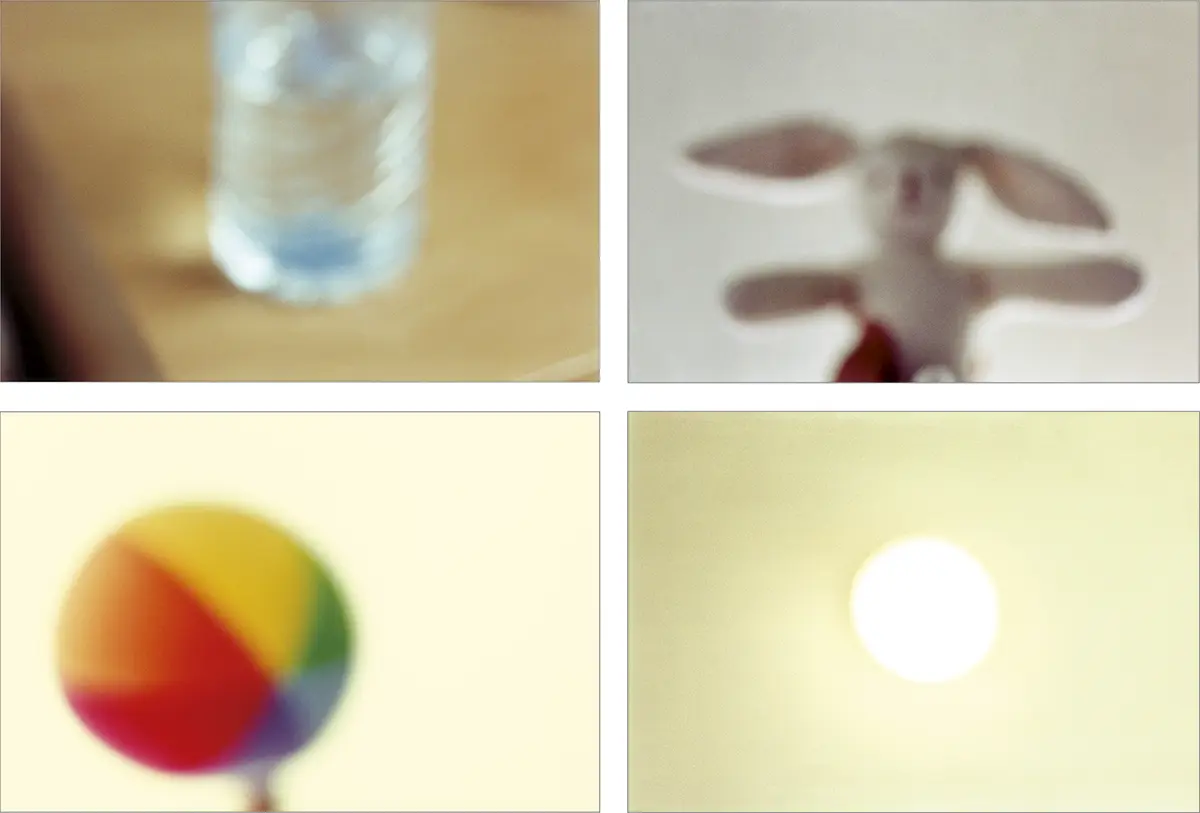
New Born deals with perceptual and cognitive aspects of vision, as well as its representational function. It is not what is represented (the child’s surrounding environment, formed by those objects close to her), nor its symbolic substratum (the transfer of emotions into the objects, or their affective equivalent), that is central to Milagros de la Torre’s images. The deeper issue is a reflection of the way in which the human process of visual perception develops. By presenting us with a blurry, confusing world, this series wants to evoke a time before the formalization of vision. Photography is usually engaged in a precise description of things, yet here it is used for the opposite —to register confusion. For instance, images that are slightly out of focus suggest the newborn’s inability to distinguish outlines with precision. Similarly, the newborn’s physical point of view, determined by an inability to prop itself vertically and hold its head upright, is replicated by means of upward and downward camera angles. The newborn’s high-contrast, color-diminished visual experience is reproduced by a slight overexposure, which narrows the image’s chromatic range.
This series constitutes an excellent example of the dual role played by the language of photography in Milagros de la Torre’s work. On the one hand, and rather obviously, photography is the technical medium in which her art is produced. On the other hand, it is a resource used consciously and self-critically to deconstruct photographic language as the ideological support of representation. While in New Born Milagros de la Torre uses photographic technique to reflect on the conditions of vision (how we see), in other series she has deconstructed that very technique in order to highlight the ideological conditions of photography (what and how the photograph sees). Thus New Born can be understood as a logical step in the evolution of a body of work built around a critique of the medium’s ideological conditions, now focused on the active appropriation of these conditions by a specific subject. In this sense, we could say that this series signals a point of inflection in Milagros de la Torre’s oeuvre, not only because of its thematic shift from social to personal issues but also because of the change in sign —from negative to positive— in the oeuvre’s symbolic constants. Such an evolution will be better understood if those symbolic constants are analyzed as keys or categories for the interpretation of the artist’s work. These categories could relate to different moments of presence, action, and consciousness of the self, each defined by the dialectical interplay of antithetical values: the first category, related to the presence of the self, comprises the battle of light and shadow —white and black— in the photographs; the second category, corresponding to the self’s action, is represented by the opposition of subject and object, the former as dynamic ability opposed to the passive or potential quality of the latter; and the third category corresponds to the consciousness of a being who reaches a level of knowledge by dominating the means to represent and identify it. If we project these categories of presence, action, and consciousness onto the different series that make Milagros de la Torre’s oeuvre, we will appreciate the paradoxical subtlety and symbolic complexity of the work, as well as its strategy of subverting the language of photography.
Presence: The Battle of Light and Shadow
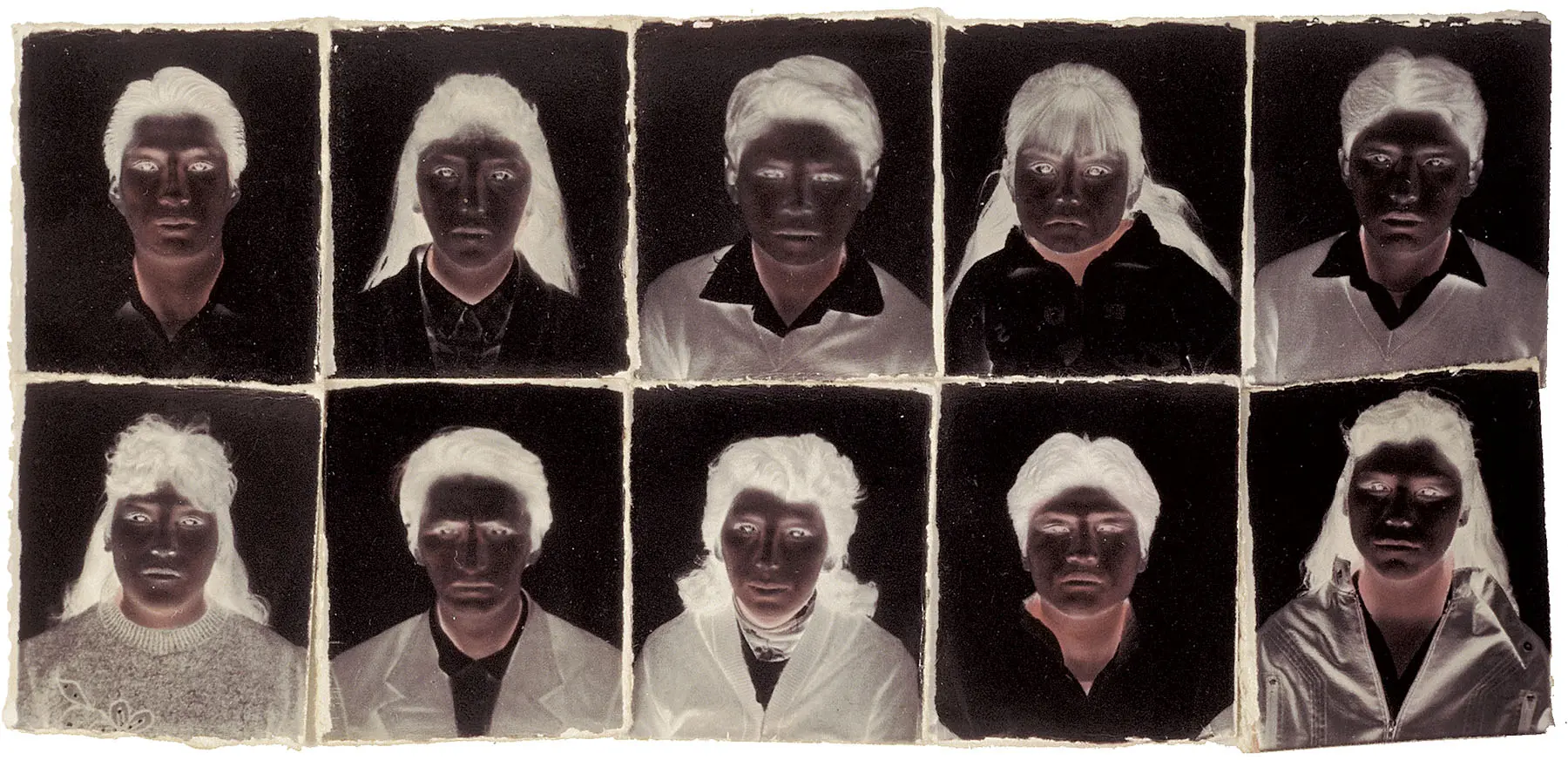
Under the Black Sun (1991-1993), Milagros de la Torre’s first known series is a collection of portraits in the style of Cuzco’s street photographers, or minuteros. These frontal, close-up views possess two distinguishing characteristics: first, they are exhibited as negatives, with their chromatic values reversed; second, they show the red ink of the photographer’s touch-up, intended to darken the skin in the negative, thus “whitening” the subject in the positive print. By omitting the end result and focusing on the process of technical manipulation, the photographer transcends the content of the portrait and underlines the parameters within the “portraiture” as it is articulated as a social practice in the Peruvian context.
By unmasking her technique, the artist turns shadows and light into something more than photographic tones. In her images, black and white become interchangeable values that fluctuate according to the social mood, as relative as a sun that turns black, and as fragile as the blotches that are their own essence as produced by light. By showing photographs as negatives, Milagros de la Torre subverts the photographic work’s deontological objective, displacing representation with the critique of representation. By making the constructability of the code explicit, the artist converts the represented (the portrait’s subject) into an absence and the medium (photography) into a presence. If the photographs taken by Cuzco’s street photographers served to identify the city’s inhabitants, Milagros de la Torre’s serve to show how it was that photography, as a technical medium and social practice, achieved that goal.
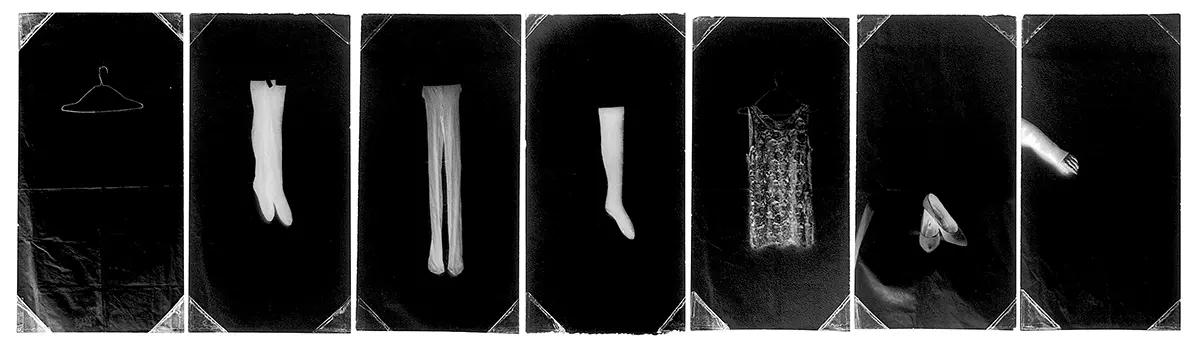
The negation of presence is the axis of yet another series, Untitled (1992), whose subtitles identify the objects in the images: Hager, Stockings, Longer Stockings, Dress, Shoes, and Hand.
Each image, printed in an exquisite photo-engraving technique, floats delicately on the white surface of a sheet of Japanese paper. Again printed as negatives, the images of the objects appear as white spaces on a flat black surface, broken only by small white stripes near the corners that remind us of the picture holders in a photo album. The dark and material surface of the photographed objects —women’s apparel and accessories— turns white and light in the negative; the objects, dark in the original become luminous and incorporeal in the version offered by the artist. If it were not for the strong contrast of their luminous contour against the black background, we would not be able to identify them and we would be left with the ethereal surface formed by a subtle range of lights, by an abstract weaving of white on white. Thus, the photograph is no longer evidence of an object —witness to the presence of something that, as Roland Barthes put it, was there— but only the hole it left in its absence. De la Torre’s garments as negative become symbols of what? a woman? an absent femininity? By emphasizing the photographic process over its results, Milagros de la Torre reminds us that photographs are nothing more than images and that images are, essentially, absences.
The dialectic of presence and absence will acquire a markedly ideological character with The Disappeared Ones, a 1998 series that dealt with physical absence as “disappearing.” This word can be a metaphor for any kind of absence, but in the Latin American context reading it as the forced disappearance of individuals, or killing as a resource for political and social control is unavoidable. This issue, so difficult to address in Latin American societies, with their history of gross human rights abuses, is approached by the artist in a mural triptych in which traces of a human presence, symbolized by gray clothes or covers, are barely discernible among the textured, dark shadows of a background of shrubbery. In this series, De la Torre barely uses any white; the images are dominated by darkness and grayness. It is as if light, a symbol of life and hope, had faded away along with the “disappeared.”
Action: The Dialectic of Subject and Object
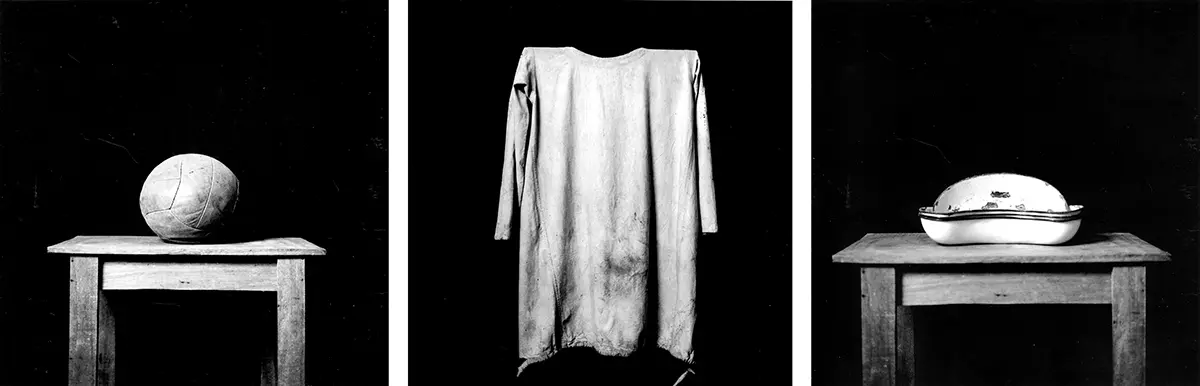
The topic of absence is also explored in Last Things (1996), another triptych installation. The subject in this series is a patient in a psychiatric hospital, and his absence is emphasized in each of the images by the clear and distinct presence of a luminous object that both replaces him and is a symbol for him; these are his last possessions, left behind at the time of his death, and they operate as terrible poetic signs of a precarious existence. A soccer ball, a straightjacket, and some damaged surgical trays; these objects highlighted against the black background of very simple images, as significant as they are minimal, become equivalents to the subject’s meager capacity for action.
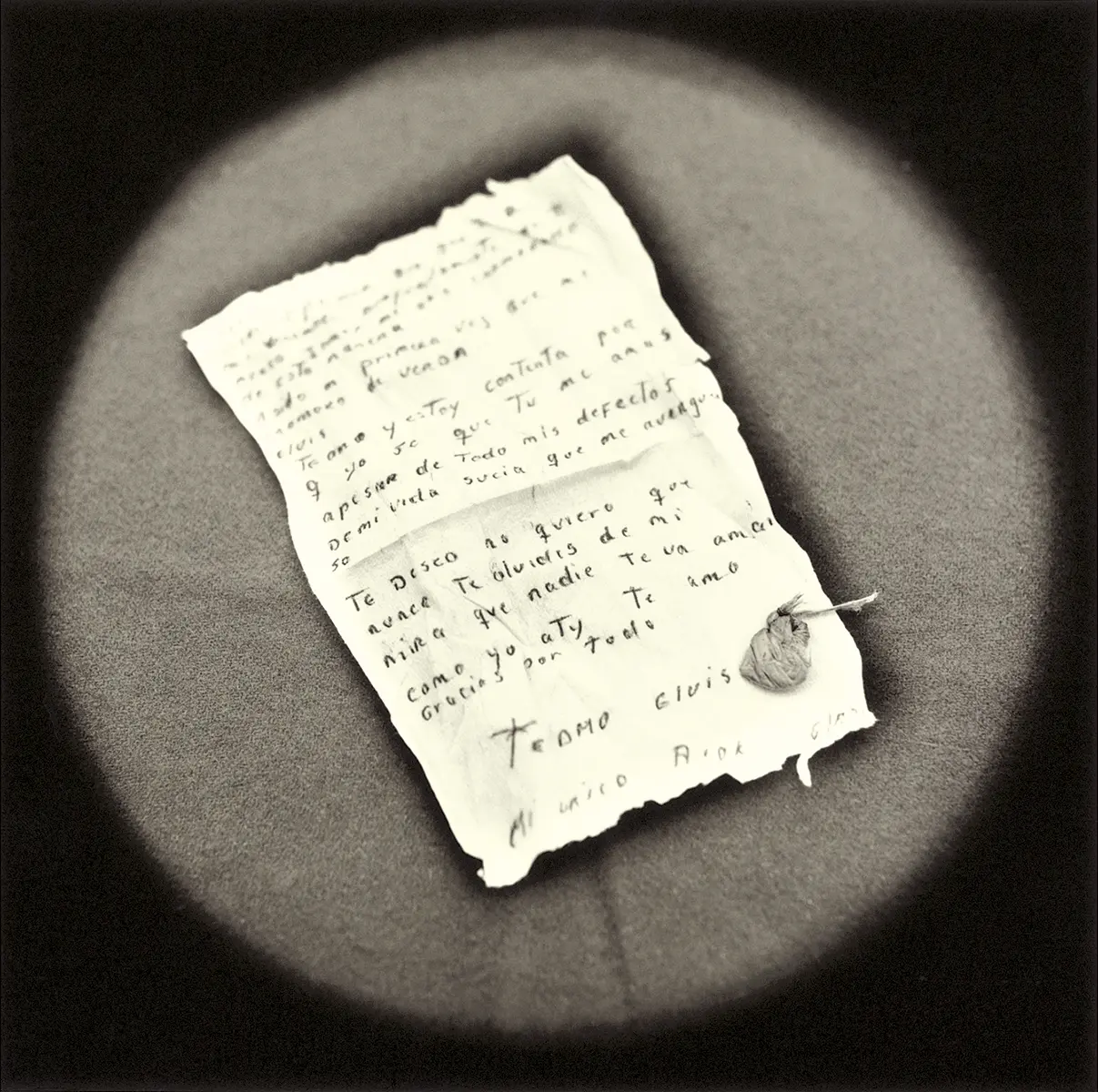
Objects, Milagros de la Torre seems to say, can be as brutal as they can be poetic. Thus the images in The Lost Steps (1996), representing objects found in the recesses of the Judicial Palace, are evidence of old crimes: the “Police identification mask for ‘Loco Perochena,’ a well-known criminal,” the “False I.D. used by a terrorist,” the “Knife improvised from parts of a prison bed frame,” the “Primitive weapon made with the bottom of a bottle and some paper,” the “Shirt belonging to a journalist killed in the Uchuraccay, Ayacucho massacre,” “Self-incriminating love letter written by prostitute to her lover,” etc.
These photographs use the technique of police photography and present an apparently simple structure: the object is centered and clearly visible, against a neutral background. However, the fifteen photographs in The Lost Steps differ radically from police photography in that they carry an extraordinary emotional effect, derived from a conscious analytical use of photographic technique. The background De la Torre uses is very dark, so that, unlike testimonial photography —which seeks to create a neutral, objective effect— her images are moving and theatrical. In these tragic scenes, the photographed object is the protagonist of the drama of human passions. And what better way to emphasize the character of these objects as subjects than to represent them as actors in a scene, framed by the circular beam of a spotlight against the darker backdrop. Even in the most abstract photograph, where we can barely discern, against the black background, some folds of black cloth representing the “Skirt worn by Marita Alpaca when she was pushed over from the 8th floor of the Lima Sheraton Hotel by her lover,” creates a very subjective effect. With their circular spotlight beam framing and containing the object, the images are reminiscent of the point of view of a peephole. The blurry circular frame not only alludes to the vignetting effect created by using photographic lenses that do not cover the larger format of the negative but also evokes a society of surveillance and punishment, thus reinforcing the prison theme. Objects are left as stand-ins for those who lost their way and were sentenced in the Judicial Palace.
The interplay of black and white as absence and presence, and of subject and object as potential or inability to act, is accurately illustrated in two later series, Blank (1998) and Censored (2000). Both series, worked in subtle and timid colors, deal with the issue of a vacuum, or the absence of information, corresponding to a positive or negative action on the part of the subject. In the first series, the images represent open books with blank pages. And although its title, Blank, may be understood as a reference to the use of white, it also points to the lack of information. The books photographed contain the population records of San Marino, Italy, and the blank pages were reserved for people who emigrated in search of a better life and who were expected to return eventually. When they did not come back, the pages were left blank, as a record not of what happened but of what will never come to pass. Again, the language of photography is subverted and made to mean the opposite of what is expected, becoming a testimonial of hopes projected into the future and of actions that did not take place.

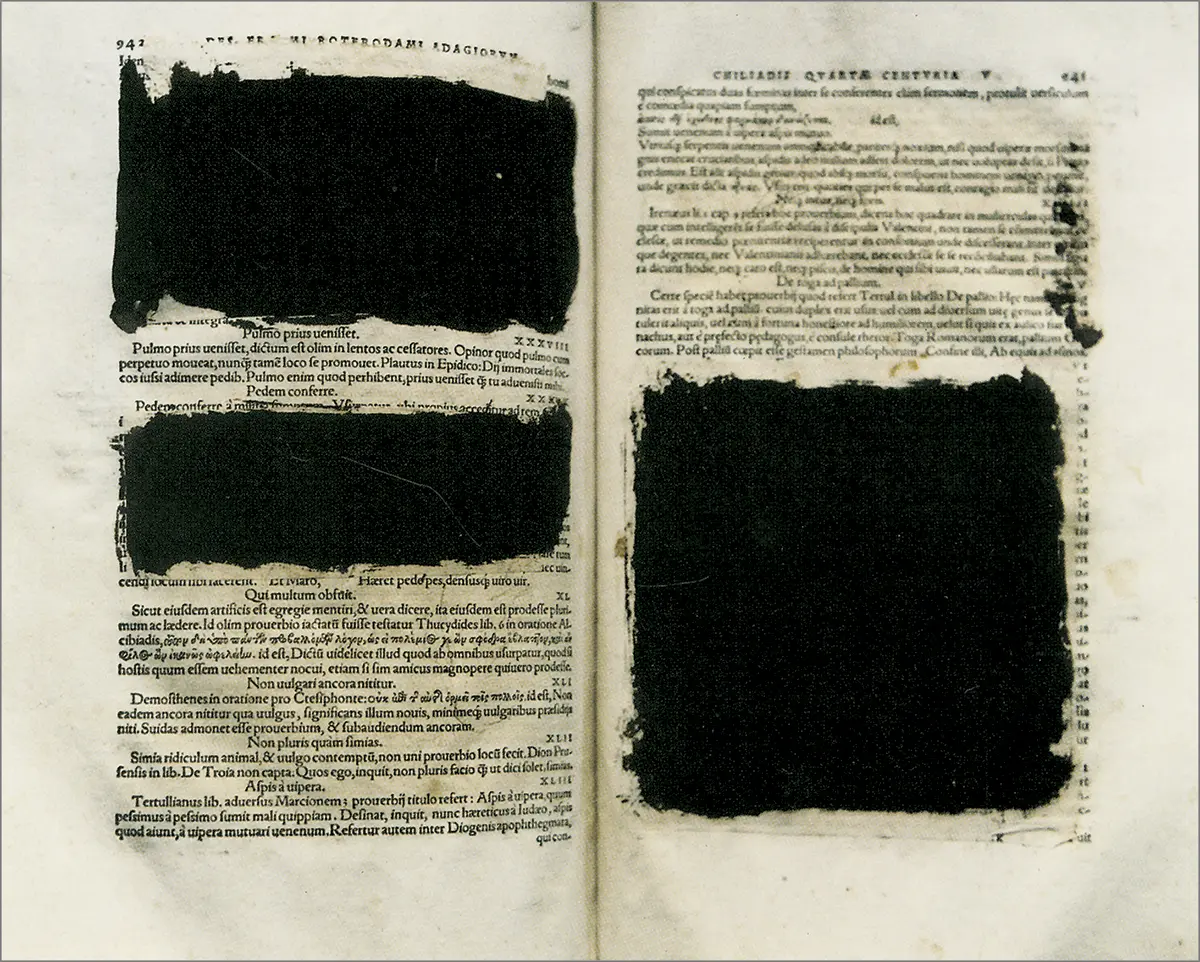
Censored resembles the previous series. It also shows pages of open books, in this case, medieval books from the Salamanca Library. These pages are not blank, however, but are blanked out. They have been censored and corrected using black ink, or decorative paper strips. What is interesting in this series —and this was Milagros de la Torre’s intention— is the achievement, thanks to photographic reproduction, of an aesthetic effect that intensifies the negative character of the corrections and scratchings. These become graphic gestures and acquire a singular beauty, like Chinese calligraphy or the drawings of Tapies, or, in the case of the decorative papers, like a piece of embroidery seen in negative. In these images, photography is used to register the book as an extremely active ideological and aesthetic battlefield: to show how, by means of corrections and coverings, people attempted to exorcize the book’s potential as a dangerous ideological subject, superimposing gestures of negation on it that, paradoxically, possessed a strong aesthetic content.
Another series devoted to the exorcism of potential dangers by visual means is Armoured (2000), which comprises five photographs of private security armored trucks. Printed in black and white, on paper of a considerably larger size than the image’s small format, the trucks seem to float in a white space. The photographs are linked by their compositional similarities: they share a common point of view and the object occupies the same portion of the frame. Seen from afar, the pieces are very similar, except for the small differences in the truck model and their accessories. All of them make evident the fact that the trucks’ very structure has been designed for protection. Given their function, to transport cash money, they are frequently attacked; in these photographs, however, the trucks seem active subjects, warriors ready for battle.
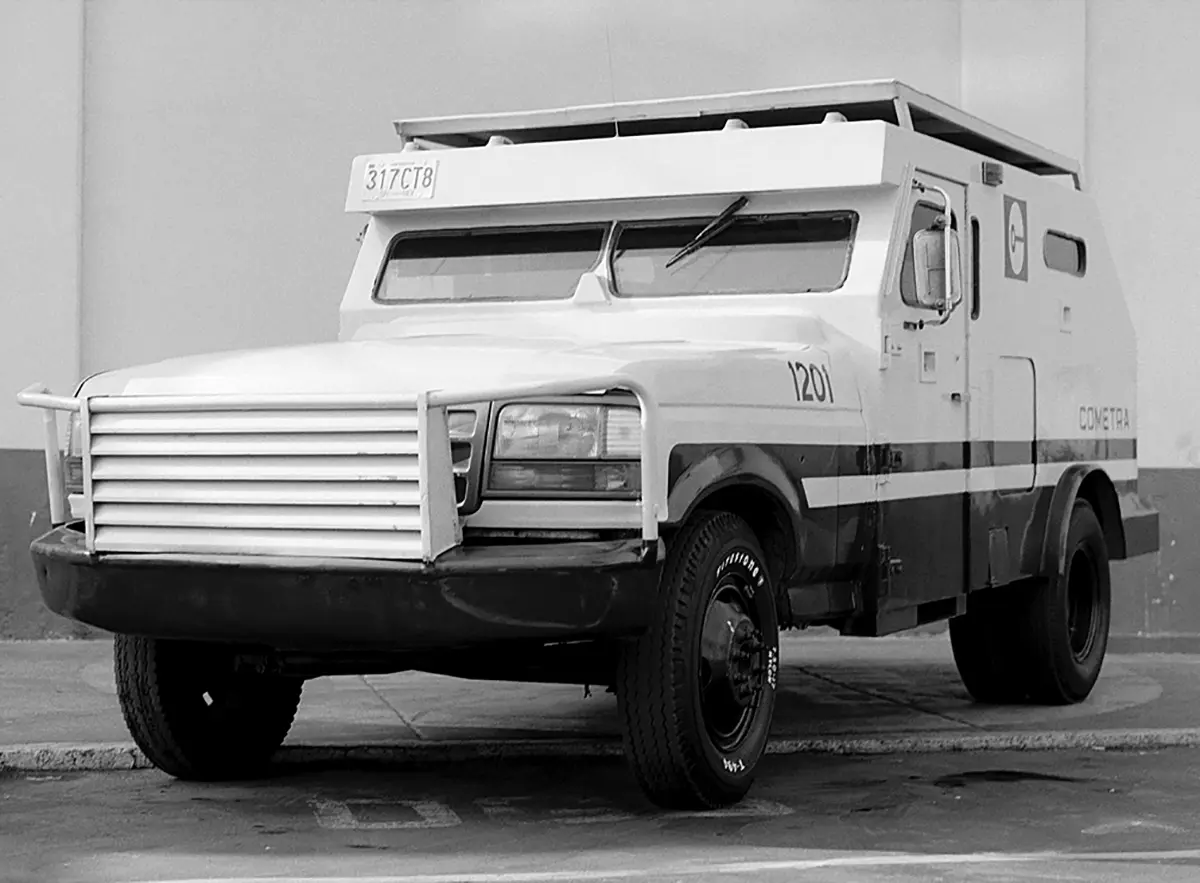
In a superficial analysis, these cold, apparently objective photographs could be related to the work of Thomas Ruff, Andreas Gursky, Günther Förg, or other photographers of the contemporary German school, heirs to the tradition initiated by Bernd and Hilla Becher. Certainly, this series builds a typology through a sequence of images of similar structure. The most evident differences are their color (in the case of the German photographers, in contrast to the black and white photographs in Armoured) and their size (large painting-like prints, in the case of the German photographers, as opposed to Milagros de la Torre’s small pieces), what truly sets these two visions apart is the disquieting, emotional effect created by the Peruvian artist. Perhaps because she has settled as a resident of the Mexican megalopolis, perhaps because of her extreme sensitivity to violence, in Armoured Milagros de la Torre attempts to exorcize the potential for danger through photographic resources. Hence her need to frame and consequently to contain distance and reduce the image of the menacing object.
Already in this series, we can appreciate the turn towards the subjective in the work of Milagros de la Torre: a movement in the direction of the intimate and the personal, towards photography that takes the subject as its point of departure and of arrival, as an increased potential for consciousness and identity.
Consciousness: Representation as a source of knowledge and identity
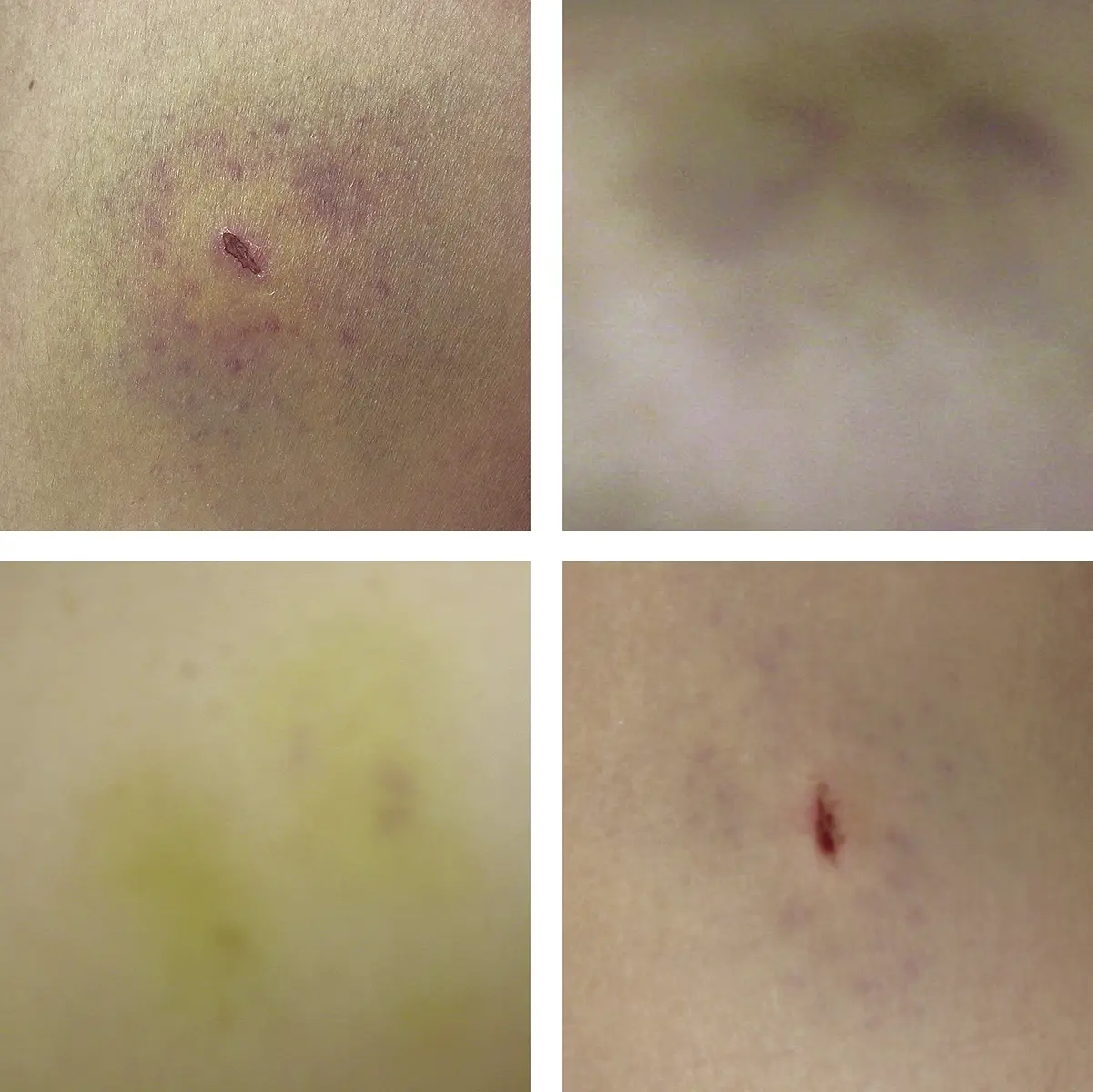
In contrast to her previous series, De la Torre’s most recent work, Bleues and Nights (2002-2003) is characterized by the inclusion of subjective elements in the image. Bleues is a linear series of eleven color photographs in medium format. The images themselves are highly abstract; in each of them, we can discern only a bluish or purple blotch against a beige or pink background. Whereas in the photographs included in New Born, objects could be intuited in the fields of color, here it is impossible to know what is being represented. Only by following the clue given in the title, Bleues (black and blue marks, in French), do we learn that what we see are photographs of lacerations on the artist’s own skin.
Just as in Censored the gesture of censorship became a positive aesthetic sign, Bleues operates as an inversion of the value of the represented object. By means of photography, the painful traces of an accident are turned into a colorful and sensual landscape. The language of photography becomes a medium for self-knowledge and recognition.
Associated with the artist’s recent motherhood, Nights is a series of five-color images that take advantage of personal experience: waking up many times during the night to answer the call of her newborn child. The images are printed sequentially on the same sheet of paper, and they represent a black space where all that is discernible are the green digits of a digital clock, each reading at a different time. The darkness that surrounds the images becomes increasingly less defined as the night progresses. The first time she wakes up, it is a well-defined area; by the fifth time, it has become blurry and indistinct. In Nights (2002), we can find echoes of the artist’s earlier works printed in negative: darkness as a territory where light and shadow battle, as a strategy for the construction of meaning. However, the meaning of this photographic work moves in a different direction. If in Under the Black Sun, of 1993, and Last Things, of 1996, the metaphoric dialogue of light and shadow is related to the representation of the social, in Noches, it relates to subjective experience. The language of photography makes it possible to represent the subject’s personal experience and it also allows the subject to identify with a symbolic representation, in this case, the figure of the mother. It is the mother who sees the son’s vomit, and it is the photographer, Milagros de la Torre, who transforms it into an aesthetic object.
Although in Nights, Milagros de la Torre speaks of a hard, dark aspect of motherhood, New Born is her most optimistic, colorful, and positive work. In that series, white is the potential for development, not absence or loss as it was in Censored or Blank. For this reason, New Born can be interpreted as a key moment in the artist’s career, where her oeuvre turns from the representation of socio-ideological themes to subjective-personal themes, while changing its symbolic associations from the negative to the positive. This and other recent series by Milagros de la Torre represent points of lucid maturity in a body of work characterized by the dialectic of light and shadow, and a promise of intelligence, sensibility, and clarity for Latin American photography.
* All images illustrating this article are a courtesy of Galería Luis Adelantado, Spain.
LAURA GONZÁLEZ FLORES
Professor, Arts Department, Universidad Autónoma del Estado de Morelos (2003), and researcher in the production, promotion, criticism, and theory of photography since 1986.