
Three immense cubes of compressed, burnt black sand, measuring up to two and a half meters in height and six meters in length occupied most of the ground floor space of Galería Fortes Vilaça. The atmosphere was filled with a sullen darkness, heightened by the sheer monumentality of the architectural constructs. Displayed against adjacent walls opposite each cube, slabs of yellow wood formed a design that echoed the surface of the cubes like a bas-relief. The exhibition was appropriately titled Luz Negra (Black Light) after a song by the famous Brazilian samba singer and composer, Nelson Cavaquinho. A film by the same title, shot on the outskirts of São Paulo, featured huge speakers being dug deep into the ground. Another famous song by Cavaquino, Juicio Final (Last Judgment), could be heard playing from the speakers.
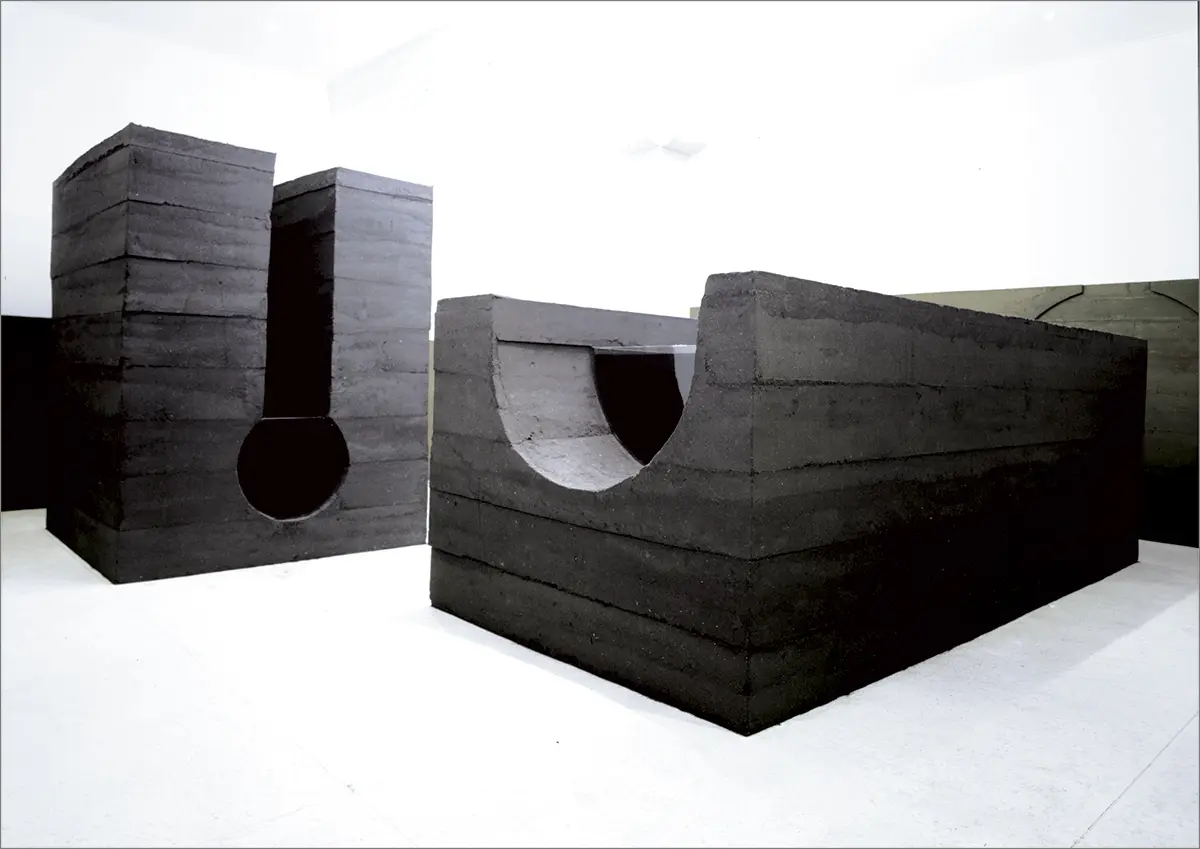
For two weeks the neat white cube of São Paulo’s trendy Vila Madalena district was turned into a construction site. Five strong men worked nonstop constructing the wooden structures that held the burnt sand together and millimeter by millimeter, mashed the dusty material into a compressed state. Tons of oil were deposited into the deep openings carved on the surface of each block and threatened to spill, destroying the massive sand blocks as well as the gallery. A lot of sweat, a lot of dirt, always working on the verge of disaster—this is Nuno Ramos. He is an artist who pushes the limits of materials to their extremes, for whom excess is merely the initial motivation that ignites the arduous process of creativity. In this context, risk is always the focal point. Risk of the failure of materials, or risk of aesthetic and formal failure, but mainly the very concept of risk is at the heart of the work.
I believe that the large framed, assemblage-like pictures composed of tin, colored acrylic sheets, Vaseline, and other materials exhibited on the top floor of the gallery were a risky inclusion, as well. At first sight, they seemed purely commercial, decorative, and too cheerful for such a somber ensemble. How is it possible to connect two such opposite sensibilities? In nature, we usually have time to become accustomed to the passage of the sun from daylight to dusk—the sunset is gradual and gentle to the eye. Ramos’s contrast, on the other hand, was harsh and the connecting element was only an abrupt open staircase.
Yet, within minutes the eyes grew accustomed to the bright colors and amorphous forms and an immediate seduction took place, making it difficult to return to the lower floor. But the same thing happened in reverse and once downstairs, the viewer was inclined to remain enveloped in the darkness and the well-defined geometry of those cubes. A melancholy state where bright colors were easily dispensed with perseverance.
The point is that Nuno Ramos works through and with opposition. In this installation, his work moves from the tragic to the euphoric. Contradiction has become an inherent element in his work—it is the source of the visceral tension in his work; it is always present formally, aesthetically, and metaphorically.
If the formal contrast between Dizque fui por aí (They Say I Roamed About)—the title of the group of bright pictures displayed in the mezzanine was borrowed from a song by another popular Brazilian musician, Zé Keti—and Luz Negra seemed immediately evident, careful scrutiny was needed for the spectator to grasp the more complex relationships prompted by such divergence.
In effect, there was less conflict between the two groups of works than there was in the materials that constituted the large blocks of Luz Negra itself; oil was chosen to coat the surface of the dark sand due to the immediate difference of the materials—oil is reflective, viscous, and fluid; sand is opaque, thin and dry. The sand was compressed into a geometric shape that defied its own physical properties, while in contrast the reflective quality of the oil was used to best advantage. On the other hand, there was a much more literal and schematic relationship between the works on the two levels: the colorful pictures were almost a blueprint of the patterns that formed on the surfaces of the black cubes when seen from a right-angled perspective. The gauges of the wooden bands nailed into the structure that held the sand together were exactly the same size as the tin gauges used in the three-dimensional collages; the format of the glass was the same in both cases, that is, the circular and tubular glass shapes in the pictures corresponded to the ones that pressed against the oil in the carved surfaces of the blocks.
Still, the carnival-like color of the pictures upstairs bothered me. And it was this annoyance that kept me thinking about the exhibition for a very long time. I still wish everything had remained black, serious, and perhaps safe, with the safety afforded by clarity, linearity, and the lack of conflict. Yet paradoxically, the safety of what is readily understandable is a safety that would not have remained in my mind for so long. Therefore, I find myself much in agreement with the artist when he says, “It’s a rich and interesting game that of being a contradictory artist.”
VERÓNICA CORDEIRO