
It is gratifying when justice is made by rescuing forgotten artists, and most of all, when their ability is unquestionable, their contributions are deep and risky for the time they had to live in. On occasion, they have fallen into slumber on the deep mattress that is history because they are low-profile people, because they gave into a strong artistic movement that absorbed them, for having been contemporaries of other artists that have firmly exteriorized their personality, for having died young or because of other issues.
This type of rescue usually occurs because of some specialist’s research, because of a late discovery of the artist’s importance, for economic or promotional reasons, and even by chance. This time, in a unique way, Feigen Gallery presents an exhibition of good standard, with the complete collection of Obra gráfica y multiples (Graphic Work and Multiples) done by Fahlström, which belongs to the Bank One collection. This group, made out of more than two dozen works, was accompanied by some pieces from private collections and the gallery itself.
Born in Brazil, it can almost be said that out of necessity, in 1948 he chose his Swedish citizenship. Yet, Öyvind Fahlström is never mentioned in any of the best Brazilian art books. With more reason, we attest to the importance of this exhibition and point out some of its characteristics. Öyvind Fahlström (São Paulo, 1928, Stockholm, 1976) is caught in Europe in World War II. He travels, and studies art at Stockholm University, he starts his deep connection with all areas of culture, which made him a herald for the arts and letters, Simultaneously he makes incursions into scenography for opera, writes cultural notes and poetry, and translates texts.
This anthology of activities was emphasized in 1954 with the publication of Manifesto para la Poesía Concreta (Manifesto for Concrete Poetry), a theme to which he became dedicated. During the mid-century, we find the artist in a very productive period, with important contributions that get around to the present —and that are pointed out in the next paragraph of this text— working as a draftsman and painter who covers as much figurative as it does abstraction. As part of its constant presence in Paris, Rome, and Stockholm, he joins the Phases movement and gets a scholarship from the Fundación SuecoAmericana.
With this achievement, New York became feasible to him, and his life experiences were shared with visual artists of the time, among them, Jasper Johns. Öyvind Fahlström started showing up in many exhibitions, both commercial and institutional, in Europe and New York, whose Museum of Modern Art includes some of his works. He participates in the most relevant gallery and museum exhibitions of the time and in the Venice Biennale. Radio, television, and recordings started to be a fundamental part of his language. He starts delving deeper and committing to graphic publications, multiples attract him visually as much as socially.
A baroque dynamic informs some periods, fed by Öyvind Fahlström’s ample knowledge of all areas of culture. The squareness, windowness, or boxiness of shapes and fragments of objects is present in other works where the author applies synthesis as an exercise of a second industrial age and the free module as a puzzle. Play is like an ingredient of the composition as much in his drawings as in his prints; these symptoms appear in his paintings in a more blended way, it almost makes you think about Antonio Seguí.
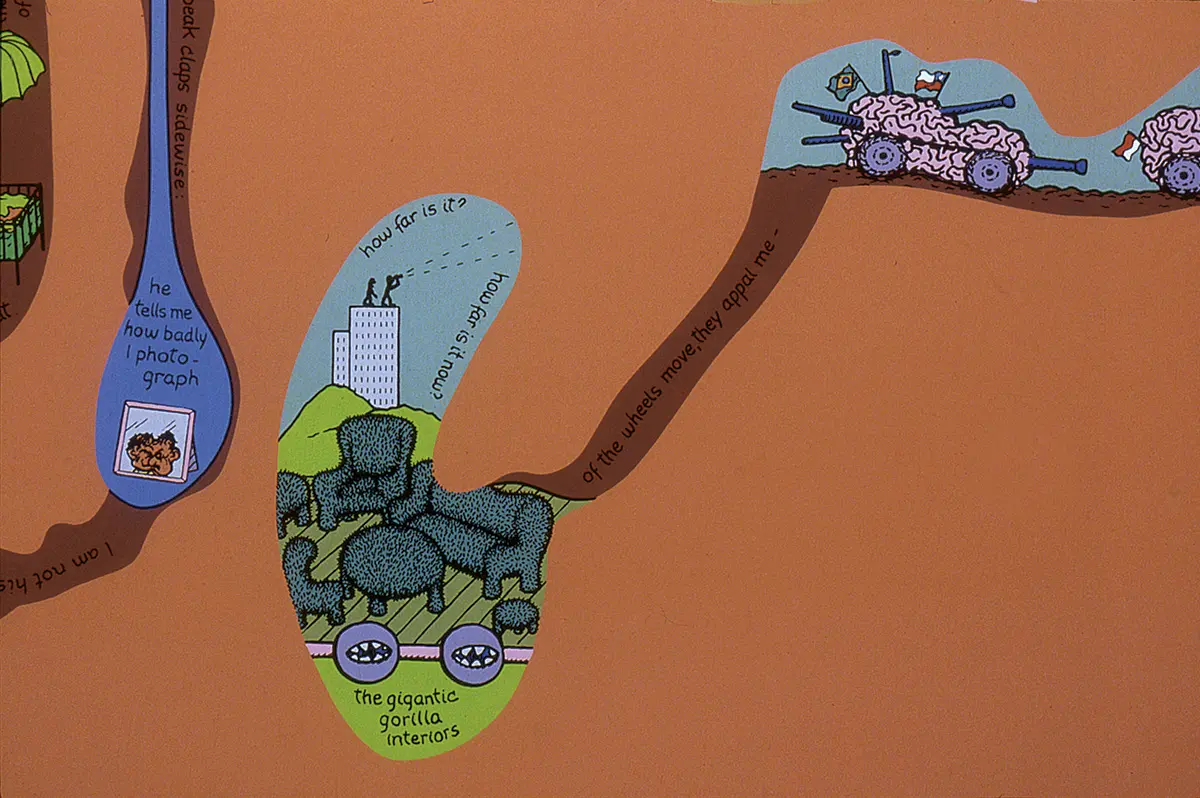
In a word game, that comes from the Brazilian and Scandinavian origins of the artist and the five languages that he mastered, from his passion for text and concrete poetry —let’s remember that comic strips in Portuguese are called cuadrinhos (little squares). It could be said, that there are postindustrial, postwar and certainly pop elements like the glimmer of an explosion that we are used to seeing in the cuadrinhos and in pop paintings. The linking of compartments where things happen accompanied by a text/dialogue bubble is not reproduced, the author recreates them and translates them in various esthetic ways. The shape of the bubble is adapted by the artist for text, for his monsters, for iron or plastic sculptures. The written content subsists but addresses an artistic coherence original of the author, with no interest in usual proportion or perspective, on occasion with magnets to hold them, on others, drawn or painted as if they were suspended on the flat and empty space of the paper.
The automatic drawing, the mappings, and concrete poetry are three features that best define Fahlström’s contributions. For many people in the art world in the United States, understanding Öyvind Fahlström’s work from the intense local appreciation that cartoons have, he is remembered and compared to Mark Stamaty and R. Crumb. Due to the celerity of his stroke, his ingenious vision, and his sense of humor —not exempt from political charge— it is true that his drawings refer to cartoons and also to Pop Art. However, his preoccupation is more extensive, I have to say that it is outlined as an anticipated global vision of the current social problem. Due to an early interest in the subject of maps, mapping, and a type of geographic stroke, we must sense his contribution to the visual arts as a wider and not conventional attitude. Öyvind Fahlström was getting away from the common canons in order to draw and paint. Fragmentation can be found in his works, as well as the creation of multiple scenes and of his own monstrous —organic/lettery—characters (a legacy from the visual poetry that he exercised early on). These elements are present as much in painting and drawing as in installation and objects; an example of this is given by Study for World Model (Garden), 1974; it is also manifest in Seven Elements from S.O.M.B.A., 1974, with a hierarchization of funny monsters. The notion of clipping, of one type or another, is frequent, be it of organic forms or small squares. From Kieffer to Kuitca, the pre-XXI Century landscape acquired a cosmogonic vision in which the subject of the landscape has been re-elaborated. Fahlström is an early agent of this change.
GRACIELA KARTOFEL