
Of particular interest at Galería Ruth Benzacar, is the exhibition of a mural by Rogelio Polesello created for Buenos Aires’ International Airport.
The 30-meter long, 2-meter wide mural is located inside the airport’s Terminal A, which was designed by the architect Juan Solsona. To create the mural, Polesello had to work around material constraints such as the presence of air conditioning equipment, an elevated location in the Departures area, a long and narrow format, and the fact that the viewers will see the piece from varied distances and at many different angles.
These problems determined the artist’s choices. The demand for visual impact drove him to take as his point of departure his own works of 1959, markedly influenced by Op Art. It also resulted in the need to use color.
Beyond the formal elements of construction, Polesello understood the site as a zone for farewells, since viewers were to see the mural only as they boarded and departed. The artist proposed an arch extended over the whole horizontal length, a curve originated on the clash of vertical rhythms —slightly oblique and on opposite inclines in the superior and inferior fields created by the monumental curve. As in every Polesello work, color relates to the analysis of light, to the spectrum. The 16-color scale works in opposition to the black and white, driving juxtapositions that are always different. Maximum luminosity is provided by the full white areas, balanced by blacks that not only delineate the surface but also articulate clarity by separating, like wedges, the white spaces.
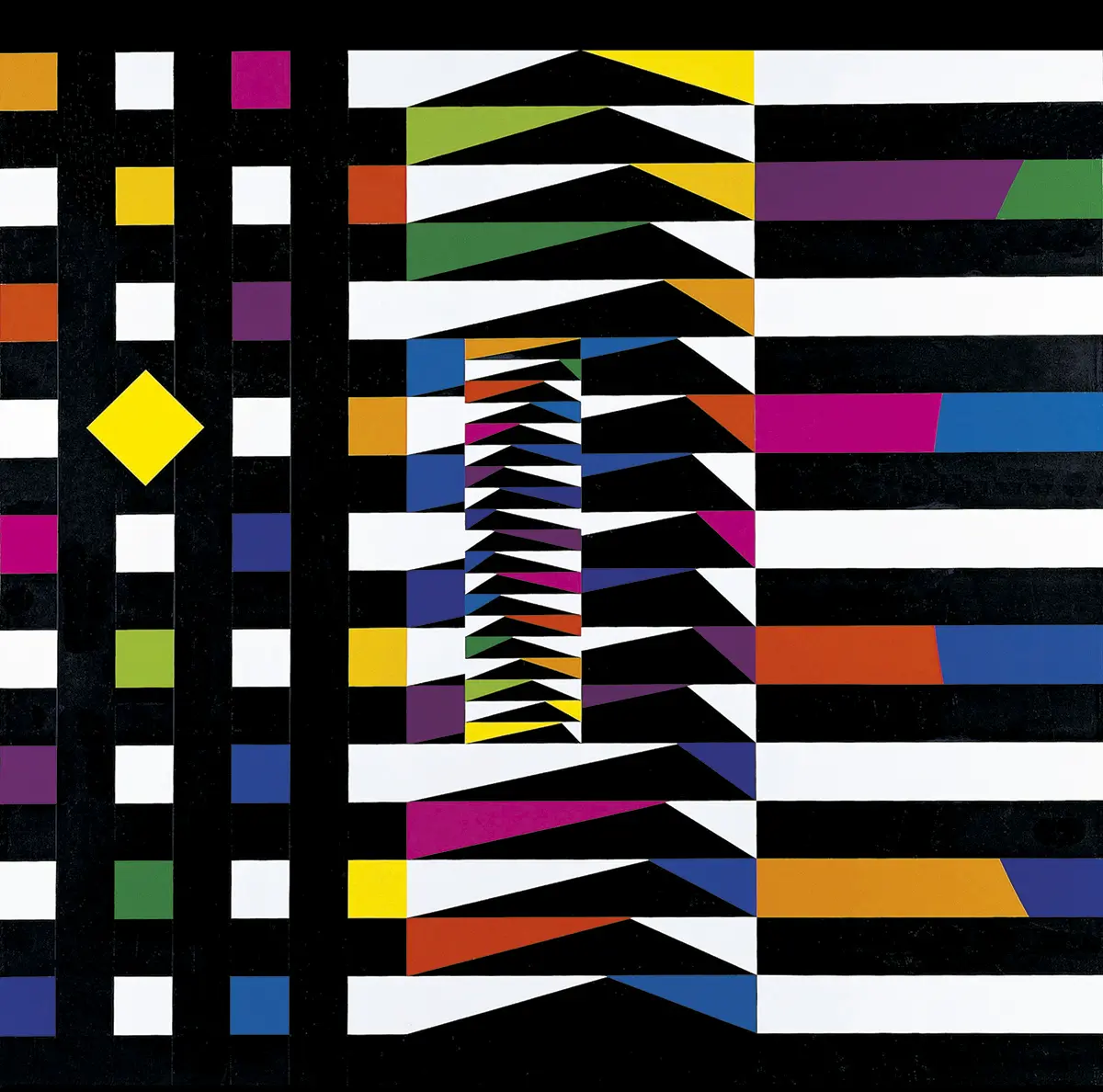
Amidst these rhythms that to some degree acknowledge as their axis the extended curve —a prefiguration of flight— there appears a similar element, smaller and inverted, suggesting the possibility of return. Polesello used this device of a window inscribed against the grain of its context since the late 1980s and through the 1990s, in anchored, dual inclusions, in visions both macro- and microscopic.
In this case, this central interaction, playing in the opposite direction, powers a proliferation of oppositions, intervals, frequencies, and reiterations, and it appears to retract the expansive forces into an introverted dialog.
Galería Ruth Benzacar is exhibiting the project’s 5-meter central section, created on paper to test the scale inside the airport. The show also includes Polesello’s black and white sketches and two paintings created as the artist was working on the mural. Polesello says that of his many murals, this is one of the most complete.
Simultaneous to this show, Panama’s Museum of Contemporary Art is presenting a large retrospective of Polesello’s work. This traveling exhibition was initiated back in 2000 at the National Fine Arts Museum in Buenos Aires. It has also been seen at the José Luis Cuevas Museum in Mexico and the Modern Art Museum in Santo Domingo.
This retrospective records the extraordinary variety of recourses and formal devices used by Polesello as he renewed and updated his journey through abstraction. What we have seen now in Buenos Aires is a more limited show, referred to as one of the artist’s most recent undertakings.
For those of us who have followed Polesello over the years, it is especially interesting to recognize the shape the artist’s development has taken: he moves in circles driving towards new dialogs with a number of constants, while some of his operational modes fade away only to reappear unexpectedly in constructions of enormous skill and virtuosity —constructions that tell us of that autonomous, personal world structured by Polesello in over 40 years of artistic activity.
NELLY PERAZZO