
Honored as an engraver with the Grand Prix at Argentina’s National Salon, Susana Rodríguez has chosen to transcend the boundaries of any one particular technique and to combine a variety of resources and materials. She responds in this way to needs that emerge from the content of her work, as well as from her interest in discovering and registering the past, in opening the past up to new details that will enrich it even as it becomes clear that it will never be complete since every new present-time perspective will drive new, unpredictable avenues of investigation.
Photography, transfer, collage, painting, as well as engraving, are the tools used by the artist to examine, comment on, erase, or highlight aspects of the past, in a narrative where autobiography plays a role alongside the biographical information of people around her. Rodríguez has recently adopted the strategy of incorporating, along with photographs of herself and of close relatives, other people’s images, which are then subjected to the same investigative work she applies to her own past. Thus, the work is presented as a large-scale text or plot in which others are also “caught” —those future readers of the work that will actualize Proust’s dictum: “Every reader is, as he reads, a reader of his own self...”
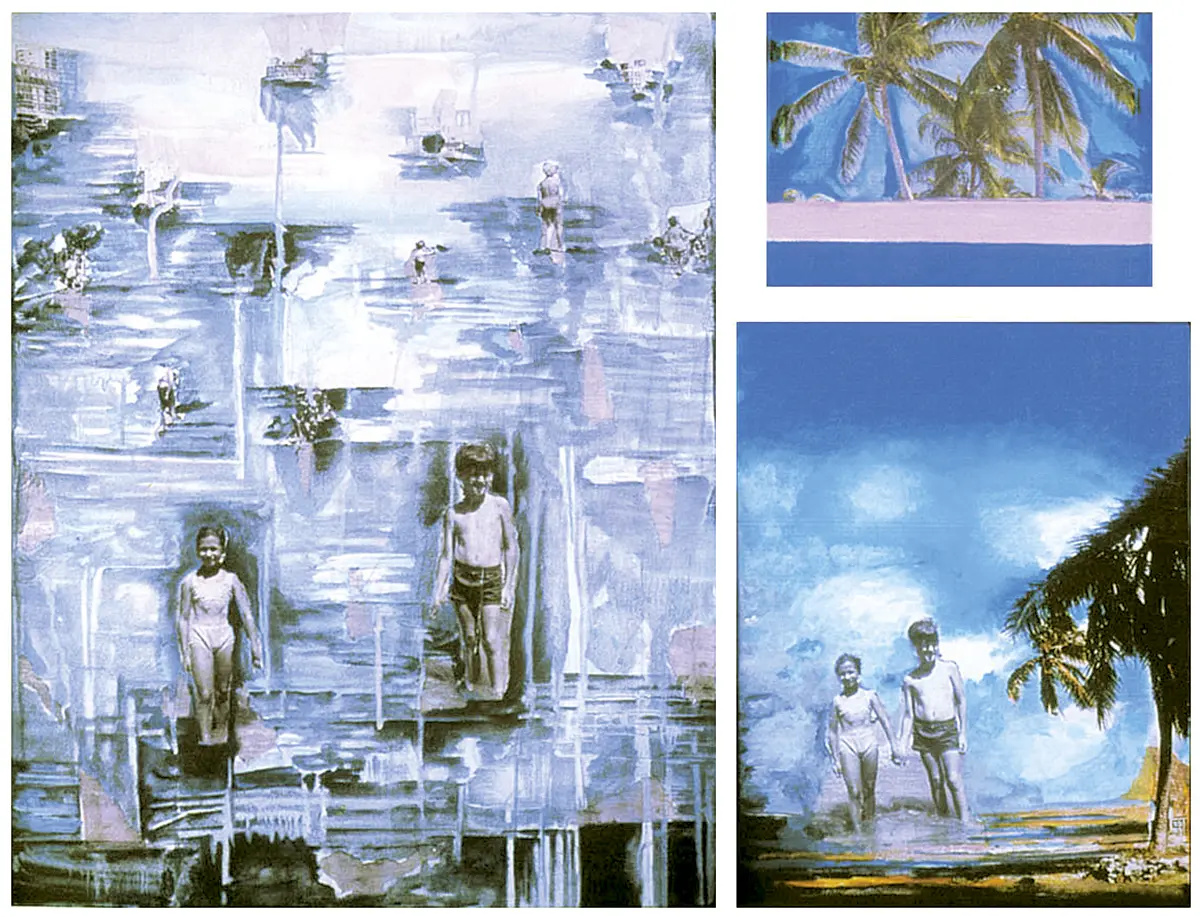
It is not only the distant past that motivates Rodríguez’s quest. She also uses scenes from the more recent past. We see long-ago moments of her childhood next to fragments of her relatively recent work, such as those images of hers that highlighted Nature. Rodríguez’s exuberant and fantastic leaves in vibrant colors, animated by almost human energy, alternate with fragments of school notebooks, scenes of family vacations in the mythic city of Mar del Plata, or religious figures (the Sacred Heart, saints, the Holy Virgin) that remind us of the artist’s early education in a Catholic school.
Rodríguez’s images are characterized by their frontal position. In this way, we are confronted with the constant glare of the artist’s father or mother, as well as of the artist as a child. In a free interplay of gazes (theirs and ours), these figures try to fix their location in space, attempting to define themselves by redrawing their own boundaries. Gazing at us, they acquire a charge of “aura,” in one of the meanings given by Benjamin to this term: “To notice an object’s aura is to give the object the power to see.” The protagonists’ auratic activity in Rodríguez’s work contrasts with the static, fragmentary, evanescent images in the background (buildings, beaches, oceans), as if memory needed to bring into focus first the character and only then, with greater difficulty, that which surrounded her.
Rodríguez has slowly abandoned her baroque view of Nature in favor of a becalmed, more introspective vision that leaves room for the paper’s or the canvas’ white areas, as well as for large color fields that highlight emptiness as it envelops or stalks memory. In this case, the emptiness is not only that of absence (that of which is no longer here and, for that very reason, causes us pain) but that of which will never be filled in or completed.
If Rodríguez’s goal were (it isn’t) to complete the sequence of images, sometimes distributed as the words in a sentence, we could say she is only partly successful: that goal is achieved only in specific areas, especially the higher ones, where blank spaces are covered. But it is not the obliteration of whiteness or the closing of sequences that really matters to the artist, but the pleasure of each new discovery, the patient labor of reeling each fleeting image in so that it continues to exist, renewed, in her consciousness and in ours.
ELENA OLIVERAS