
Waltercio Caldas is a Brazilian artist who uses simple materials in space to articulate forms. His three-dimensional paintings project from the wall into the space of the gallery. Using either paint or vinyl, Caldas creates colored rectangles on the wall and then extends their shape using colored yarns that hang from the ceiling. The abstract forms come alive in three-dimensional space. Where the viewer moves in relation to the work determines how the pieces are completed visually. From one vantage point, the edges line up, from another, they do not. The works play with perspective and illusion and although made from the simplest of materials, they are complex and innovative. Much has been said of Caldas’s emergence following the Neo-Concrete movement in Brazil in the 1960s, of his relationship to Minimalism, Constructivism, and Modernism, and his current works follow those traditions. Yet, rather than concentrate on the historical precedents for Caldas’s investigations, it seems more appropriate to discuss the poetic qualities of the work —its beauty, simplicity, and grace.
The works dance. Framed between the walls of the Christopher Grimes Gallery where Caldas is having his third solo exhibition, are two works that incorporate graceful arches made from pieces of suspended colored yarn that flow with the force of gravity. In Nearest Air Series #3, 1991, arcs and lines of red and blue yarn intersect to create shapes in the space just above the gallery floor. In this work the two straight lines fuse with the two arcs, creating a kind of three-dimensional drawing that changes shape when seen from different places within the gallery. Similarly, in Nearest Air Series #9, 1991, pieces of purple and green yarn cascade from ceiling mounts, crisscrossing in space to form abstract shapes against the gallery wall. These ephemeral works almost disappear in the cavernous space, yet once their presence is recognized they activate the room around them.
In the Yellow Room, 2000, Caldas paints a large yellow rectangle directly on the gallery wall to focus the viewer’s gaze in relation to the hanging yarn. Lengths of yarn in different shades of yellow are suspended from the ceiling and echo the shape defined by the rectangle. Depending on where the viewer stands, the yarn may line up to perfectly frame the yellow rectangle or intersect it, creating the illusion of negative space. Caldas created similar perceptual illusions in AP, 1999, where lengths of blue and black string hang in front of blue and black vinyl rectangles adhered to the wall. As in Yellow Room, the relationships between wall and space, between foreground and background, and between presence and absence become the integral themes of the work.
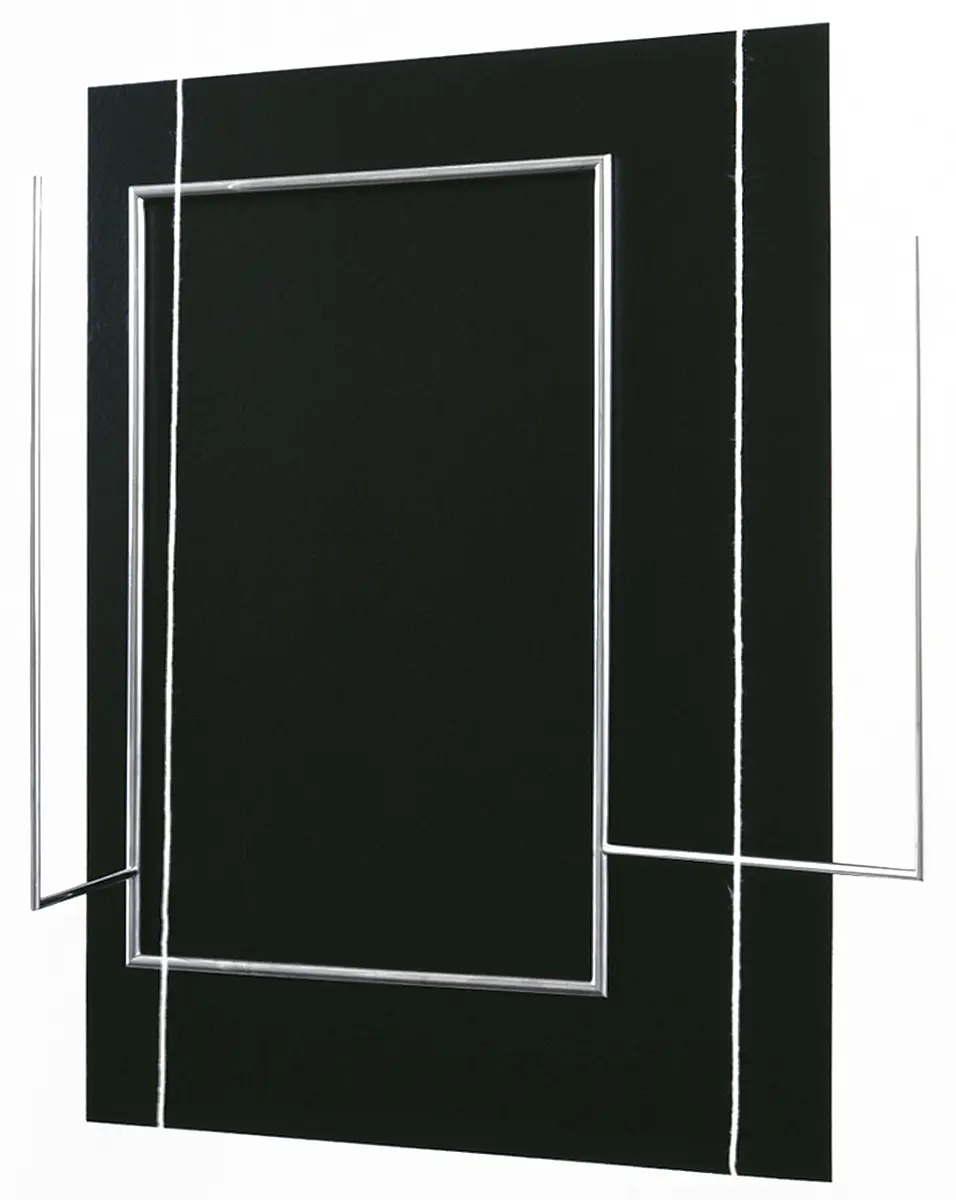
Caldas’s works play sophisticated perceptual games with the viewer’s expectations. What appears to be so simple —the use of yarn and solid rectilinear forms— is in fact a well-planned study of the language of abstraction, and challenges the way shapes are perceived in two- and three-dimensional space. In new works like Yellow ( ), 2002, or Jazz Mirror, 2003, he combines flat geometric forms with stainless steel tubing that juts from the wall and into the gallery space. Jazz Mirror comprises a black vinyl rectangle, two strands of white yarn, and a steel framework that echoes both. As the viewer moves, the string dances between the steel and the vinyl, and the side-to-side motion creates a jazzy rhythm. Caldas explores the place between presence and absence in these works. Understanding that the mind’s eye can complete a form, Caldas lets the viewer’s imagination fill in the gaps.
In works such as Spot, 2002, he constructs an object out of steel, yet allows the ground to remain ambiguous. Here a three-dimensional line drawing of a bottle hangs from the wall, held in place by a rectangular frame that is at once its armature as well as being an element of the work. The viewer’s eye follows a red thread from point to point within the sculpture, but the line drawn by the thread does not provide additional information. It simply describes a pathway the eye might follow to view the work.
Caldas’s works challenge expectations. In his sculptural pieces, he investigates the difference between what one sees and what one thinks one sees. Using simple materials he reduces forms to their essential elements and activates the gallery space by juxtaposing these simple elements in surprising and often unexpected ways.
JODY ZELLEN