

Mexico doesn’t exist. Such is, at least, the impression left by a visit to the exhibition mounted by Asociación Cultural Prometeo at the magnificent San Mateo church located in the heart of the old city of Luca, Italy. Mexico, this show seems to say, does not exist within the iconographic and cultural parameters we conventionally use in order to classify things from those latitudes. Artistic and culturally speaking, Mexico today is a state of mind, more a fact of evolutionary anthropology than of geography.
Indeed, it takes its main characteristics, presuppositions, and consequences from anthropology and from various evolutionary processes. The environment from which artists come and the space in which they move are riddled with contradictions, with tense passages, and there are no clearly defined maps to navigate them.
In other words, it is ideal for the construction of new linguistic and anthropological models. It is a space where the most extreme expressions of political and cultural conservatism live side by side with the most extreme expressions of aesthetic experimentation.
Sub-Commander Marcos’ website, webmastered by a Canadian liberal, is one of the clearest examples of interactive politics and a global strategy that acts locally and is heard globally. It brings together technological and scientific backwardness and the most up-to-date communication strategies.

As this explosive mix emerges, other, more general components come to the fore, such as the dissolution of historical ideologies and the demise of the old political and cultural blocks that supported them. Many pieces in this show emphasize the human and cultural model brought about by this process of dissolution —a human and cultural model based on logic, in the fragmentariness of the senses, in control and stability, in specialization and dominion over necessity, implying a serialization of experience and, above all, forcing us to adopt partial, limited identities.
One take on this is Gustavo Artigas’ video Dúplex, which shows that the new human models are not generated by mutation or alteration, but by expansion. A serious debate develops between a number of characters —all of them hypothetical— around the issue of the scientific basis for the multiple-personality disorder as a psychiatric condition; the conclusion is that there are no therapeutic solutions and that, at any rate, they wouldn’t want them if such solutions existed.
Yoshua Okón and Artemio also allude in their works to the expansion of identity as a preamble to a wider project, one engaged in the codification of new behavioral models based on the stereotypes of mexicanness promoted by the culture industry.
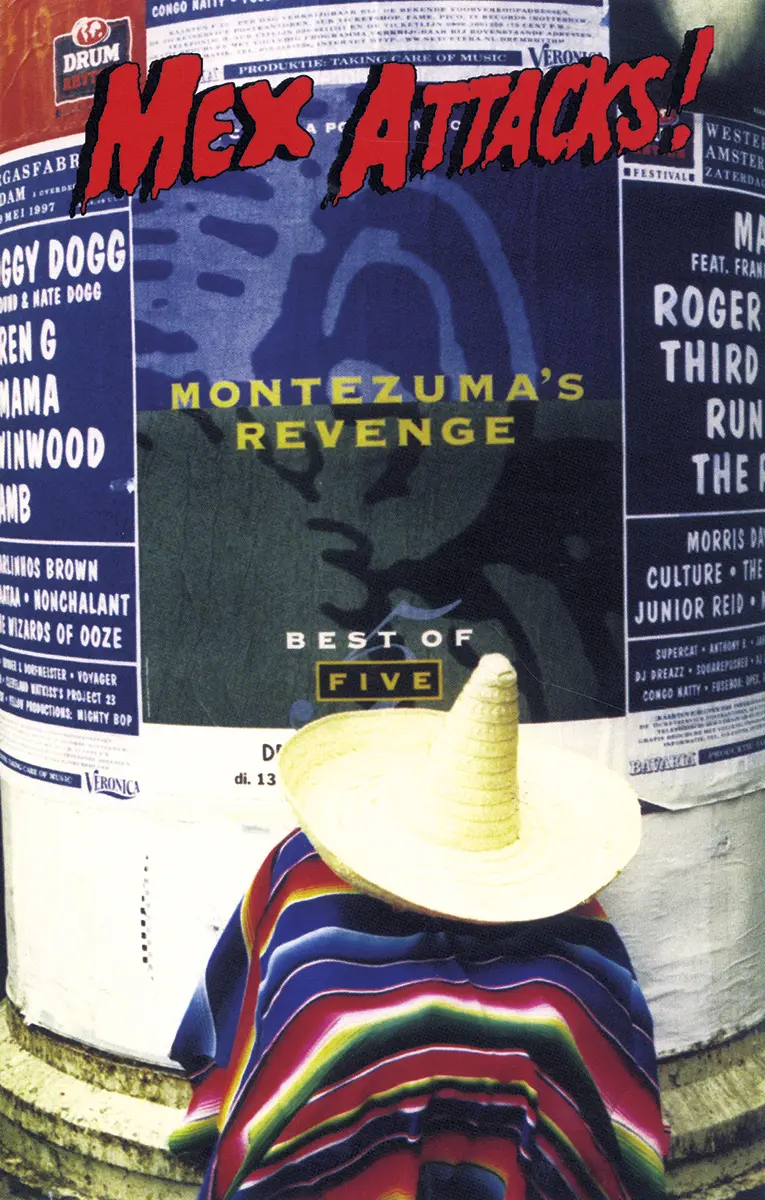
Mex Attack, Artemio’s series of photographs taken in seven European cities, is a perfect example of this iconographic displacement: "the" traditional Mexican attire, including the sombrero, poncho, and leather bag are registered in typical Old Europe locations.

Yoshua Okón’s work, in turn, achieves harmony of concept and formal execution. A Carrara marble cone —of clear phallic symbolism, taken from the "sculptor’s paradise"— worked and finished in the artisan tradition, hosts in its interior a video projector, which illuminates a church’s apse by projecting rhythmically a sentence that invites the viewer to initiate a dialog with his sexual organ. The displacement of cultural and linguistic stereotypes is even more subtle and penetrating here than in Okón’s previous work (Chocorol), and it touches on the thorny subject of cultural colonialism.
The border as a concept and as an immanent, invasive presence haunts the work of several artists, becoming a factor in the definition and expression, at the level of language and behavior, of new codes and new models. These in turn fuel meditations on the subject of identity. It is not only that the physical divide between Tijuana and San Diego impedes cultural and social flows; the border itself signals limits in conventional maps. Yet it is in this territory, the borderland, that new vital solutions emerge and develop, making it imperative —as this group of artists points out— to take into account everything happening there, where no previously defined rules apply.
The borderland is a site of permanent physical and intellectual migration. Identities are deconstructed in this process, to be re-structured later (see Gustavo Artigas’ video Las reglas del juego). Melanie Smith’s Six Steps Forward revolves just around this issue, and so does Spiral City, where the Mexican megalopolis —filmed from a flying plane— becomes a diagram-like Mondrianesque image, its urbanistic and architectural definitions, along with what they imply in social and political terms, completely obliterated.
José Dávila also works with stimuli associated with the concept of borderlands, such as the ideas of nomadism (physical and perceptual) and fleetingness, placing the individual and his/her perceptual parameters in the context of the real, and forcing him/her to put into practice new principles and codes.

Ningún lugar es lejano, a piece by Dávila, comprises a structure we can traverse to reach the windows of a church, at 7.5 meters above the ground and 2 meters from the ceiling. It offers two points of view: inside towards the church, outside towards the city. It symbolizes the diaphragm represented to this day by the social factor, as a checkpoint for controlling and regulating the flow between the individual and the universal.
Santiago Sierra offers yet another entry in his investigation of the magma where politics and the exploitation of labor mix, as in cultural and economic neo-colonialism. His work more and more demands a reading as an artistic oeuvre rather than as a thesis that escaped from the realm of philosophy into the realm of art, if only by being more militant and incisive. In this show we should highlight the photographic series 11 personas remuneradas para aprender una frase and the video Espreado de poliuretano sobre 18 personas.
Teresa Margolles, César Martínez, and Carlos Amorales redefine the concept of the body as a site and agent of cultural and historical clashes. The bionic body of the cyberpunk imaginary, or the body as an object for surgical intervention, or the body as a factor in making suffering and exhibitionism a spectacle of cruelty.
With an intervention titled Vaporización, Margolles brings to a close years of research about the way corpses are treated as a passage between life and death. She developed a very detailed work that sublimates the unsanitary aspect of using water to bathe corpses, "sacralizing" the exhibition space through an "aspersion" of vapors.
With his inflatable latex bodies, Martínez underscores the ephemeral character of the human condition, of identity, and of cultural and political divisions.
With his work, be it in installation or video (Choreography or Teresita cleaning bad vibes), Carlos Amorales brings to the fore the ideology-versus-biology debate, establishing a connection between biological memory and ancestral memory in order to digest the mountains of heavy matter representing historical memory. The artist delineates a strategy of ecstasy, recovering Dionysiac rituals and energies no longer based on society’s partial laws but on an inspiring principle of expansiveness —a principle that is not subjugated by metaphysical or social judgments. This is a kind of knowledge that emerges from the organism as a whole rather than from the mind, which is only partial. It thus awakens our vital centers and our senses; it eroticizes and multiplies our energies, languages, contacts, and consciousness.
Mexico Attacks shows the permeability of Mexican culture, made of a wise mixture of "organic" epidemic energy (as seen in the film Amores perros) of images and shadows that allude to basic impulses (as seen in Guillermo del Toro’s film Cronos, less well-known but no less incisive) and organizational ability and technical-communicational mastery (to continue with the movie metaphor, I’m thinking of Robert Rodriguez’s work who beginning with El Mariachi and later in The Faculty and Spy Kids has been able not only to alter traditional Hollywood genres but to subvert the very hierarchies of work in the movies, redefining himself as set designer, director, photographer, and camera operator.)
ALESSANDRO ROMANINI