
It is true that Carla Rippey’s works about the image of the feminine and about touristic or private spaces (particularly her excellent graphite-on-paper pieces) can be understood not only as a meditation on the recuperation of the past, but also as a revision of the stereotypes through which the building of memories is attempted, or the hypocrisy with which such images are de-personalized in the space of consumerism —erotic or of family fetishism. Yet it is also evident that in a large portion of her remaining work, references to memory transcend those boundaries to become a whole thematic body of the kind customarily labeled —often from a deplorable automatism of political correctness, even of intellectual correctness— as the image of the Other.
To certify the particularities of that Other solely on the basis of phenotypes, landscapes, and objects that are alien to the everyday experience of one’s own culture, or to conceptualize him/her from the perspective of our inability to comprehend universes in which the Other would be us, is nothing but a comfortable oversimplification that glossess over the connotations of violence, discrimination and genocide —even among the different cultures that shape that Other— that are so medular to Carla Rippey’s work. The incorporation of authentic and manufactured objects, and the various techniques employed, from graphic transfer to ceramics, are a formal warning not of the fact that there is no such thing as a pure memory, but of the many ways in which memory is manipulated —manipulations that, obviously, are not limited to conceptual attributes but extend to the visual contexts on which the image is inscribed, and to the instruments used for its iconic sublimation. On the one hand, there are those personal or family memories mentioned before; on the other, there is historical memory, the memory of cultural losses, or the memory of the colonizer as he portrays the colonizer, which is also part of a peculiar, brutal memory of travel.
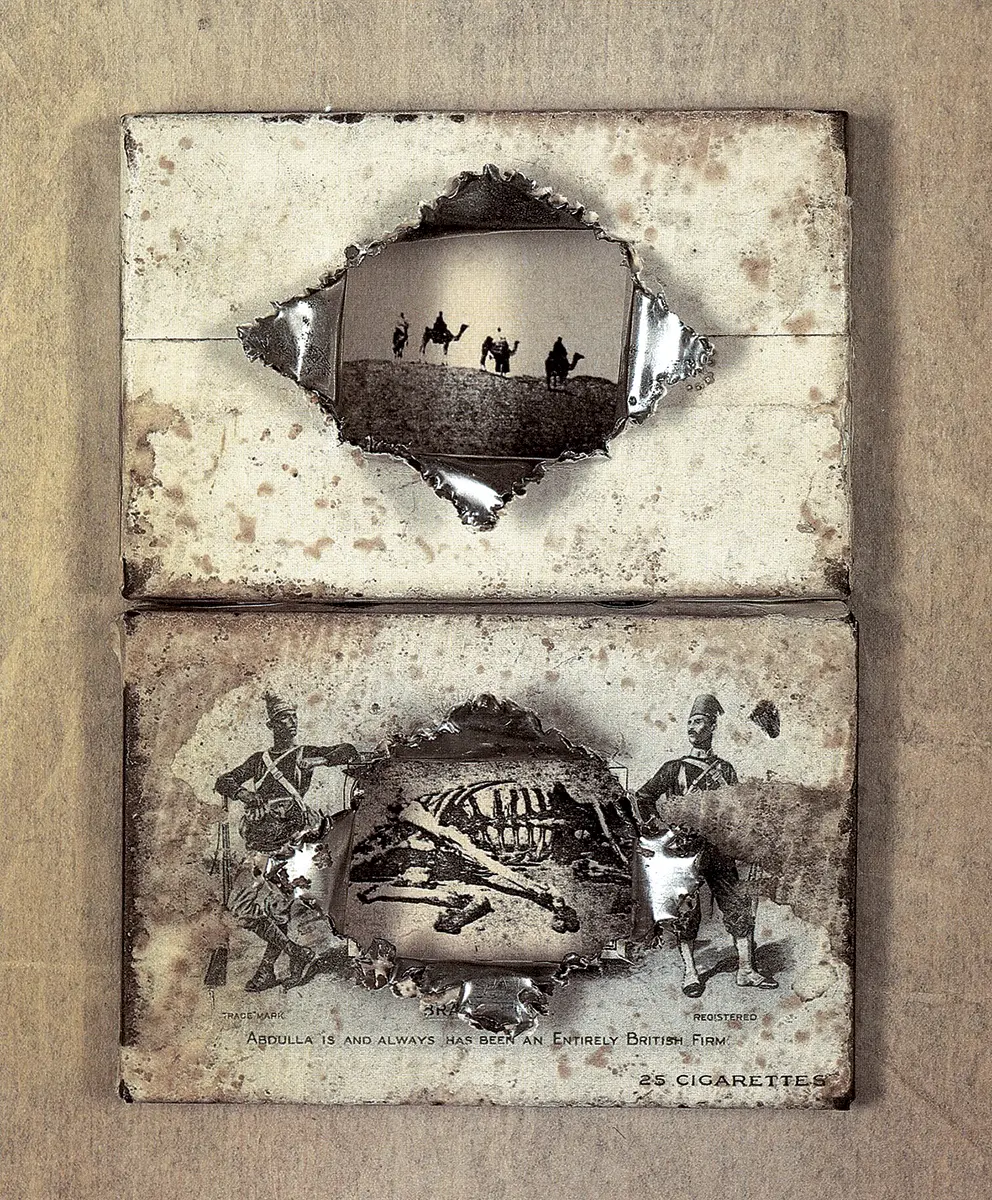
Of the 35 works in La imagen fija (se mueve en la memoria) —a selection of six themes explored between 1998 and 2002— almost half assume as their referent specific cultures and geographic spaces. In the case of the original inhabitants of North America, the cultures of Northern Africa, or of Jewish culture, it is inevitable to be put in mind, before any other kind of memory, of the violence of which they were victims. Pieces like Holocausto and Civilización acknowledge the tragedy of the Jewish people as well as the resiliency of its cultural heritage. Holocausto is a raw-wood column, with a rectangular perforation; the empty space is framed by a metallic border with a star of David. In Civilización, the spine of a book has been pushed into a similar column, and it seems to share the wood’s natural essence. What is important with regard to such simplicity and such allegorical effectiveness is, in fact, the central aspect of Rippey’s art: the specificities of content do not aspire to self-sufficiency; instead, they exist in an extremely coherent agreement with the formal dimensions through which they are expressed, a plastic quality that is the precise opposite of a theoretical manner in which “transcendent themes” are placed to be enough all by themselves. The same can be said of El ocaso del imperio II, a metallic tobacco box from England that has been perforated by what seem like gunshots; through the holes, we can see, as if through an old-time spyglass, fragments of a desert landscape. The image of soldiers and the original inscription on the box’s lid, Abdulla is and always has been an Entirely British Firm —more than commercial slogans, frank allusions to British colonialism— give closure to part of the relationship the piece establishes between the colonial purpose, who carries it forward and who suffers its consequences, the way in which all of this happens, the geographies in play and, of course, the way in which it all was evoked.
In the case of Japanese culture, Rippey generates another subtle interplay. Japan continues to be one of the West’s more permanent Others, not only because it was never colonized and thus maintained its original tradition, but also because it imposes a singular economic competition, while generalized Western interest in Japanese technology and marketing strategies is inversely proportional to the West’s knowledge of the culture that produces them. What is taken as ancient Japanese traditions have often been built in modern Japan. The West has taken them at face value, creating a vast imagery around them, a variation on a variation. Rippey’s works engage many of these levels: the distance between formal calligraphy and the aesthetic qualities that are projected onto the ideograms (Treatise on Variable Meanings, pages from the Yomiuri newspaper cut into different sizes and spread out in an aleatory manner); the penetration of Japanese comic books, or manga, in the West (a ceramic piece titled Primera pieza manga, among others); interpretative variations on Japanese traditions or contemporary myths (A Pillow Book, The Realm of the Senses, etc.) But there is something perhaps more difficult to notice: Japanese imperialism and fascism. A piece like El ejército del emperador alludes to just that, with its background of comic-book images of Japanese soldiers celebrating their invasion of Korea, against which the artist has placed the photograph of a samurai.
It would be incongruous to limit our approach to the complexity and diversity of Carla Rippey’s work, barely sketched here, to that soft-repeated “reflection about ourselves provoked by the presence of the Other” (an Other as undifferentiated as, for instance, the very concept of the Orient is), or to the tired slogan about “the recuperation of memory,” without making explicit —something that not always happens in the paroxism of theoretical languages— concepts so central to her work as discrimination, violence, colonialism or imperialism.
EMILIA GARCÍA MONTIEL