
Daniel García (Rosario, 1958) creates provocative works that communicate all of his passion for painting. In a way, Bondage, displayed in two rooms at the Museo Nacional de Bellas Artes, relates to Viajes, citas y otros compromisos (Trips, Appointments, and other Engagements), which was presented at Gallery Ruth Benzacar a few months ago. Both exhibits are filled with artistic and intellectual consideration and are worthy examples of the artist’s journey—which began with his first exhibition in 1982 and includes his participation as the representative of Argentina in the 1997 Venice Biennial.
According to the dictionary, bondage is defined as captivity, servitude, or submission. Leather straps, iron mittens, chains, and collars with metal spikes are part of the imagery exhibited in this group of works that affirm an absence. The paintings on canvas and the drawings on paper allude to objects designed to cover and bother a body—which either social or personal, does not show itself.
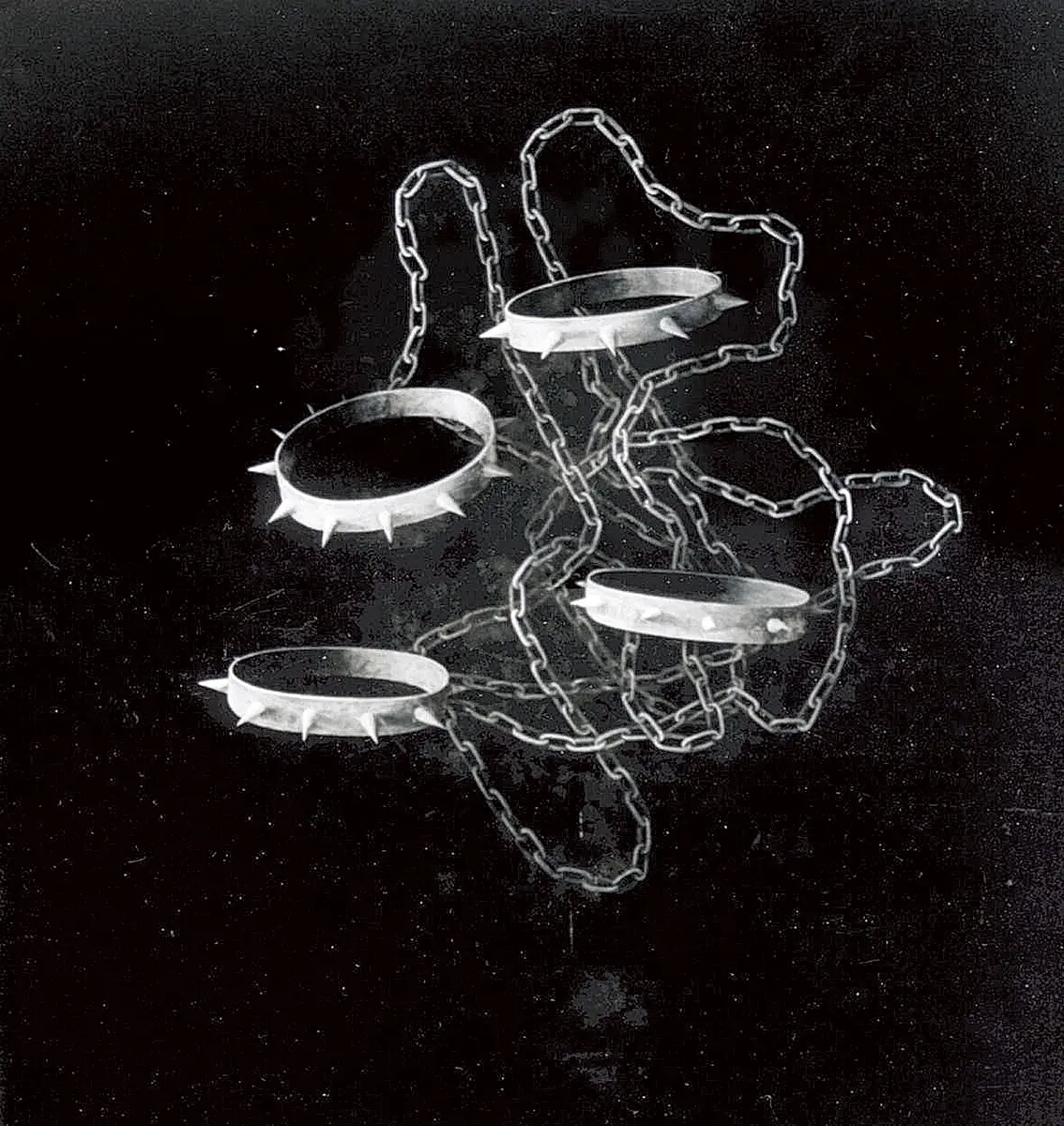
Facing García’s paintings it is possible to be immersed in an invisible space and an unreal time. The images, strange but convincing, anticipate mistreatment and destruction. For the most part, they seem to be taken from a catalog of objects for sadomasochists, and they refer to pain, profanity, and oppression. The violence that the canvases suggest is also accentuated by the washes and the crosshatches in the backgrounds of the paintings. Austere in their number and realization, the works in Bondage create a stripped and cruel window—of reality or of painting?— proof, once again, of the talent of this Argentinean artist.
The drawings consist of some sort of modules that form a bigger structure and were done on fragments of material used to paper walls. The paper’s sweet motifs—delicate flowers, soft strips of color, bucolic landscapes—are the support of a menacing chain that has neither beginning nor end. The contrast between the gentleness of the background decoration and the heavy shape of the instrument of subjection is evident. Yet García doesn’t indicate who or what is to be bound, or who we will see punished.
Daniel García was always interested in that which moves away from the norm. In previous paintings, he suggested not only smiles that froze, eyes that went blind, faces that were erased, bodies that were folded, and blood that was spilled, but also stretchers—literally the support for a series—that endured.
There are usually no innocent representations. In the past García has painted bandages, faceless heads, and nameless handkerchiefs that, in a country like Argentina with thirty thousand desaparecidos, might have different meanings, one being that memory persists. Now, his paintings seem to point to the recent maladies of a community that nostalgically remembers a magnificent past, that unexpectedly and indescribably suffers an impoverished present, and that imagines an enslaved future. If previously he reflected on the social symptoms and disease, with the decline of ideologies and the death of utopias, it could well be said that the artist is again interested in society and the desolation that surrounds him.
Yet, Daniel García’s works do not have a clear narrative intention; they stir up an emotional exchange, a sensitive reconciliation before an intellectual one. They offer an aesthetic experience that triggers ideas, tensions, and ambiguities. Faced with the challenging presence of his paintings, the viewer is absolutely free to resort to his or her own evocations and associations, to arbitrary sensations and recollections.
The leather harnesses and metal devices that inhabit his paintings are depicted suspended in a void. For example, the spiked collars of Abstracción Lírica (Lyrical Abstraction) seem to float magically, lacking any reference. Some viewers might see the instruments of their fantasies and sexual choices in these representations. Others, perhaps, will find that the images exude the certain promise of servitude and submission. But to whom, or to what? Does the work refer to the brutality of private domestic violence, or to the economic snare of the FMI (Fondo Monetario Internacional) that has taken over public affairs? How much masochism is in the discourse of the common Argentinean who is scourged and questions the origins of the national misfortune? Filled with questions, the works by Daniel García implicate the observer.
VICTORIA VERLICHAK